Magnesium CNC Machining for Portable Electronics | Tyneen
Magnesium Alloy CNC Machining for Portable Electronics: Engineering Overview
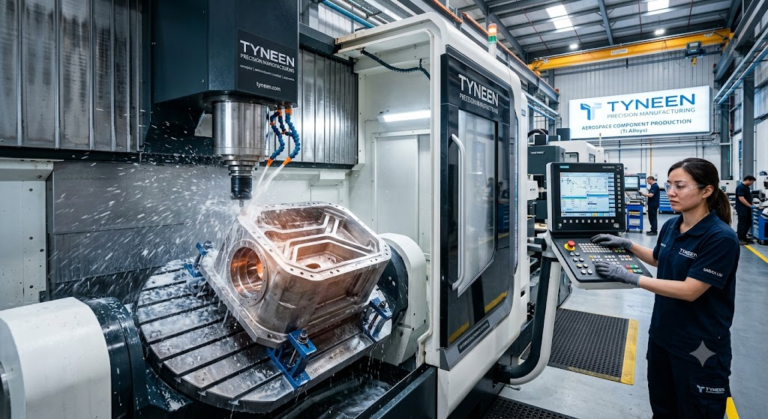
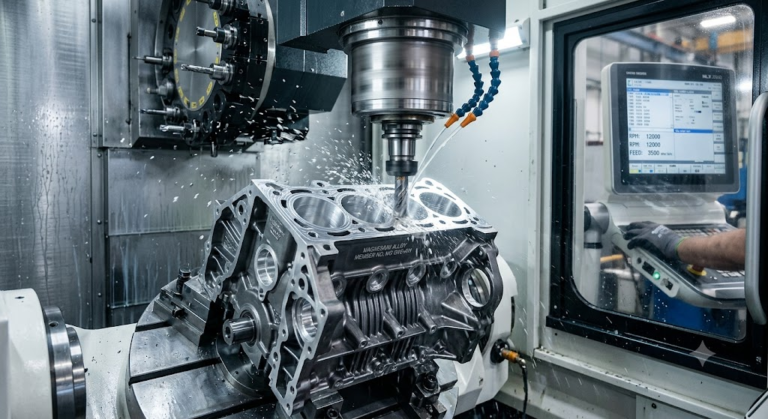
Magnesium alloy CNC machining for portable electronics delivers structural housings with a 33% weight reduction over aerospace aluminum and five times the vibration damping of standard polymers. By combining high-speed subtractive milling with specialized surface passivation, magnesium enables ultra-thin, highly rigid enclosures that double as integrated thermal spreaders and electromagnetic shields.
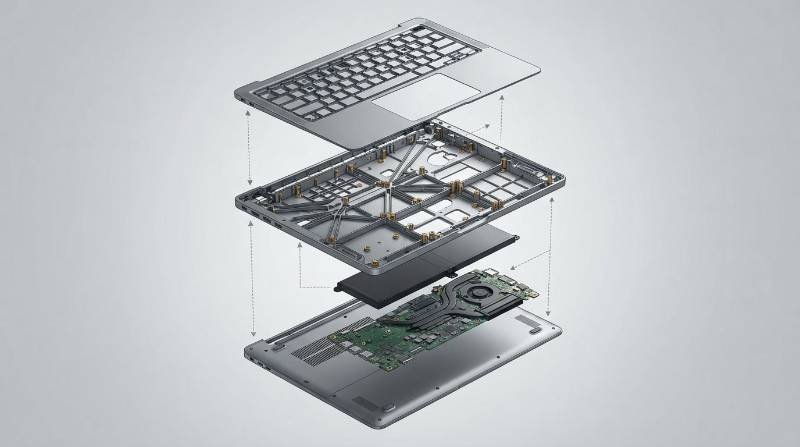
Portable devices such as ultra-slim laptops, high-end camera bodies, enterprise handheld terminals, and AR/VR headsets demand rigid, featherweight frames. In our manufacturing experience, machining solid billet or wrought magnesium sheet bypasses the porosity defects, draft-angle constraints, and high tooling lead times inherent to high-pressure die casting.
Material Physics: Why Magnesium Outperforms Aluminum and Plastics in 3C Hardware
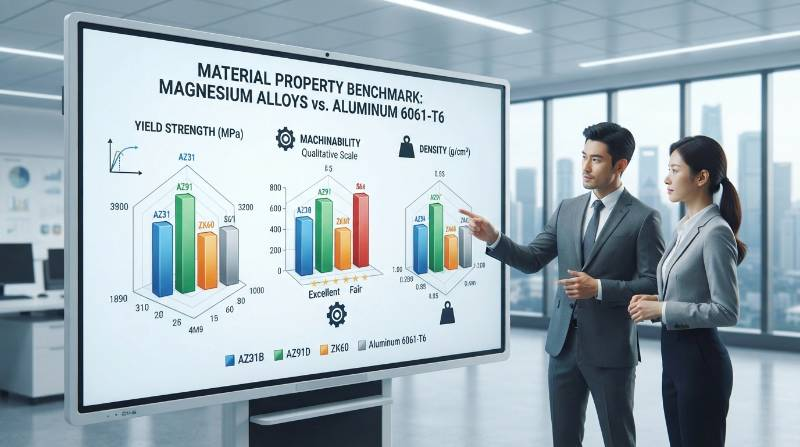
Magnesium has a density of roughly 1.74 to 1.81 g/cm³, making it the lightest structural metal available to mechanical design engineers. When compared to standard 6061-T6 aluminum (2.70 g/cm³) or structural polycarbonates (1.20–1.45 g/cm³), wrought magnesium offers an unmatched specific strength-to-weight ratio.
Specific Strength: The ratio of a material’s tensile yield strength to its density, calculated as \(\sigma_y / \rho\). Magnesium alloys regularly reach specific strengths exceeding 130 kN·m/kg, outperforming commercial-grade aluminum alloys under dynamic bending loads.
For mobile electronics subject to drops and impact shocks, magnesium absorbs elastic energy rapidly. Its damping capacity is 10 times higher than that of aluminum and 50 times higher than that of steel, which safeguards delicate OLED panels, camera sensor actuators, and solder joints during drop events.
| Material Property | AZ31B-H24 Magnesium | 6061-T6 Aluminum | PC/ABS Blend (30% Glass) |
|---|---|---|---|
| Density (g/cm³) | 1.78 | 2.70 | 1.45 |
| Yield Strength (MPa) | 220 | 276 | 110 |
| Specific Strength (kN·m/kg) | 123.6 | 102.2 | 75.8 |
| Thermal Conductivity (W/m·K) | 96 | 167 | 0.25 |
| Damping Capacity Factor (SDC %) | 18 – 25% | 1.5 – 2.5% | N/A (Viscoelastic) |
To evaluate alternative alloys alongside magnesium for structural covers, consult our comprehensive CNC machining materials guide.
Grade Selection Matrix: AZ31B vs. AZ91D vs. ZK60 for Precision Housings
Selecting the right magnesium specification dictates both machining dynamics and mechanical durability. Wrought and extruded alloys are standardized globally under ASTM B90 (sheet/plate) and ASTM B107 (extrusions).
AZ31B: The Wrought Industry Standard
AZ31B (3% Al, 1% Zn balance Mg) is the premier wrought alloy for CNC milling. It exhibits moderate strength, high ductility (12-15% elongation), and excellent stability during aggressive face milling passes.
AZ91D: Billet CNC vs. Semi-Solid Die Casting
While AZ91D is conventionally used in high-pressure die casting, machining AZ91D cast blocks introduces micro-porosity issues on cosmetic surfaces. CNC machining wrought stock ensures uniform density, zero hidden air cavities, and tighter thread engagement strengths on M1.2 to M2.0 fastener bosses.
ZK60: High-Yield Structural Integrity
ZK60 (5.5% Zn, 0.5% Zr) provides enhanced yield strengths up to 290 MPa due to zirconium grain refinement. It is ideal for internal load-bearing skeleton frames in mobile devices that require superior fatigue limits under repetitive flexure.
Thermal Dissipation and EMI/RFI Shielding Dynamics in Handheld Devices
Modern mobile System-on-Chips (SoCs) and 5G transceiver modules generate concentrated heat loads upwards of 15–25 W in confined form factors. Magnesium housings act as unified thermal dissipation sinks and Faraday cages.
Chassis-Level Thermal Management
With bulk thermal conductivities ranging between 96 and 156 W/m·K (depending on the alloy and grain direction), magnesium conducts heat roughly 400 times better than standard unfilled polymers. This enables direct contact thermal pad routing from the mainboard to the CNC-machined outer shell, eliminating noisy micro-fans.
Electromagnetic Interference (EMI/RFI) Attenuation
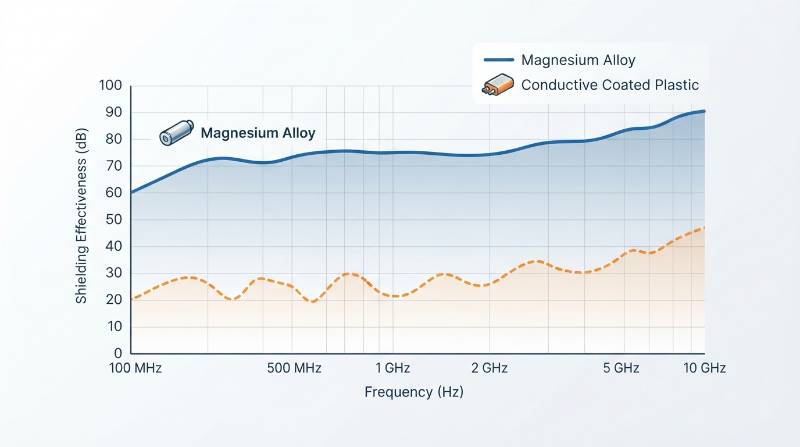
Plastic enclosures require secondary conductive paint spray, vacuum metallization, or copper tape, which can peel and crack over thermal cycles. In contrast, CNC-milled magnesium delivers inherent, continuous electrical conductivity across the entire enclosure.
- Shielding Effectiveness: Delivers 60 to 80 dB attenuation across the 1 GHz to 10 GHz RF spectrum.
- High-Frequency 5G Immunity: Attenuates mmWave internal crosstalk between RF front-end modules and system memory.
- Grounding Reliability: Direct contact ground planes eliminate discrete grounding clips.
The Tyneen UTM-4P™ Methodology: Precision Thin-Wall Machining Protocol
Machining thin magnesium enclosures with sub-0.5 mm walls presents risks of part deflection, chatter marks, and residual stress warping. To counter these mechanics, our engineering team implements a proprietary framework for high-precision electronics production.
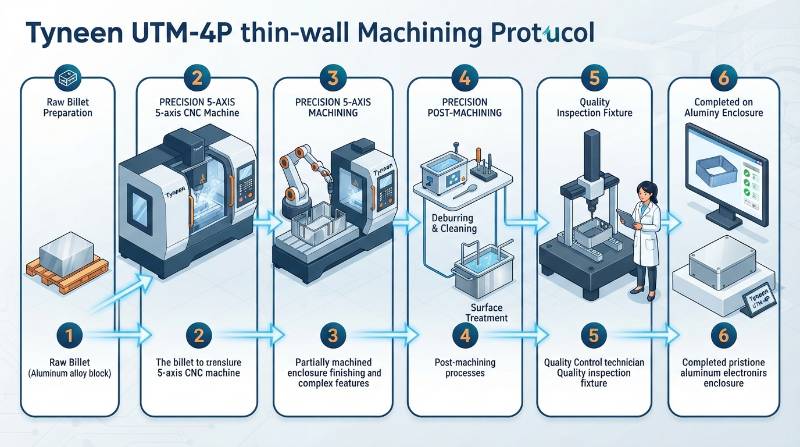
The Tyneen UTM-4P™ Framework: Our standardized 4-Phase Ultra-Thin Magnesium Machining Protocol engineered specifically for consumer electronics enclosures requiring tolerances within ±0.010 mm on unsupported spans.
- Phase 1: Dynamic Vacuum & Custom Sacrificial Fixturing: We employ conformal vacuum nests with embedded elastomeric seals. This fixture eliminates clamping distortion and dampens acoustic vibration across unsupported wall spans.
- Phase 2: High-Speed Spindle Trajectory Optimization: Utilizing high-torque 24,000 to 30,000 RPM spindles on precision CNC milling services platforms. We optimize toolpaths using high-speed trochoidal milling with low radial depth of cut (\(a_e\)) and elevated axial engagement (\(a_p\)).
- Phase 3: Ultra-Sharp, Low-Rake Polycrystalline Diamond (PCD) Tooling: Magnesium demands single-point cutting geometry with zero or low positive rake angles and mirror-polished flutes to prevent material sticking, built-up edge (BUE), and tool deflection.
- Phase 4: Multi-Stage Residual Stress Annealing: High-precision housings undergo thermal stabilization between rough roughing and final light skimming passes (typically 180°C for 2 hours) to relieve internal lattice strains.
Shop-Floor Safety and Chip Management: Managing Flammability Risks
Fine magnesium swarf, dust, and chips are combustible when exposed to ignition temperatures (around 473°C / 883°F). Controlled CNC machining of magnesium requires rigorous process discipline governed by international industrial standards such as NFPA 484.
Based on our CNC production data, fine chip accumulation is the single largest fire hazard. We implement four mandatory shop-floor protocols to ensure safety and quality:
- No Water-Based Coolants: Water reacts with hot magnesium to produce hydrogen gas (\(Mg + 2H_2O \rightarrow Mg(OH)_2 + H_2\)). We exclusively utilize high-flashpoint mineral oils or dry machining with Minimum Quantity Lubrication (MQL) using specialized synthetic esters.
- Sharp Cutting Tool Geometry: Dull cutting edges create excessive friction and heat. We monitor tool life automatically via spindle load metrics, retiring cutters well before thermal thresholds are reached.
- High-Velocity Swarf Evacuation: Continuous vacuum suction extracts chips immediately from the cutting zone into dedicated, explosion-proof wet collectors.
- Class D Fire Suppression Infrastructure: CNC cells are equipped with specialized Class D flux/salt extinguishing agents (copper powder or sodium chloride based). Water or standard CO₂ extinguishers are strictly prohibited.
Surface Finishing and Galvanic Corrosion Prevention Protocols
Magnesium is an active metal with a standard reduction potential of -2.37 V. Untreated magnesium parts corrode rapidly in humid or saline environments, particularly when in direct contact with dissimilar metals (like steel screws or copper thermal modules).
Micro-Arc Oxidation (MAO / PEO)
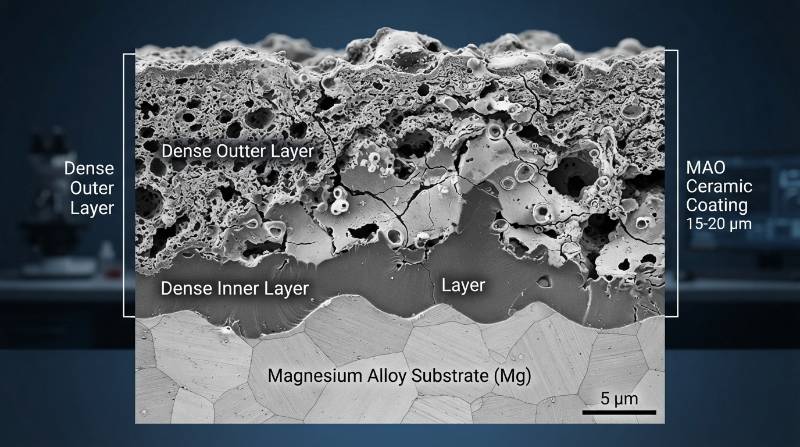
Micro-Arc Oxidation (also called Plasma Electrolytic Oxidation) is the gold standard for high-end consumer hardware. MAO forms a hard, ceramic-like oxide layer (\(MgAl_2O_4\)) in situ using high-voltage electrical discharges in an alkaline electrolyte bath.
- Layer Hardness: 400 to 800 HV, offering exceptional scratch and wear resistance.
- Corrosion Barrier: Resists over 500 hours of continuous salt spray testing (ASTM B117).
- Cosmetic Finish: Provides an ultra-matte, tactile ceramic texture suited for premium smart devices.
Electroless Nickel Plating & Conversion Coatings
Where electrical continuity and EMI grounding across mating splits are mandatory, electroless nickel plating (ENP) with an immersion zincate pre-treatment delivers uniform coverage even inside micro-tapped screw holes. Discover our complete range of specialized coatings through our advanced CNC machining services.
3C Application Case Studies: Real-World Performance Benchmarks
Case Study 1: 14-Inch Ultralight Laptop Top Cover (A-Cover)
A flagship computing client required an ultralight A-cover with an integrated display rib structure. The original design utilized 6063 aluminum weighing 184 grams with a nominal thickness of 0.80 mm.
- The Solution: Machined using AZ31B billet on 5-axis machining centers using the Tyneen UTM-4P™ protocol, reducing nominal wall thickness to 0.45 mm.
- The Result: Finished part weight dropped to 112 grams (a 39.1% reduction) while improving torsional screen stiffness by 14% due to deeper structural ribbing.
Case Study 2: Professional 3-Axis Handheld Gimbal Frame
A camera accessories manufacturer experienced high-frequency motor resonance on an aluminum drone-mounted stabilizer arm, leading to micro-jitter on 8K sensor footage.
- The Solution: Switched the material specification to high-strength ZK60 magnesium with an MAO matte-black ceramic finish.
- The Result: Resonance amplitude decreased by 72%, eliminating sensor vibration while shaving 45 grams off the payload motor assembly.
Prototyping to Low-Volume Scaled Production with Tyneen
Transitioning precision magnesium designs from CAD models to finished enclosures requires specialized 5-axis CNC machining centers, high-vacuum workholding, and metrology verification. At Tyneen, we verify dimensional accuracy through multi-sensor CMM inspection systems capable of holding tolerances down to ±0.005 mm.
Our engineering team delivers automated Design for Manufacturability (DFM) reviews within 24 hours, flagging potential tool deflection zones, thin-wall vibration risks, and blind tapped-hole depths. Whether you require 5 functional prototypes for drop testing or 10,000 bridge-production housings, we maintain strict process controls from raw billet certification to final MAO coating.
Ready to validate your next generation of portable electronics? Reach out directly to request a CNC machining quote and review your DFM file with our senior engineering team.
Frequently Asked Questions About Magnesium CNC Machining
What is the minimum achievable wall thickness for CNC-machined magnesium?
With specialized tooling, high-speed spindles, and custom vacuum fixture nests, nominal wall thicknesses down to 0.40 mm (0.015 in) are achievable on localized spans. For large unsupported structural faces, we recommend maintaining 0.60 mm to 0.80 mm to ensure structural rigidity and prevent handling damage.
Is magnesium CNC machining safe?
Yes. When performed in professional machining facilities complying with NFPA 484 standards, magnesium machining is safe. Safety relies on using non-water-based MQL or mineral oils, sharp PCD cutters to prevent friction heat, high-suction vacuum extraction, and Class D fire safety infrastructure.
How much lighter is magnesium compared to aluminum in actual parts?
Magnesium has a density of ~1.78 g/cm³ compared to aluminum’s 2.70 g/cm³, representing a 33% raw weight reduction. In finished designs, the higher specific stiffness allows engineers to machine thinner skins with deeper internal ribs, often achieving overall weight savings of 35% to 42%.
Why choose CNC machining over die casting for magnesium electronics housings?
CNC machining is ideal for rapid prototyping, design iterations, and low-to-medium volume production (1 to 20,000 parts). It eliminates expensive die casting tooling ($25,000–$80,000+), avoids 10-16 week mold lead times, guarantees zero internal gas porosity, and allows much tighter mechanical tolerances (±0.010 mm vs ±0.10 mm for casting).