
PMMA (Acrylic) Machining
Polymethyl methacrylate (PMMA), commonly known as acrylic or Plexiglas, offering exceptional optical clarity, UV resistance, and excellent machinability for optical, medical, and display applications.
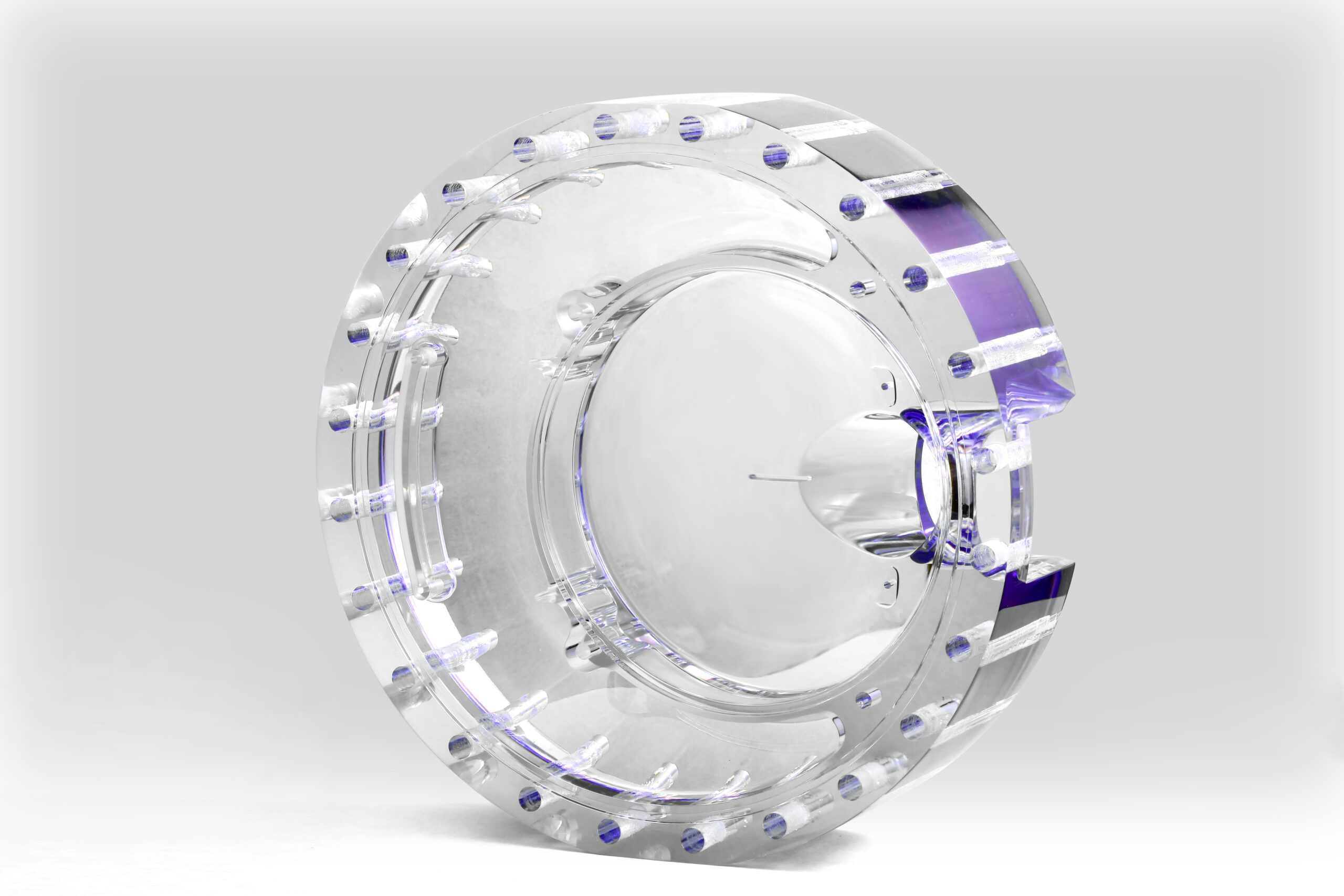
Material Properties
1.17-1.20
g/cm³
160
°C
70-80
MPa
3.1-3.3
GPa
92
%
1.49
M97-M100
0.19
W/m·K
Machining Recommendations
Recommended Methods
CNC milling, turning, drilling, laser cutting, polishing
Tool Materials
Sharp carbide or high-speed steel tools; single-flute or two-flute end mills preferred
Cutting Speeds
200-600 m/min (high speed to minimize heat buildup)
Feeds
0.05-0.2 mm/rev (light feeds to prevent chipping)
Coolant
Dry machining or compressed air; avoid water-based coolants that may cause crazing
Machinability
Good – brittle nature requires sharp tools and careful fixturing to prevent cracking
Surface Finish
Ra 0.1-0.4 μm achievable; flame or diamond polishing can produce optical-grade clarity
Application Case Studies
Optical Lens Arrays for Imaging Systems
Industry: Optics & Photonics
Challenge
Precision PMMA lens arrays for industrial vision systems requiring 92%+ light transmittance and sub-micron surface roughness
Solution
Implemented diamond-turning process followed by optical polishing, with CMM verification of form accuracy
Result
Achieved Ra 0.05 μm surface finish and 99.2% optical transmission; supplied 20,000+ lenses annually
Medical Microfluidic Chips
Industry: Medical & Life Sciences
Challenge
PMMA microfluidic channel plates for diagnostic devices requiring channel widths of 100–500 μm with smooth walls
Solution
Utilized precision micro-milling with 0.1 mm end mills and solvent bonding for chip assembly
Result
Achieved channel dimensional accuracy within ±5 μm; passed biocompatibility testing per ISO 10993
Display Lightguide Panels
Industry: Consumer Electronics
Challenge
Large-format PMMA lightguide panels for LCD backlighting requiring uniform light distribution and tight thickness tolerance
Solution
CNC-machined microstructure dot patterns on panel surface combined with precision edge polishing
Result
Achieved luminance uniformity of 95% and supplied 50,000+ panels per year to display manufacturers
Architectural Decorative Panels
Industry: Architecture & Interior Design
Challenge
Custom-shaped PMMA decorative panels with engraved patterns for high-end retail environments
Solution
CNC engraving combined with LED edge-lighting design for dramatic visual effect
Result
Delivered 500+ custom panels with zero defect rate; reduced installation time by 30%
Protective Covers for Scientific Instruments
Industry: Laboratory & Scientific
Challenge
UV-resistant PMMA enclosures for sensitive laboratory instruments requiring chemical resistance and optical clarity
Solution
Selected UV-stabilized PMMA grade and implemented precision CNC machining with solvent-welded joints
Result
Extended instrument service life by 3× compared to standard polycarbonate covers
Technical Specifications
Available Forms
1mm to 200mm thickness; sheets up to 2000×3000 mm
Tolerances±0.01mm to ±0.05mm (standard); ±0.005mm for optical applications
Lead Times1-2 weeks for standard orders; 3-5 days for prototypes
Quality StandardsFrequently Asked Questions
Related Services
CNC Milling
Learn more about our cnc milling capabilities
CNC Turning
Learn more about our cnc turning capabilities
CNC Drilling
Learn more about our cnc drilling capabilities
Advanced Machining
Learn more about our advanced machining capabilities
Ready to Get Started?
Contact our engineering team to discuss your metals machining requirements.