
Titanium Alloy Machining
Titanium alloys including Grade 2 (pure Ti), Ti-6Al-4V (Grade 5), and Ti-6Al-4V ELI (Grade 23), delivering an unmatched combination of high strength, low density, biocompatibility, and corrosion resistance for aerospace, medical implant, and high-performance industrial applications.
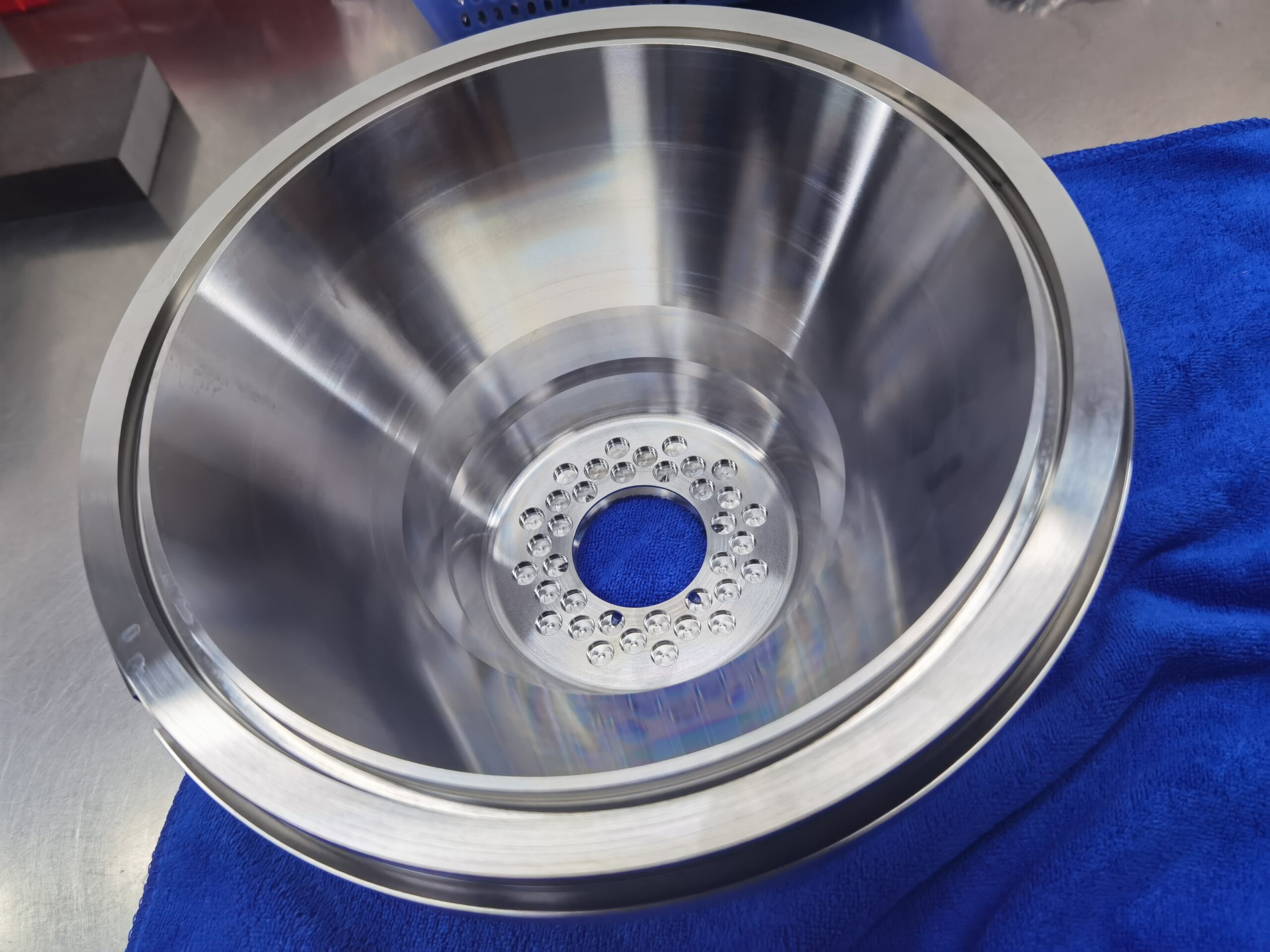
Material Properties
4.43-4.51
g/cm³
1604-1670
°C
950
MPa
880
MPa
114
GPa
510
MPa
6.7
W/m·K
Excellent (seawater, acids)
Machining Recommendations
Recommended Methods
CNC milling, turning, drilling, grinding — requires specialized approach due to low thermal conductivity
Tool Materials
Premium submicron carbide tools with TiAlN or AlTiN coating; avoid TiN-coated tools (chemical affinity with titanium)
Cutting Speeds
30-80 m/min (significantly lower than aluminum; heat buildup is the primary challenge)
Feeds
0.05-0.15 mm/rev (light feeds to minimize work hardening)
Coolant
High-pressure, high-volume coolant (through-spindle preferred) is essential to manage heat and prevent tool wear
Machinability
Difficult – low thermal conductivity causes heat concentration at cutting edge; work hardening tendency requires sharp tools and consistent engagement
Surface Finish
Ra 0.4-1.6 μm standard; Ra 0.1-0.2 μm achievable with grinding or superfinishing
Application Case Studies
Orthopedic Implant Components
Industry: Medical & Life Sciences
Challenge
Ti-6Al-4V ELI (Grade 23) hip and knee implant components requiring biocompatibility, ±0.01 mm tolerances, and mirror-polished articulating surfaces
Solution
5-axis CNC machining with through-spindle coolant; electropolishing and passivation for biocompatibility; 100% CMM inspection per ISO 13485
Result
Achieved Ra 0.05 μm on articulating surfaces; passed ISO 10993 biocompatibility testing; supplied 10,000+ implants annually to leading orthopedic OEMs
Aerospace Structural Brackets
Industry: Aerospace & Defense
Challenge
Ti-6Al-4V structural brackets for commercial aircraft requiring AS9100D certification, full material traceability, and fatigue life > 10⁷ cycles
Solution
5-axis machining from certified billet with full first-article inspection; shot peening to improve fatigue life; complete material traceability documentation
Result
Passed all AS9100D first-article requirements; fatigue life exceeded 2×10⁷ cycles; qualified as approved supplier for Boeing and Airbus programs
Marine Propeller Shafts
Industry: Marine & Offshore
Challenge
Grade 2 pure titanium propeller shafts for naval vessels requiring exceptional seawater corrosion resistance and precise dimensional accuracy
Solution
CNC turning and grinding with high-pressure coolant; surface roughness Ra 0.4 μm on bearing journals; full dimensional inspection
Result
Zero corrosion after 5 years in seawater service; eliminated scheduled replacement interval, saving $500K per vessel over 10 years
High-Performance Motorsport Components
Industry: Motorsport & Automotive
Challenge
Ti-6Al-4V connecting rods and fasteners for Formula racing engines requiring maximum strength-to-weight ratio and fatigue resistance
Solution
Precision 5-axis machining with optimized tool paths to minimize residual stress; shot peening and anodizing for fatigue enhancement
Result
Achieved 40% weight reduction vs steel equivalents; withstood 18,000 RPM engine operation without failure throughout race season
Chemical Processing Reactor Components
Industry: Chemical & Petrochemical
Challenge
Grade 2 titanium reactor internals for aggressive acid environments (HCl, H₂SO₄) requiring long service life and zero contamination
Solution
Precision CNC machining with passivation treatment; weld-free design to eliminate corrosion initiation sites
Result
Extended reactor service interval from 2 years to 8+ years; eliminated product contamination incidents
Technical Specifications
Available Forms
2mm to 400mm diameter/width; sheets up to 1500×3000 mm
Tolerances±0.01mm to ±0.05mm (standard); ±0.005mm for medical implant applications
Lead Times2-4 weeks for standard orders; 1-2 weeks for prototypes
Quality StandardsFrequently Asked Questions
Related Services
CNC Milling
Learn more about our cnc milling capabilities
CNC Turning
Learn more about our cnc turning capabilities
CNC Drilling
Learn more about our cnc drilling capabilities
Advanced Machining
Learn more about our advanced machining capabilities
Ready to Get Started?
Contact our engineering team to discuss your metals machining requirements.