Precision Brass Machining for High-End Audio Hardware
Material Metallurgy: Selecting Brass Alloys for Acoustic Performance and Shielding
Precision brass machining delivers the physical mass, internal mechanical damping, and non-ferrous electromagnetic isolation required to eliminate parasitic micro-vibrations in high-end audio equipment. By pairing tight dimensional control down to ±0.005mm with alloys tuned for resonance absorption, acoustic engineers isolate sensitive analog signals from unwanted chassis ring and electro-mechanical interference.
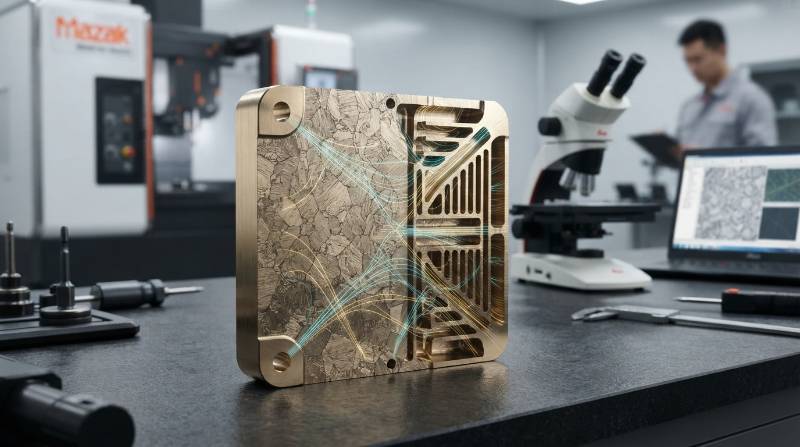
Audiophile enclosures, tonearm bases, and connector assemblies rely on specific copper-zinc ratios to balance structural rigidity with acoustic dissipation. Selecting between free-cutting, cartridge, or lead-free brass dictates both machinability and vibrational decay rates in precision custom brass materials.
Acoustic Resonance Damping Factor (η): The mechanical loss factor representing a solid material’s internal dissipation of kinetic vibration into thermal energy, preventing resonant peaks in audio frequency bands (20 Hz – 20 kHz).
| Alloy (UNS Designation) | Composition (%) | Machinability Index | Resonance Damping (Loss Factor η) | Primary Audio Application |
|---|---|---|---|---|
| C36000 (Free-Cutting) | Cu 61.5, Zn 35.5, Pb 3.0 | 100% (Baseline) | 0.0018 – 0.0022 | Turntable platters, tonearm bases, volume knobs |
| C26000 (Cartridge Brass) | Cu 70.0, Zn 30.0 | 30% | 0.0012 – 0.0015 | Drawn shields, thin-wall acoustic enclosures |
| C46400 (Naval Brass) | Cu 60.0, Zn 39.2, Sn 0.8 | 30% | 0.0020 – 0.0024 | High-load spiked isolation footers, sub-chassis |
| C69300 (Eco-Brass®) | Cu 76.0, Zn 21.0, Si 3.0, P 0.1 | 80% | 0.0025 – 0.0029 | RoHS/REACH-compliant high-end connectors & DAC bodies |
Standard free-cutting brass compliant with ASTM B16 remains the benchmark for complex geometries due to broken chip formation. However, modern environmental directives drive adoption toward silicon-alloyed lead-free brass, which delivers superior high-frequency damping properties.
The Tyneen Acoustic-Resonance Damping Machining (ARDM) Protocol™
Standard CNC strategies often introduce residual stress and localized work hardening into dense non-ferrous alloys. When machined components undergo thermal cycles during amplifier operation, these internal stresses release, creating micro-warping and unpredictable harmonic nodes.
To eliminate these mechanical artifacts, we developed The Tyneen Acoustic-Resonance Damping Machining (ARDM) Protocol™. This proprietary manufacturing methodology stabilizes crystalline structures in acoustic brass throughout multi-axis cutting sequences.
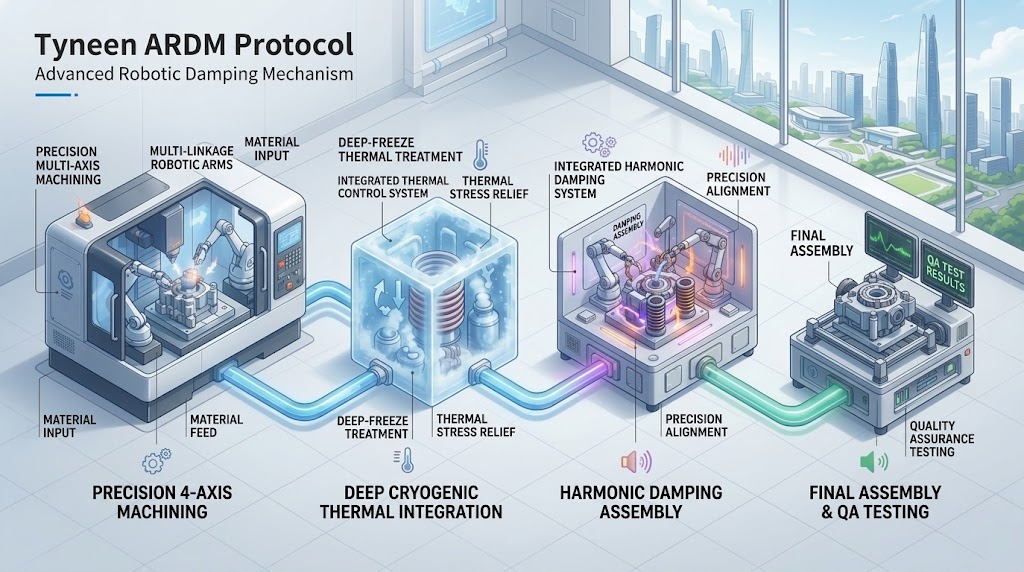
The Four Pillars of the ARDM Protocol™
- Harmonic Toolpath Balancing: High-speed dynamic tool engagement angles prevent cutter chatter, maintaining consistent load and preventing micro-fracturing along grain boundaries.
- Cryogenic Micro-Mist Thermal Stabilization: Sub-zero liquid nitrogen cooling mist prevents localized expansion at the tool-tip, keeping cut tolerances within ±0.003mm without inducing thermal stress.
- Adaptive Dynamic Damping Fixturing: Custom thermoplastic elastomer (TPE) chucking nests absorb resonant feedback during high-RPM turning of thin-walled cylindrical enclosures.
- Post-Roughing Cryogenic Annealing: Sub-zero thermal soaking relieves bulk lattice stresses before final finish cuts, ensuring perpetual dimensional stability under listening room conditions.
Multi-Axis Machining Capabilities & Sub-Micron Tolerances for Audio Hardware
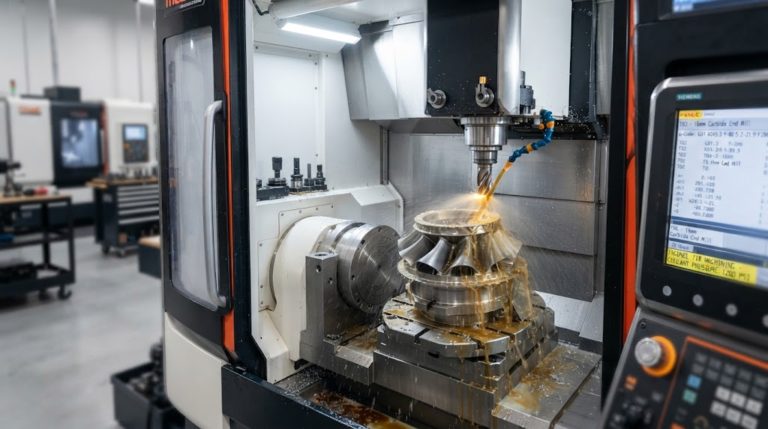
High-end audio hardware demands geometry that serves both acoustic wave propagation and industrial elegance. Tyneen utilizes 5-axis CNC milling centers equipped with high-frequency 40,000 RPM spindles to carve complex horn flares, non-parallel internal chassis chambers, and parabolic acoustic diffusers in single-setup operations.
Single-setup 5-axis operations eliminate datum shift errors, ensuring concentricity and perpendicularity within 0.005mm across intricate internal port channels. This mechanical accuracy prevents acoustic phase distortion inside tonearm gimbals and waveguide cavities.
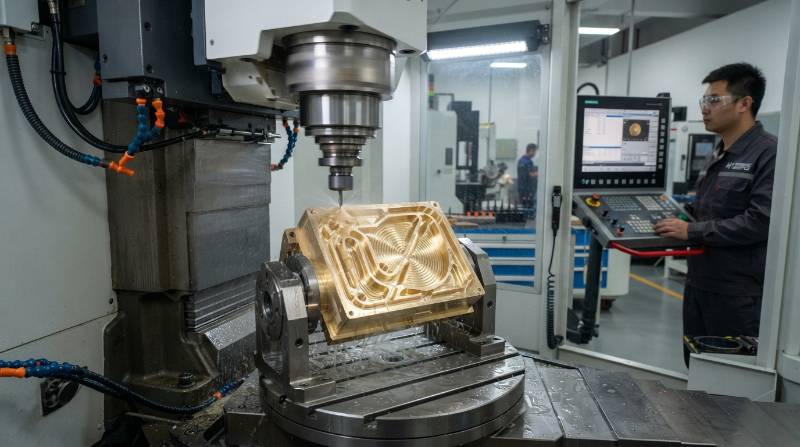
For cylindrical components like stepped volume attenuators, tonearm counterweights, and heavy-mass control knobs, our high-precision Swiss-lathe centers execute precision CNC turning with live tooling. Simultaneous multi-axis turning and broaching maintains thread pitch accuracy and smooth rotary damping tactile feel across thousands of duty cycles.
Our integrated advanced CNC machining services deploy diamond-tipped endmills to mill micro-grooves and knurled grip profiles without burr formation, eliminating manual deburring steps that compromise critical tolerances.
Audiophile Plating Metallurgy & Luxury Surface Finishing
Surface finishing on acoustic brass components serves two critical roles: ultra-low signal resistance at contact interfaces and high-end visual aesthetics. In RF and ultra-high-frequency audio signal transmission, electrical current concentrates along the outermost boundary of the conductor due to the skin effect.
Skin Depth Formula: $\delta = \sqrt{\frac{\rho}{\pi f \mu}}$, where $\rho$ is electrical resistivity, $f$ is operating frequency, and $\mu$ is magnetic permeability. At high audio harmonics and RF carrier frequencies, signal integrity depends almost entirely on the quality and conductivity of the outer 1–5 µm plating layer.
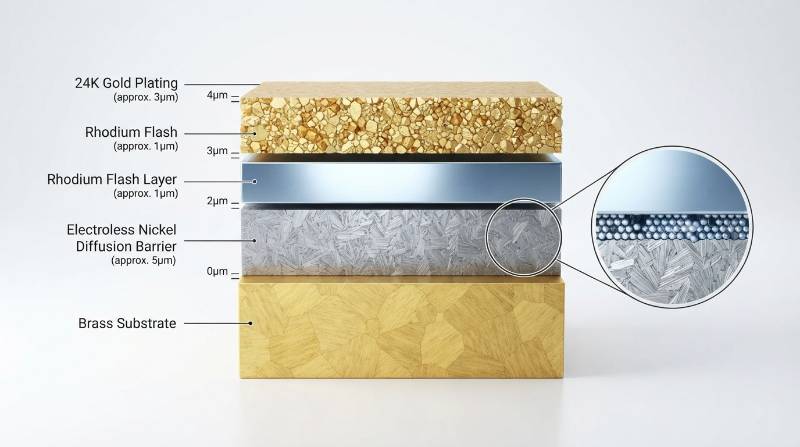
Direct electroplating of gold over raw brass triggers zinc diffusion, causing gold discoloration, micro-porosity, and contact resistance degradation over time. Tyneen solves this metallurgical challenge by engineering a multi-layer protective barrier stack compliant with surface roughness specifications under ISO 1302.
Plating and Mechanical Finishing Specifications
- Electroless Nickel Barrier (ASTM B733): 3.0 to 5.0 µm high-phosphorus nickel sub-layer completely blocks copper-zinc migration into contact surfaces.
- 24K Hard Gold Plating (MIL-G-45204C): 1.5 to 3.0 µm purity 99.7% hard gold layer provides oxidation resistance and consistent micro-ohm contact resistance.
- Rhodium Contact Deposition: 0.5 to 1.0 µm ultra-hard, non-tarnish layer applied to high-wear phono pins, speaker binding posts, and XLR terminal shells.
- Physical Vapor Deposition (PVD): Titanium carbonitride (TiCN) or true black PVD applied directly to mirror-polished brass chassis faceplates for wear resistance.
- Optical Mirror Polishing: Multi-stage automated buffing wheels achieve surface roughness values down to Ra 0.2 µm prior to electroplating or clear ceramic sealing.
Core Audiophile B2B Applications and DFM Guidelines
High-end audio OEM/ODM hardware manufacturers depend on strict Design for Manufacturability (DFM) principles to prevent resonance propagation while keeping production yields predictable. In our manufacturing experience, small geometry optimizations dramatically enhance mechanical damping performance.
1. Monolithic High-Mass Turntable Platters
Massive 8–15 kg brass platters require extreme rotational balance to minimize wow and flutter. We turn platters on twin-spindle lathes and dynamically balance each unit to Grade G0.4 per ISO 1940-1, reducing dynamic radial runout below 0.004mm at 33.3 and 45 RPM.
2. Acoustic Isolation Spikes and Decoupling Pucks
Point-contact isolation spikes require tip radii controlled between 0.25mm and 0.50mm to direct structural vibrations into dissipation bases. Turning tips under continuous toolpath offsets prevents tip chatter and uneven pressure distribution under multi-kilogram monoblock amplifiers.
3. Monolithic Faceplates and Stepped Volume Controls
Billet-machined amplifier front panels with integrated shielding pockets must maintain pocket wall thicknesses of at least 1.5mm to avoid acoustic drumhead vibration. Internal radii are standardized at $R \ge 1.0\text{ mm}$ to allow high-feed 5-axis ball endmills to clear material without chatter marks.

Quality Assurance, Metrology & Compliance for High-End Audio Brands
Audiophile luxury hardware allows zero aesthetic or dimensional defects. Tyneen operates an AS9100D and ISO 9001:2015 certified quality inspection lab in temperature-stabilized environments ($20 \pm 0.5^\circ\text{C}$).
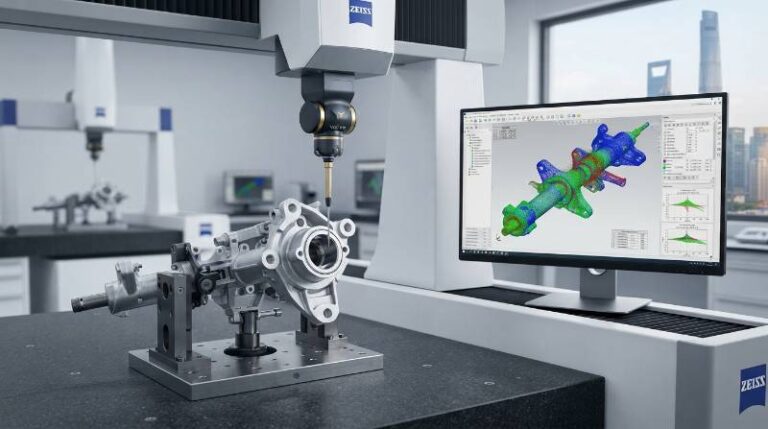
Dimensional verification utilizes Zeiss Coordinate Measuring Machines (CMM) with scanning sub-micron touch probes. Every high-precision bore, bearing journal, and mounting register undergoes automated scanning to verify concentricity, circularity, and positional true tolerance.
Quality Control Standards
- Statistical Process Control (SPC): Critical dimensions maintain Process Capability Index $C_{pk} \ge 1.67$, ensuring repeatable sub-micron consistency across large batch orders.
- Dynamic Balancing Reports: Every rotating acoustic assembly includes ISO 1940-1 compliance documentation with logged residual unbalance values in $g\cdot mm$.
- Environmental Directives: Full compliance testing and material certs for EU RoHS 3 (Directive 2015/863) and REACH (EC 1907/2006) for global market distribution.
- Surface Metrology: Contact and optical profilometers verify mirror surface finishes to Ra 0.2 µm across all cosmetic and contact zones.
Ready to engineer zero-resonance brass hardware for your next audio flagship? Consult our engineering team and request an audio manufacturing quote to start your DFM review.
Frequently Asked Questions (FAQ)
Why is machined brass preferred over aircraft-grade aluminum for high-end audio hardware?
Brass offers over three times the density of aluminum (8.5 g/cm³ vs 2.7 g/cm³) and superior internal acoustic damping characteristics. This added mass lowers the resonant frequency of audio chassis, preventing acoustic microphonics from distorting delicate low-level analog signals.
How does Tyneen manage lead-free compliance for audio brass sold in the EU and North America?
We source certified lead-free brass alloys (such as C69300 Eco-Brass® or Cuphin®) containing less than 0.1% lead by weight. Every batch is certified with full mill test reports (MTR) and third-party laboratory RoHS/REACH compliance documentation.
How does plating thickness affect signal conductivity in audio connectors?
High-frequency signals travel predominantly along the component surface due to the skin effect. Controlling hard gold or rhodium layer thickness to precise micro-inch standards over an electroless nickel barrier prevents zinc migration while maintaining minimum contact resistance ($< 5\text{ m}\Omega$).
What tolerances can Tyneen maintain on multi-axis turned brass tonearm components?
With high-precision Swiss-type lathes and temperature-controlled workshops, we consistently hold linear dimensions to $\pm 0.005\text{ mm}$ ($\pm 0.0002\text{ in}$) and bearing journal roundness within $0.002\text{ mm}$.
Elevate Your Audiophile Hardware Manufacturing
Partner with Tyneen for high-precision multi-axis CNC machining, specialized acoustic metallurgy, and mirror luxury finishing tailored for world-class audio brands.