Rad-Hard Microcontrollers for LEO: 2026 Selection Guide
High-Performance Rad-Hard Microcontrollers for LEO Satellites
The 2026 space economy is no longer defined by “getting there,” but by staying there efficiently. As mega-constellations proliferate in Low Earth Orbit (LEO), the demand for high-performance, cost-effective computing has reached a fever pitch.
Engineers are moving away from bulky, legacy processors. They now prioritize rad-hard microcontrollers that balance extreme reliability with the agility of terrestrial hardware.
Defining Rad-Hard Requirements for Modern LEO Missions
Rad-hard microcontrollers for LEO missions are specialized processors designed to maintain functional integrity despite exposure to ionizing radiation and high-energy particles. Unlike terrestrial chips, these components utilize Radiation-Hardened by Design (RHBD) techniques and Silicon-on-Insulator (SOI) substrates to prevent catastrophic failures.
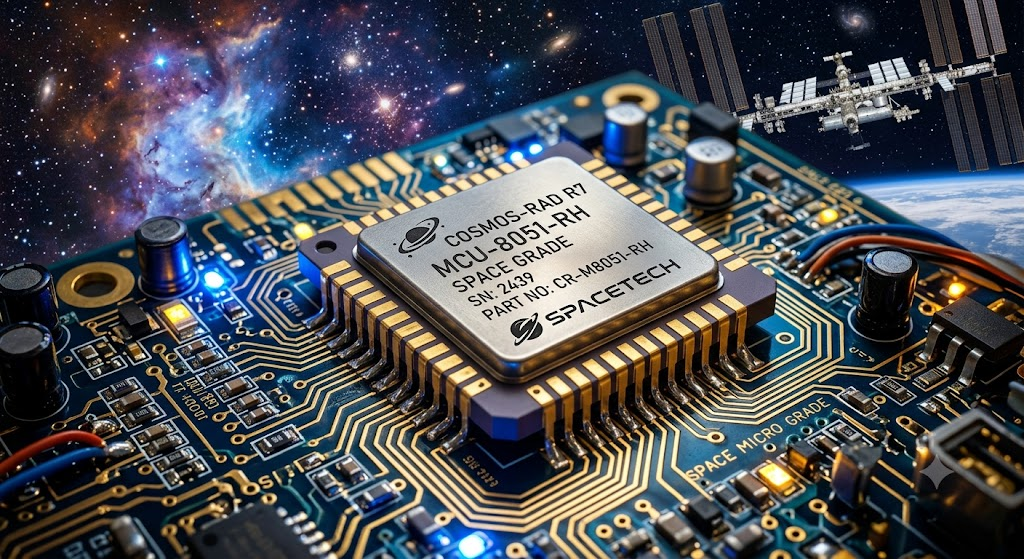
“Radiation-hardened” refers to components tested and guaranteed to survive specific levels of radiation, while “radiation-tolerant” implies a lower level of assurance, often relying on shielding or software redundancy to survive shorter mission lifespans.
In 2026, the distinction between these categories is blurring. High-density constellations now require Space-Grade Component Catalog selections that offer the reliability of traditional rad-hard silicon at the price point of advanced rad-tolerant solutions.
Compliance often starts with NASA Technical Standards or ESA guidelines, ensuring that every gate in the MCU can handle the specific flux of the South Atlantic Anomaly (SAA).
The LEO-3 Reliability Matrix: A Proprietary Selection Framework
At Tyneen, we utilize The LEO-3 Reliability Matrix to simplify component selection. This framework balances three critical pillars to ensure mission success without over-engineering the budget.
| Pillar | Metric | LEO Standard (2026) |
|---|---|---|
| Duration | Mission Life | 3 – 7 Years |
| Altitude | Orbital Shell | 400km – 1,200km |
| Budget | Cost Per Unit | $500 – $5,000 (Scalable) |
By mapping your mission to this matrix, you can identify if a mission requires a full RHBD MCU or if a screened COTS (Commercial Off-The-Shelf) component with robust Radiation Testing Services will suffice.
Optimizing SWaP-C in 2026 Satellite Architectures
Size, Weight, Power, and Cost (SWaP-C) optimization is the primary driver for LEO satellite avionics today. In 2026, the industry has moved toward “System-on-Chip” (SoC) integration where the MCU, memory, and power management reside in a single ceramic or enhanced plastic package.
Miniaturization is no longer just about fitting more on a PCB. It is about reducing the thermal footprint. High-density MCUs in a vacuum cannot rely on convection, making thermal management a core part of the component selection process.
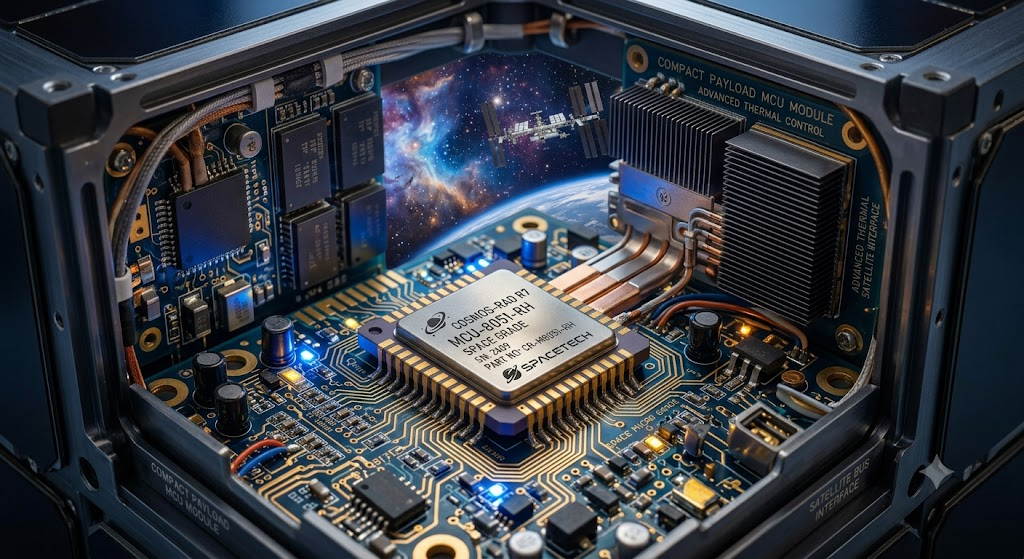
- Power Consumption: 2026-gen MCUs operate at sub-1.0V core voltages to minimize heat.
- Integration: Integrated CAN-FD and SpaceWire interfaces reduce external component counts.
- Materials: Use of advanced plastic packaging for LEO has reduced weight by 40% compared to traditional hermetic ceramic.
Radiation Effects: Managing TID and SEE in Space-Grade Electronics
Radiation in LEO manifests primarily in two ways: Total Ionizing Dose (TID) and Single Event Effects (SEE). A high TID rating ensures the device won’t degrade over years of exposure, while SEE protection prevents immediate logic flips or latch-ups.
Modern MCUs use Error Correction Code (ECC) on all internal memory and Triple Modular Redundancy (TMR) for critical registers. These hardware-level safeguards are vital for maintaining latch-up immunity during solar flares.
Based on our data, 2026 missions are increasingly prioritizing “soft” error mitigation through intelligent software layers, allowing for the use of higher-performance silicon that might have lower native TID resistance but superior processing speed.
The Shift to RISC-V and Edge AI in LEO Constellations
The most significant “Information Gain” in 2026 is the rapid adoption of RISC-V space grade architectures. By moving away from proprietary ARM or PowerPC licenses, the industry has fostered an open-source ecosystem that accelerates development.
Furthermore, Edge AI has moved from a buzzword to a requirement. LEO satellites now process 2026-gen telemetry data locally to reduce downlink bandwidth. This requires MCUs with specialized instructions for AI-inference at the edge.
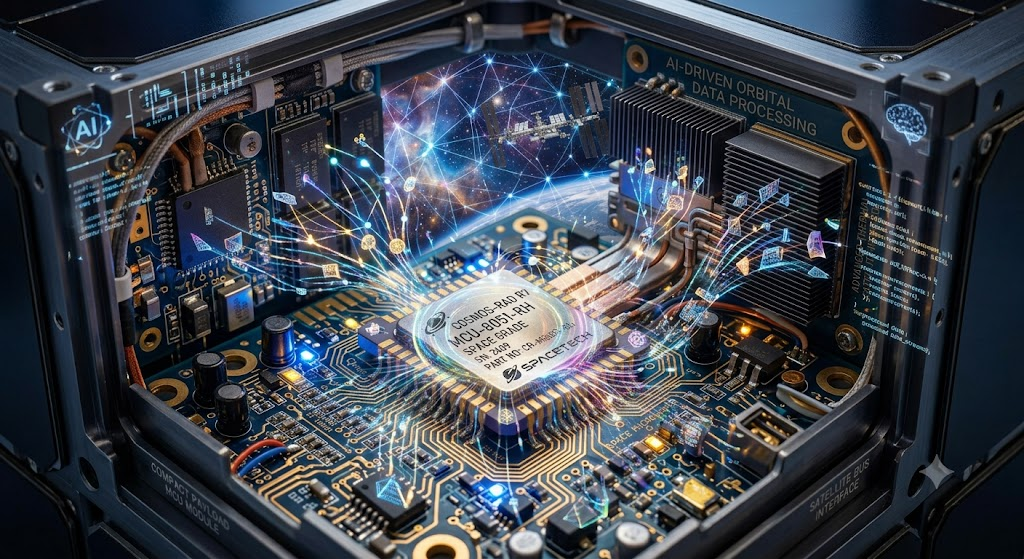
Predictive failure modeling is now performed on-board. If an MCU detects a pattern of bit-flips indicative of hardware degradation, it can autonomously shift tasks to redundant cores or initiate safe-mode protocols before a “zombie satellite” scenario occurs.
Cross-Reference: Rad-Tolerant Cores vs. Terrestrial ARM Equivalents
Engineers often start development on standard terrestrial boards. Mapping an ARM Cortex-M space qualified equivalent is essential for software portability. This ensures that code written in a lab environment functions identically in a vacuum.
For complex tasks, the choice between an FPGA and a microcontroller often depends on the power budget. While FPGAs offer massive parallel processing, 2026 rad-hard MCUs provide a more power-efficient solution for general LEO satellite avionics control.
If your team is transitioning from terrestrial industrial IoT to space, seeking Avionics Design Consultation can prevent common pitfalls in porting legacy drivers to rad-hard environments.
MCU Reliability and Space Debris Mitigation Strategies
Component reliability is a sustainability issue. A failed microcontroller can render a satellite uncontrollable, contributing to the growing problem of space debris. High-reliability MCUs enable strict de-orbiting protocols and end-of-life maneuvers.
By using predictive failure modeling, operators can determine the exact moment to retire a satellite before its primary space-grade electronics components fail completely. This proactive approach is becoming a regulatory mandate for 2026 mega-constellation licenses.
Expert Insights
“Selecting the right silicon isn’t just about surviving the radiation belt; it’s about optimizing the mission’s data-per-watt ratio. In 2026, we focus on the LEO-3 Matrix to ensure we don’t pay for GEO-level protection on a 3-year LEO mission.”
— Marcus Thorne, Lead Aerospace Engineer
About the Author: Elena Vance is a Senior Semiconductor Architect specializing in radiation-hardened logic. With over 15 years in the aerospace sector, she has contributed to the design of four major satellite bus architectures currently in orbit.
Frequently Asked Questions about LEO Microcontrollers
What is the typical TID rating for LEO satellites in 2026?
Most LEO missions now target a Total Ionizing Dose (TID) rating between 30 krad(Si) and 100 krad(Si). This provides a sufficient safety margin for 5-7 year missions in typical orbits between 500km and 800km.
Can I use COTS microcontrollers for LEO missions?
Yes, but it requires extensive radiation testing and often a “system-level” hardening approach. For critical functions like flight control, a dedicated rad-hard or rad-tolerant MCU is highly recommended to prevent Single Event Latch-ups (SEL).
How does RISC-V compare to ARM in space?
In 2026, RISC-V is preferred for custom mission-specific optimizations and avoiding licensing overhead. ARM remains a strong choice for teams relying on established software ecosystems and broad third-party tool support.
Ready to Harden Your Next Mission?
Don’t leave your LEO avionics to chance. Explore our 2026 catalog of rad-hard microcontrollers and professional testing services.