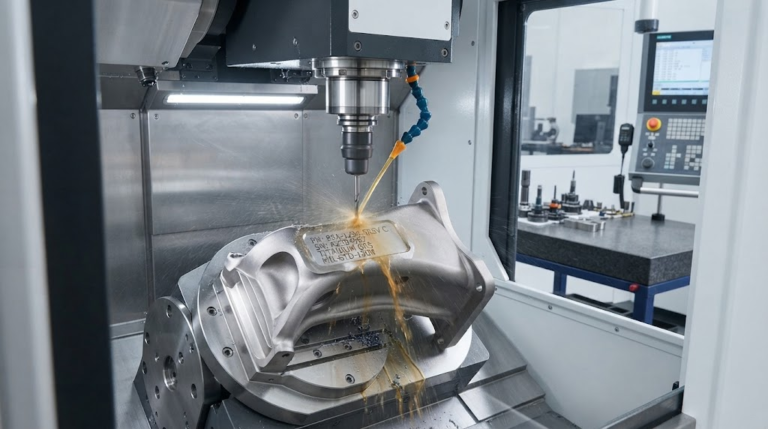
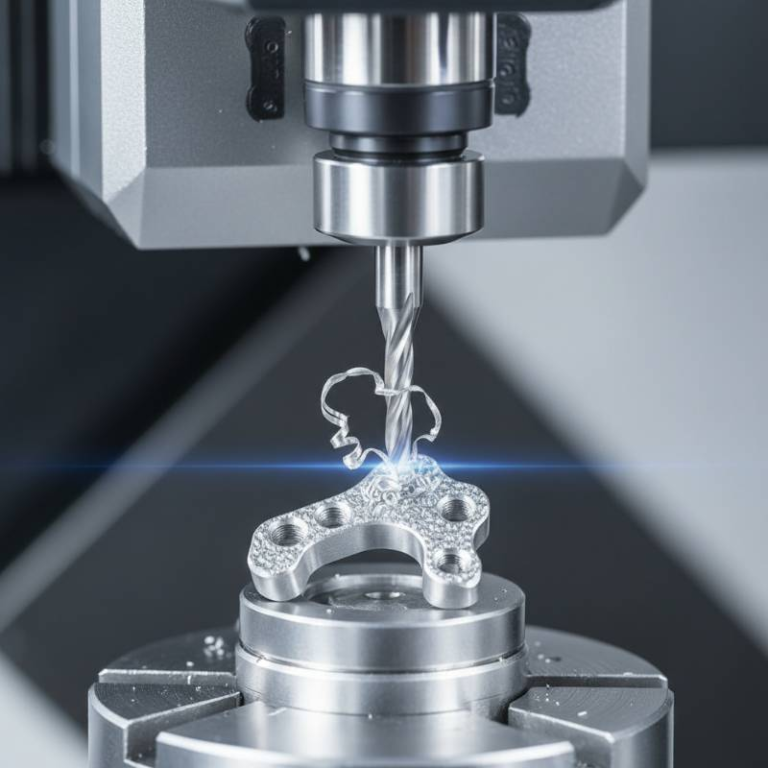
Custom CNC Milling for Advanced Robotics Actuators
High-torque-density robotic joints demand structural enclosures that do far more than shield electronics. In humanoid bipedal systems, surgical manipulators, and high-payload cobots, the actuator housing functions as the primary mechanical backbone. It must maintain rigid sub-micron gear centerlines while undergoing continuous dynamic shock loads.
Achieving zero-backlash motion transfer in cycloidal and harmonic drives requires machining critical bearing journals and stator bores to tolerances tighter than ±0.005 mm. Standard CNC operations fail here because cutting heat, tool deflection, and clamping stresses warp thin aluminum shells during release. High-precision custom CNC milling for advanced robotics actuators demands advanced toolpath dynamics, multi-axis single-setup architectures, and disciplined stress-relief workflows.
Engineering Evaluation Matrix: 4 Critical Dimensions of Actuator Housing Machinability
To evaluate if an actuator housing design is ready for high-yield CNC manufacturing, mechatronics hardware teams must analyze four key mechanical dimensions. Neglecting any single pillar leads to high reject rates, dynamic gear binding, or premature field failure.
Actuator Machinability Criterion: The quantifiable index balancing structural stiffness, thermal stability, multi-axial geometric tolerances, and volumetric tool reach to ensure zero-backlash transmission under dynamic motor loads.
- 1. Dynamic Coaxiality & Runout: True position tolerances ≤ 0.010 mm across opposing bearing journals. Radial runout must stay within ±0.005 mm to prevent uneven cycloidal disc tooth loading.
- 2. Thin-Wall Resonance & Deflection: Cantilevered structural ribs and stator shells (≤ 0.6 mm) must resist chatter during high-speed cuts and maintain cylindrical geometry under radial motor clamping pressures.
- 3. Micro-Surface Integrity: Bearing journals and dynamic O-ring sealing grooves demand Ra 0.4 μm surface finishes to prevent micro-fretting and oil-seal degradation.
- 4. Geometric Dimensioning & Tolerancing (GD&T) Metrology: Full ISO 1101 and ASME Y14.5 compliance verified via multi-sensor coordinate measuring machines at standard reference temperatures (20°C).
Radial cutting forces cause significant elastic deflection when milling unsupported thin walls. Engineers should calculate theoretical wall deflection using the cantilever plate model to set appropriate step-over values:
δ: Wall deflection (mm), F_r: Radial cutting force (N), L: Unsupported wall height (mm), E: Young’s Modulus (GPa), I: Area moment of inertia (mm⁴)
Robotics Actuator Geometries: Overcoming Critical CNC Milling Challenges
Next-generation robotics rely on compact, power-dense actuator designs. Each architecture presents distinct challenges on the machine floor, requiring specialized custom CNC milling services to hold geometry.
Frameless brushless DC (BLDC) motor stator carriers need exact inside diameter (ID) tolerances to ensure uniform electromagnetic air gaps (typically 0.15 mm to 0.3 mm). Strain wave gear cups demand precise wall concentricity to absorb continuous high-frequency flexing without fatigue cracking.
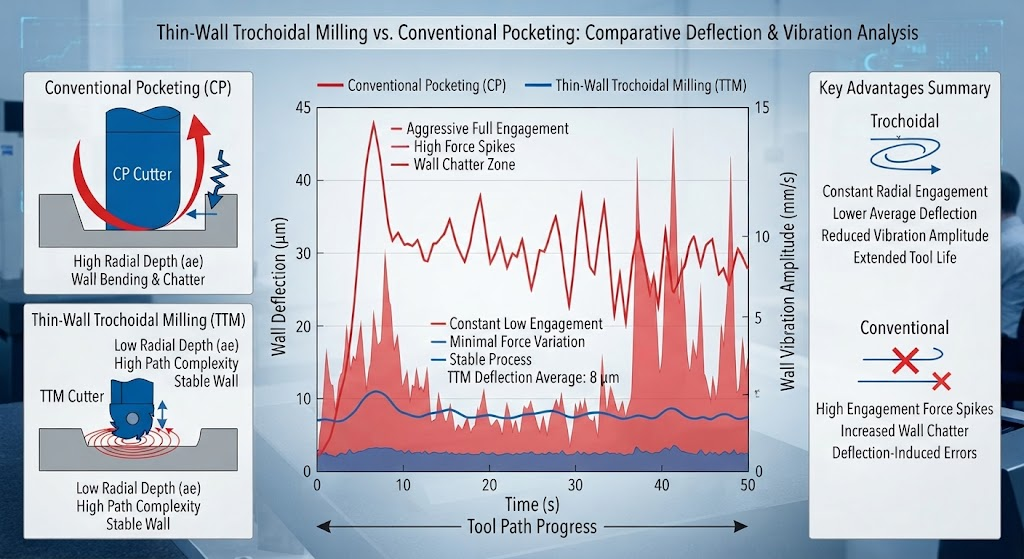
Mitigating Thin-Wall (≤ 0.8 mm) Resonance and Clamping Distortion
Thin outer skirts easily deflect and vibrate when cut with conventional end mills. This vibration leaves chatter marks and causes dimensional drift across the casing diameter.
- Trochoidal Toolpath Strategies: Maintaining a low radial engagement angle (ae ≤ 5% to 10% of tool diameter) minimizes cutting pressure and disperses heat into the chip rather than the thin component wall.
- Conformal Fixturing & Potting: Custom-machined aluminum nests, low-melt thermoplastic supports, and multi-port vacuum chucks damp structural vibrations during finish passes.
- High-Helix Carbide Cutters: Variable-helix end mills (38°/41°) break up harmonics and evacuate chips cleanly at peripheral cutting speeds over 600 m/min.
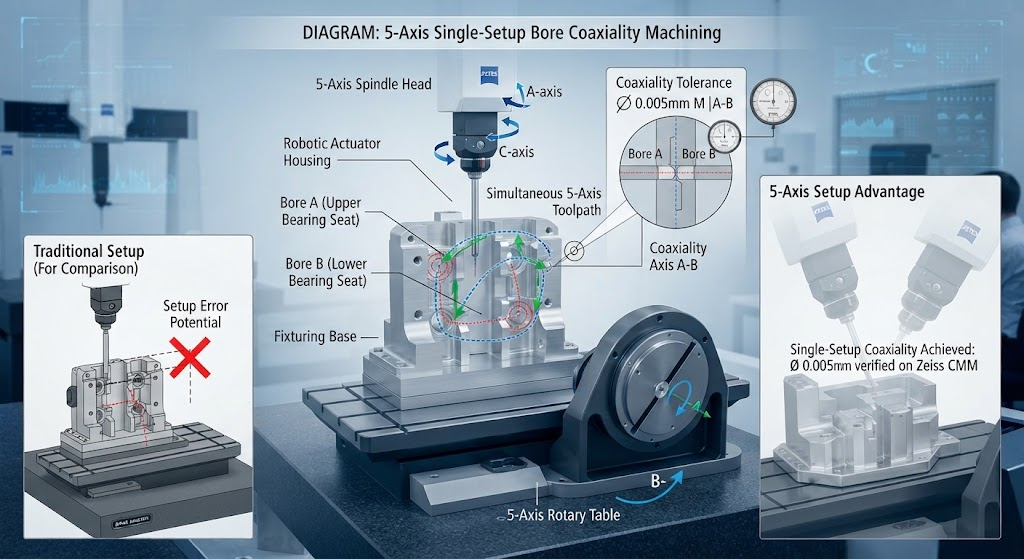
Achieving Dual-Bearing Bore Coaxiality Without Re-Chucking
Machining opposing bearing journals across two separate clampings introduces cumulative setup error. Fixture runout and part repositioning can quickly stack up to 0.025 mm of misalignment, causing premature bearing failure.
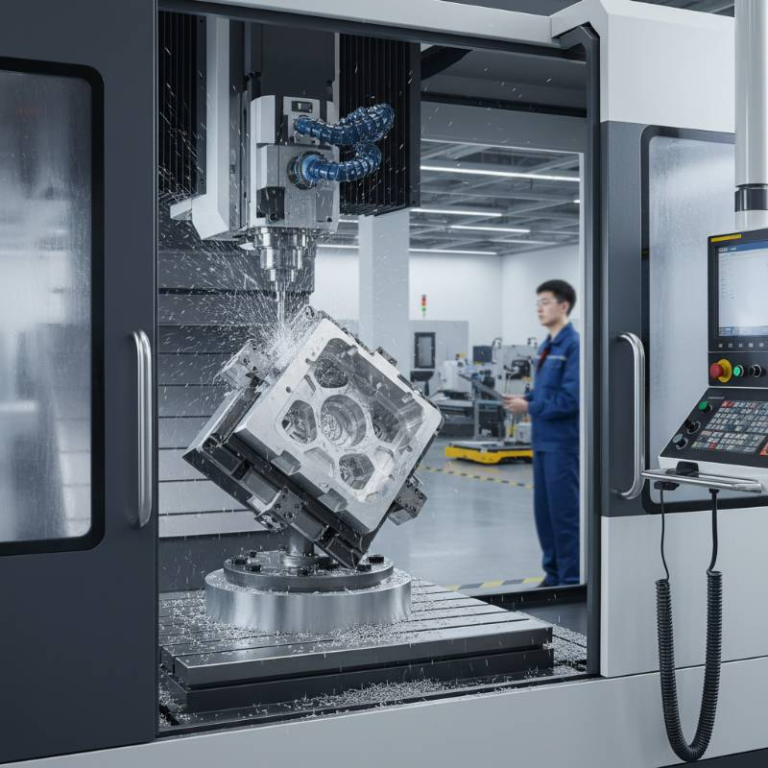
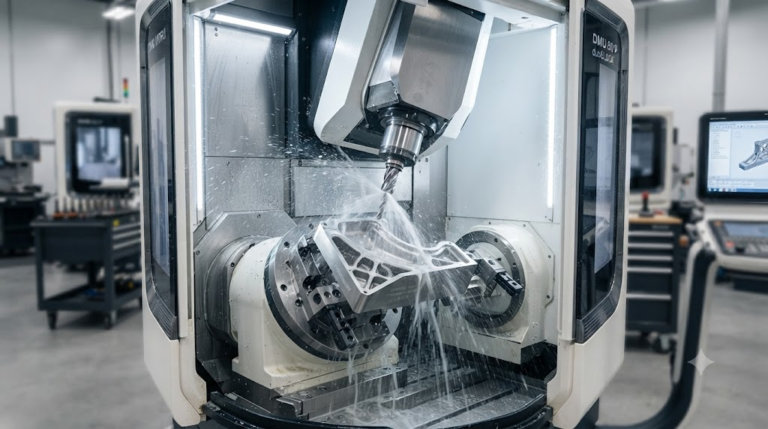
Deploying advanced 5-axis machining solutions lets you complete both bearing journals, integrated cycloidal pin locations, and seal registers in a single automated setup. Continuous 5-axis spindle indexing holds total runout below ±0.005 mm relative to the primary datum plane.
The Tyneen 4-Phase Micro-Stabilization Protocol (T-MSP) for Actuator Housings
Residual stress in billet aluminum often causes parts to warp hours or days after machining. Tyneen’s proprietary 4-Phase Micro-Stabilization Protocol (T-MSP) relieves internal stresses throughout the production cycle, guaranteeing long-term dimensional stability.
- Phase 1: High-Efficiency Roughing: Remove up to 85% of bulk material using adaptive trochoidal milling paths, leaving a uniform 0.50 mm finishing stock across all surfaces.
- Phase 2: Sub-Zero Cryogenic Thermal Cycling: Deep-freeze parts from -80°C to +160°C across 3 controlled cycles. This transforms unstable residual austenite and balances internal stresses across complex asymmetric pockets.
- Phase 3: Semi-Finishing & In-Situ Renishaw Probing: Mill components down to 0.05 mm of final dimensions. High-speed spindle probes check true datum alignment directly on the machine table.
- Phase 4: Diamond Micro-Finishing & 20°C Thermal Soaking: Execute final high-speed passes using ultra-sharp PCD tooling at controlled temperatures. Parts then soak in a 20°C ±0.5°C climate room for 24 hours before final CMM inspection.
Material Selection & Surface Engineering for Mission-Critical Actuators
Choosing the right structural alloy requires balancing strength-to-weight ratio, thermal dissipation, fatigue endurance, and machining performance. Review our high-performance robotics materials to match mechanical properties with operational demands.
Al 7075-T651 vs. Al 6061-T6 vs. Titanium Grade 5: Engineering Trade-Off Matrix
| Material Designation | Yield Strength (MPa) | Density (g/cm³) | Thermal Conductivity (W/m·K) | Machinability Index (%) | Recommended Robotics Application |
|---|---|---|---|---|---|
| Al 7075-T651 | 503 | 2.81 | 130 | 70% | Humanoid dynamic hips, knees, and cycloidal gear carriers |
| Al 6061-T6 | 276 | 2.70 | 167 | 90% | BLDC motor stator cooling jackets and low-stress cobot links |
| Ti-6Al-4V (Grade 5) | 880 | 4.43 | 6.7 | 22% | Surgical robotic wrists, aerospace manipulators, and high-impact end-effectors |
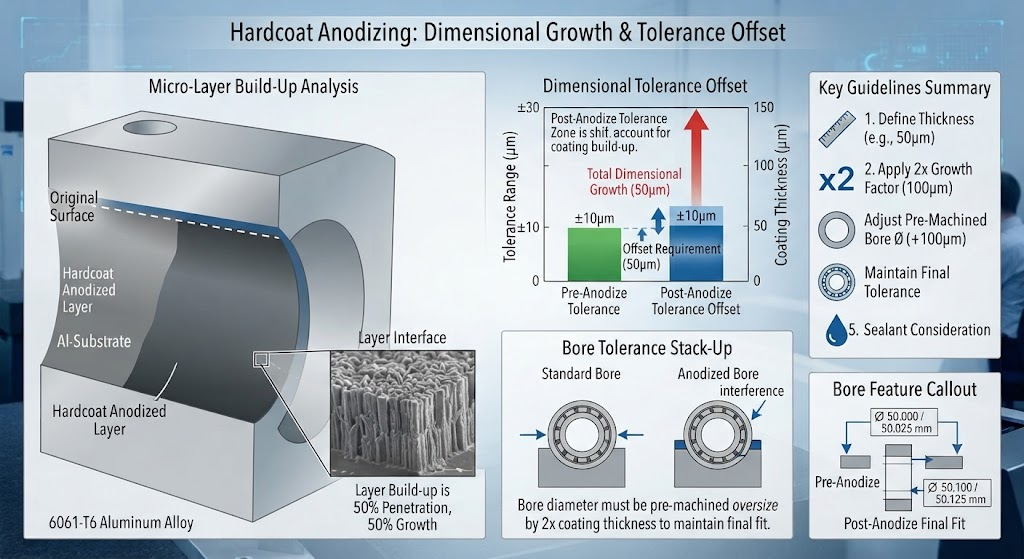
Hardcoat Anodizing (MIL-A-8625 Type III) & Dimensional Growth Offsets
Actuator enclosures frequently undergo MIL-A-8625 Type III Hardcoat Anodizing (Class 1 or Class 2) to prevent surface wear and galvanic corrosion. This process forms an ultra-hard aluminum oxide layer (60 to 65 HRC) that alters critical dimensions.
The standard growth rule specifies that 50% of the total coating thickness penetrates the substrate, while 50% builds outward on the surface. For a standard 0.050 mm (50 μm) total hardcoat layer, external surfaces grow by 0.025 mm per side. Internal bearing bore diameters shrink by 0.050 mm in total diameter.
D_machined: Pre-anodize bore diameter, D_nominal: Target finished diameter (e.g., ISO H7), t_growth: Outward radial layer growth (0.025 mm for 50 μm hardcoat)
Machinists must compensate for this dimensional shift in their finishing toolpaths or protect sensitive bearing seats with custom silicone masking plugs during anodizing.
Extreme Niche Benchmark: 5-Axis Milling of Ultra-Thin-Walled (≤ 0.6 mm) Al 7075-T651 Humanoid Joint Housings
A premier humanoid robotics manufacturer partnered with Tyneen to machine their primary bipedal hip actuator housing. The component integrated an outer motor stator mount with a high-ratio cycloidal pin-ring assembly in a single monocoque housing.
- Challenging Part Specifications: 0.60 mm wall thickness across a ⌀140 mm shell, 40 internal cycloidal pin pockets holding ±0.006 mm true position, dual bearing journals requiring ±0.005 mm concentricity, and Ra 0.4 μm seal tracks.
- Initial Manufacturing Failure: Previous suppliers experienced 42% scrap rates due to thin-wall vibration, part ovality post-unclamping, and surface chatter along the cycloidal ring.
- The Tyneen Engineering Solution: We developed custom polyurethane expansion mandrels that pressurized the thin casing from the inside during outer-diameter finish passes. We then ran the parts on a DMG MORI 5-axis machining center using the Tyneen Micro-Stabilization Protocol.
- Final Quality Results: 100% first-pass metrology yield across a 250-piece production run. Opposing bore runout held at 0.0038 mm, circularity measured within 0.003 mm, and cycle times dropped by 34%.
Tyneen Quality Assurance: Certified Standards, In-Situ Metrology & Clean-Room Inspection
Robotics manufacturing requires strict process control and traceability. Tyneen operates certified quality systems compliant with ISO 9001:2015, IATF 16949, and AS9100D aerospace standards.
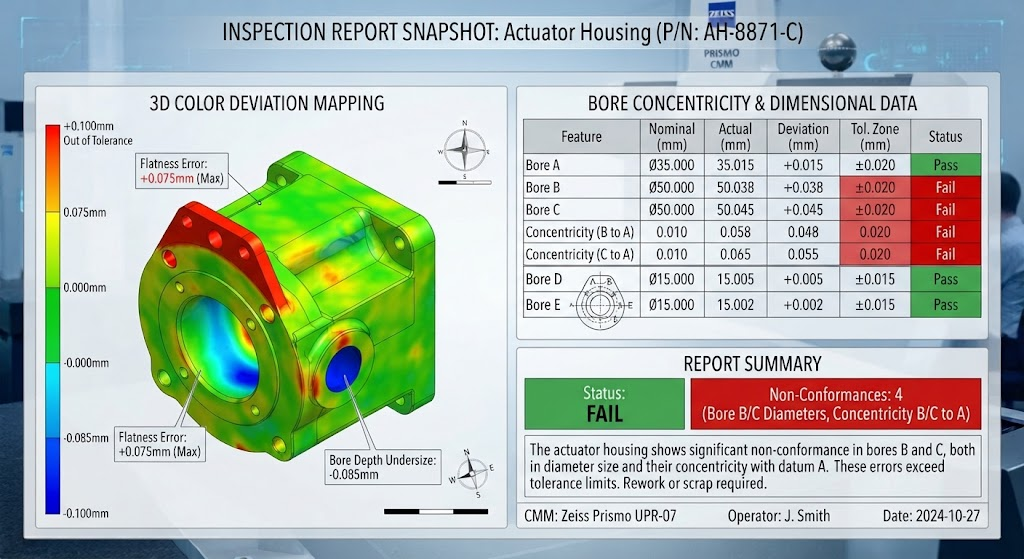
Every critical feature undergoes automated scanning on multi-sensor Zeiss Prismo Coordinate Measuring Machines with a volumetric length measurement error of E0,MPE = 0.5 + L/500 μm. We pair this with complementary precision CNC turning capabilities for symmetric rotor shafts and harmonic spline interfaces.
- EN 10204 Type 3.1 Traceability: Full chemical analysis and mechanical tensile test reports for every raw billet lot.
- 100% First Article Inspection (FAI): Complete AS9102-compliant metrology packages, including optical profile scans and bore roundness plots.
- Climate-Controlled Clean Packing: Ultrasonic washing, de-burring under 20× optical magnification, and vacuum-sealed bagging prevent dust contamination before clean-room assembly.
Deep Engineering Comparisons & Quality Verification Checklist
Custom CNC Milling vs. Direct Metal Laser Sintering (DMLS) for Actuator Enclosures
Direct Metal Laser Sintering (DMLS) works well for organic, low-volume structural brackets. However, subtractive CNC milling remains the better choice for high-stress actuator housings.
| Performance Parameter | 5-Axis Precision CNC Milling | Direct Metal Laser Sintering (DMLS) |
|---|---|---|
| Mechanical Isotropy | 100% isotropic wrought billet strength (Al 7075-T651) | Anisotropic Z-axis weakness; micro-porosity risk (0.1% to 0.5%) |
| Bearing Seat Surface Finish | Direct Ra 0.4 μm to Ra 0.2 μm diamond-milled surfaces | As-printed Ra 6.3 μm to 10 μm; requires post-machining operations |
| Bore True Position Accuracy | ±0.005 mm in single 5-axis setups | ±0.10 mm to ±0.20 mm (requires secondary CNC re-machining) |
| Mid-Volume Unit Economics (50-2000 pcs) | Highly scalable; rapid cycle-time amortization | High unit cost; slow laser build rates limit scalability |
Robotics Procurement Quality Checklist: Verifying Bore Concentricity and Material Authenticity
Hardware quality leads can use this 6-point verification framework to audit high-precision actuator shipments:
- [ ] Optical Emission Spectrometry (OES): Verify the raw aluminum or titanium bar stock matches standard ASTM alloy compositions.
- [ ] Multi-Axis Bore Roundness & Concentricity: Confirm dual-bearing journal runout falls within ±0.005 mm using continuous CMM probe scanning.
- [ ] Ultrasonic Wall Thickness Gauging: Verify thin-walled structural shells (≤ 0.8 mm) show no cutter-deflection taper from top to base.
- [ ] Surface Metrology Verification: Measure dynamic O-ring grooves and bearing journals with a calibrated profilometer to verify Ra ≤ 0.4 μm.
- [ ] Thread Go/No-Go Gauging Post-Anodizing: Inspect all small tapped holes (M2 to M4) with calibrated thread gauges after surface treatment.
- [ ] Helium Mass Spectrometry Leak Testing: Confirm IP67/IP68 sealed joint housings show zero porosity or joint leakage under high vacuum.
3-Step Production Pathway: Rapid Engineering to Certified Actuator Delivery
Precision Actuator Manufacturing Pathway
Move your complex robotic joint designs from 3D CAD models to production parts with speed, precision, and reliable lead times:
- Step 1: Upload CAD & GD&T Drawings
Send us your STEP/Parasolid models alongside 2D PDF tolerance prints via our secure customer portal. - Step 2: Automated DFM Analysis & Instant Engineering Feedback (≤ 2 Hours)
Our engineering team evaluates tool clearances, thin-wall vibration risks, and anodize growth offsets, providing a detailed DFM report and firm quote. - Step 3: 5-Axis Precision Production & Certified Global Dispatch
We run your parts on multi-axis DMG MORI CNCs, complete full Zeiss CMM inspections, apply MIL-spec coatings, and dispatch them within 3 to 5 business days.
Frequently Asked Questions (FAQ): CNC Machining for Robotics Actuators
What is the minimum wall thickness possible for custom CNC milled robotics actuator housings?
Using 5-axis high-speed trochoidal toolpaths and custom potting dampening fixtures, we routinely mill aluminum 7075-T651 housings down to a wall thickness of 0.50 mm to 0.60 mm while keeping wall taper and runout within ±0.010 mm.
How does Tyneen maintain ±0.005 mm bearing seat concentricity across opposing casing halves?
We use 5-axis continuous multi-tasking CNC centers to machine both opposing bearing seats, oil seal surfaces, and locating dowels in a single continuous setup. This single-clamping workflow avoids the stackup errors common in multi-fixture re-clamping.
Should I tap threads directly or use Helicoil wire inserts in Al 7075-T651 housings?
For structural fasteners (M3 and above) exposed to high cyclic dynamic loads or frequent field maintenance, we recommend stainless steel Helicoil or Keysert (Keensert) locking thread inserts. Direct tapping is suitable for low-torque sensor mounts or permanent assembly closures.
What standard lead times can we expect for quick-turn prototype actuator housings?
Precision 5-axis prototype actuator enclosures typically ship in 3 to 7 business days, complete with First Article CMM inspection data, material test certificates, and post-surface treatments like hardcoat anodizing.