Sustainable CNC Milling: CBAM-Compliant Green Machining
Sustainable CNC Milling & Low Carbon Manufacturing Services
Modern procurement has shifted. High-precision engineering is no longer enough; global supply chains now demand environmental accountability. At Tyneen, we bridge the gap between rigorous tolerance requirements and aggressive decarbonization goals.
As we navigate 2026, the industrial sector faces unprecedented pressure to reduce Scope 3 emissions. Sustainable CNC milling is the strategic response to this pressure, optimizing material usage and energy consumption without sacrificing the mechanical integrity of critical components.
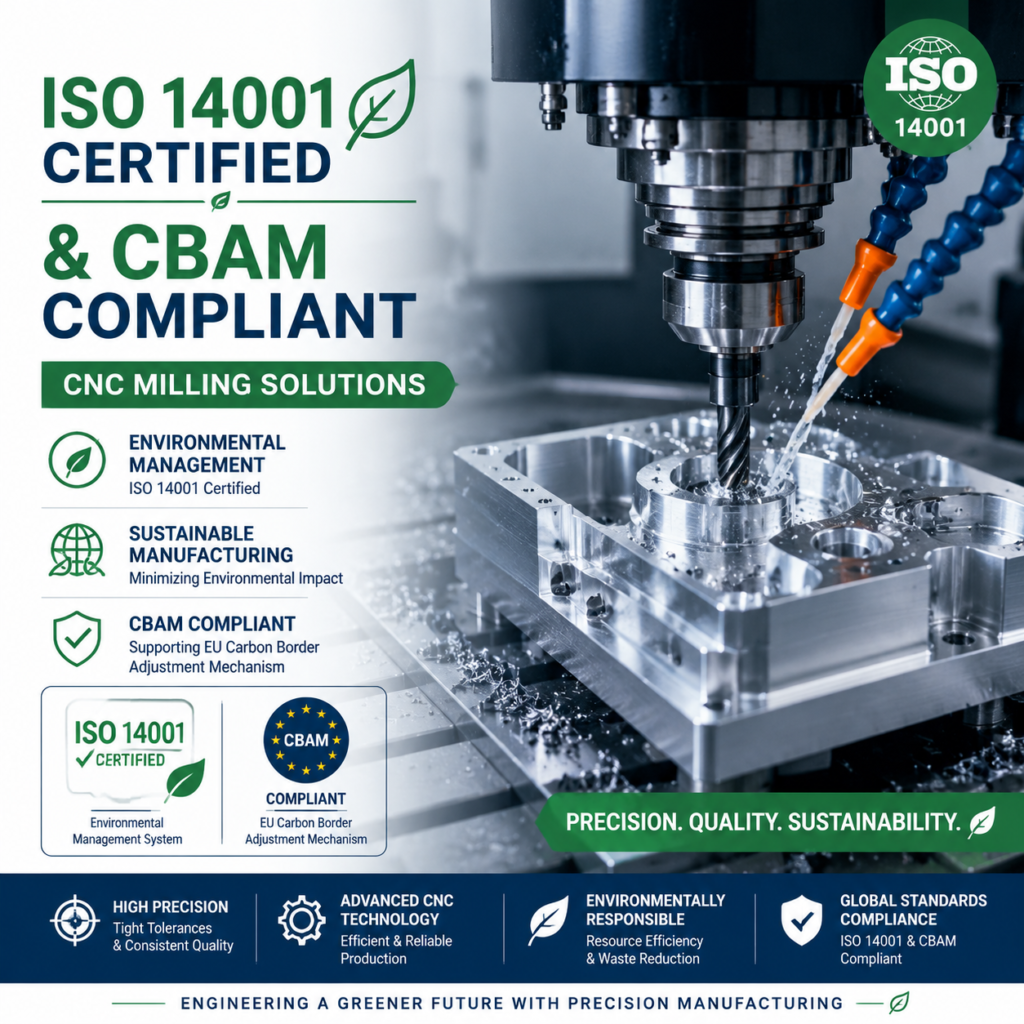
ISO 14001 Certified & CBAM Compliant CNC Milling
Sustainable CNC milling combines energy-efficient hardware with intelligent toolpath strategies to minimize the carbon footprint of metal and plastic parts. By 2026 standards, this process includes providing verified Scope 1 and 2 emission data, allowing European buyers to seamlessly comply with the Carbon Border Adjustment Mechanism (CBAM) and avoid costly import penalties.
Our facility operates under a strict ISO 14001 Environmental Management System. This isn’t just a certificate on the wall; it is the foundation of our operational logic. We provide direct reporting capabilities that align with ISO 14064 standards, ensuring your “embedded carbon” calculations are audit-ready for the European Union market.
“By integrating real-time energy monitoring into our Precision CNC Machining Services, we offer a level of transparency that was historically impossible in the subcontracting sector.”
What is Sustainable CNC Machining?
We define eco-friendly CNC as the holistic optimization of the subtractive manufacturing lifecycle. It moves beyond simple recycling to address the Greenhouse Gas Protocol requirements at the point of origin.
Traditional milling is often “linear”—raw material enters, chips are discarded, and energy is consumed without recovery. Sustainability transforms this into a circular model. It involves selecting materials with lower embodied energy and utilizing machines that feature regenerative braking systems to feed power back into the grid.
The Eco-Precision Protocol: Our Proprietary Decarbonization Methodology
To maintain consistency across diverse projects, we utilize The Eco-Precision Protocol. This 4-step framework ensures that every part we manufacture for the Aerospace Engineering Solutions or medical sectors meets stringent ESG mandates.
- AI-Path Optimization: We use advanced CAM algorithms to reduce “air-cutting” time and optimize chip loads, reducing spindle energy draw by up to 22%.
- Near-Net-Shape Selection: Instead of milling from solid blocks, we start with forgings or castings that closely resemble the final geometry, slashing material waste.
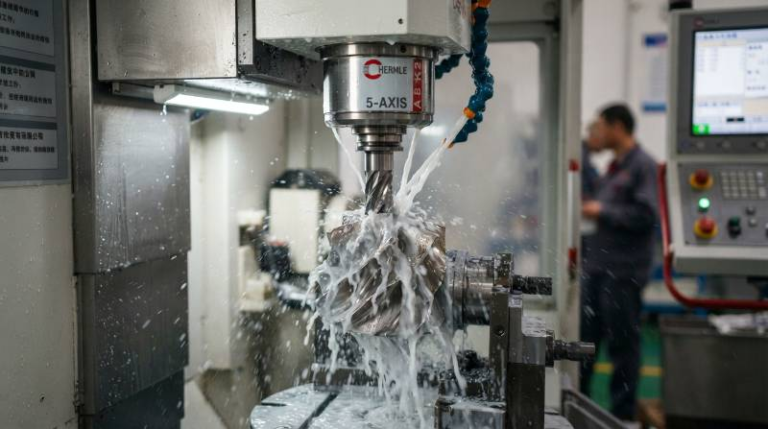
- MQL Integration: Minimum Quantity Lubrication replaces high-volume flood coolant, using a fine mist of biodegradable oil to reduce fluid consumption by 95%.
- Closed-Loop Recycling: Every gram of swarf is color-coded, compressed into briquettes, and returned to the smelter with zero cross-contamination.
Technical Excellence: Near-Net-Shape Processing & High-Efficiency Spindles
The most sustainable way to mill a part is to remove as little material as possible. Our Near-Net-Shape (NNS) approach is a critical differentiator. By collaborating with our customers during the design phase (DfM), we often recommend starting with a 3D-printed or forged blank.
Furthermore, our 2026 fleet of machines utilizes high-efficiency synchronous spindles. Unlike older induction motors, these units maintain high torque at lower power levels. When the spindle decelerates, regenerative drives capture the kinetic energy, converting it into electrical energy for use elsewhere in the factory.
Quantifiable Sustainability: Data-Driven Carbon Reduction Metrics
We do not deal in vague “green” claims. Our performance is measured in hard numbers that you can include in your annual ESG reports.
| Metric | Traditional CNC | Tyneen Sustainable CNC |
|---|---|---|
| Material Utilization | 30% – 50% | 85% – 92% (NNS) |
| Aluminum Chip Recycling | Mixed / Low Value | 98% High-Purity Reuse |
| Coolant Life-Cycle | 3-6 Months | Closed-loop / MQL |
| Energy per Part | Standard Grid Mix | -30% kWh (Regen + AI) |
Industry-Specific Blueprints: Aerospace, Automotive, and MedTech
Different industries have different decarbonization hurdles. For Automotive Component Manufacturing, the focus is on light-weighting and high-volume circularity. We ensure that every steering knuckle or battery housing is produced with a verified carbon footprint per unit.
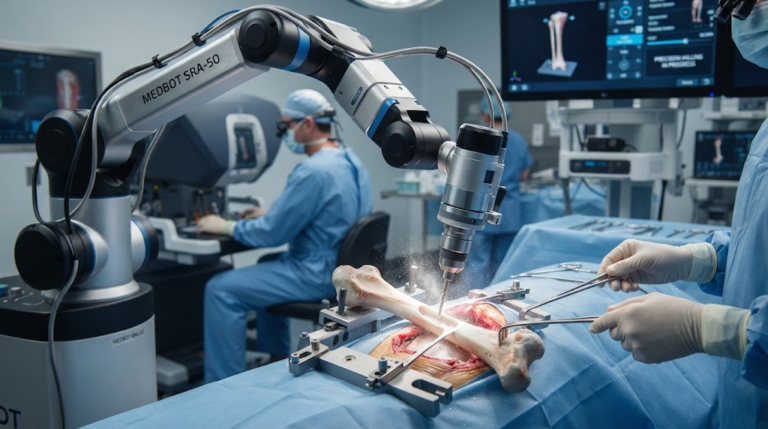
In MedTech, the challenge is maintaining bio-compatibility while moving away from harsh chemical solvents. Our green machining services use vegetable-based lubricants that exceed medical safety standards while remaining 100% biodegradable.
Calculate Your Impact: Interactive Carbon Footprint Calculator
Are you ready to see the difference? Our internal data shows that switching to The Eco-Precision Protocol can reduce the total CO2e (Carbon Dioxide Equivalent) of a typical aluminum batch by up to 45%.
Request Your 2026 ESG Audit Report
We provide full transparency into our operations. Download our latest factory compliance audit to see how our decarbonization efforts support your Scope 3 reduction targets.
[Interactive Tool Placeholder: Carbon Footprint Estimator]
Frequently Asked Questions About Sustainable CNC
Does sustainable machining cost more?
Initially, green tech required a premium. However, in 2026, the efficiency gains from reduced material waste and lower energy consumption often offset the technology costs. Furthermore, avoiding CBAM taxes makes sustainable milling significantly cheaper for European imports.
How do you verify CBAM emissions?
We track direct emissions (Scope 1) from our machines and indirect emissions (Scope 2) from our renewable energy providers. This data is compiled into a standardized report using the GHG Protocol methodology, ready for your customs declaration.
Does MQL affect tool life or part finish?
In many cases, Minimum Quantity Lubrication (MQL) actually improves tool life. By providing precise lubrication exactly at the cutting edge without the thermal shock of flood coolant, we achieve superior surface finishes on titanium and aerospace-grade alloys.
Ready to Decarbonize Your Supply Chain?
Get a CBAM-compliant quote for your next high-precision project. Our engineers are ready to help you meet your 2026 sustainability targets.