Magnesium CNC Machining & MAO Coating Solutions
Precision Magnesium CNC Machining & MAO Coating Solutions
Defining the Integrated Magnesium Advantage
Integrated Magnesium CNC Machining & MAO Coating Solutions provide a high-precision manufacturing route that transforms raw magnesium alloys into flight-ready or medical-grade components. By merging advanced milling with Electrolytic Plasma Oxidation (MAO), manufacturers achieve superior corrosion resistance and wear durability without the logistical risks of multi-vendor supply chains.
In the 2026 manufacturing landscape, the demand for Lightweight Material Engineering has moved beyond simple weight reduction. Engineers now require surface integrity that matches the structural performance of the alloy.
Magnesium is highly reactive. When a part is machined at one facility and shipped to another for coating, microscopic oxidation begins immediately. Our one-stop solution at Tyneen eliminates this “hidden window” of vulnerability, ensuring the MAO process bonds to a pristine, un-oxidized surface.
The PFIM Protocol: Our Proprietary Magnesium Framework
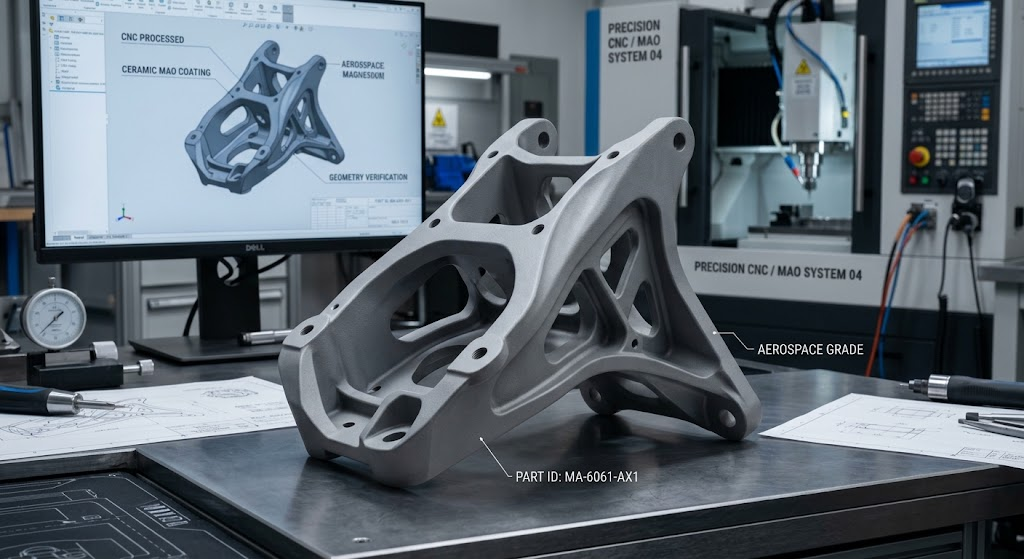
To address the complexities of magnesium, we developed the Precision-First Integrated Magnesium (PFIM) Protocol. This methodology synchronizes the machining tolerances with the specific growth rates of the MAO ceramic layer.
The “Hidden Cost” of separate machining and coating often manifests in scrap rates. Traditional workflows see a 15-20% rejection rate due to dimensional shifts during surface treatment. The PFIM Protocol uses a Dimensional Tolerance Matrix to calculate exactly how much the ceramic layer will “build up” and “penetrate” the surface.
Based on our data, this integrated approach reduces lead times and scrap rates by 30%. We define the PFIM Protocol as the gold standard for high-stress magnesium components where zero-tolerance degradation is non-negotiable.
High-Speed CNC Machining for Magnesium Alloys
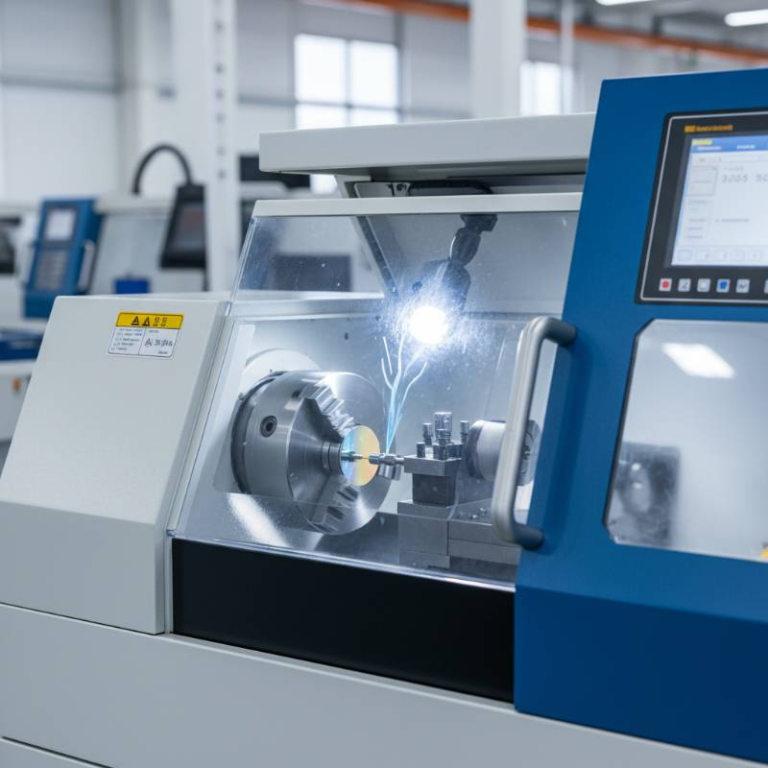
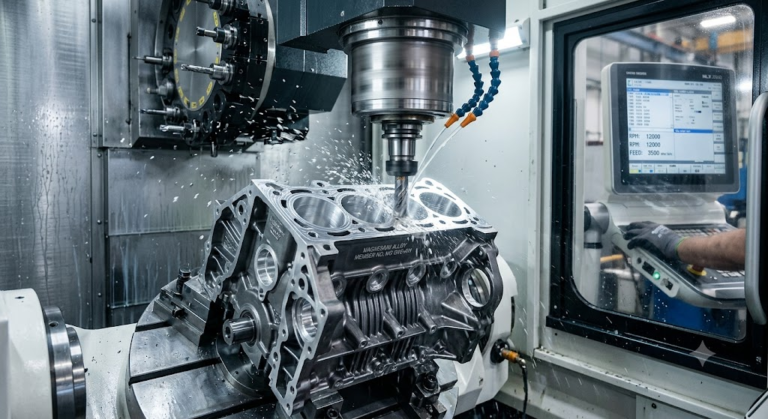
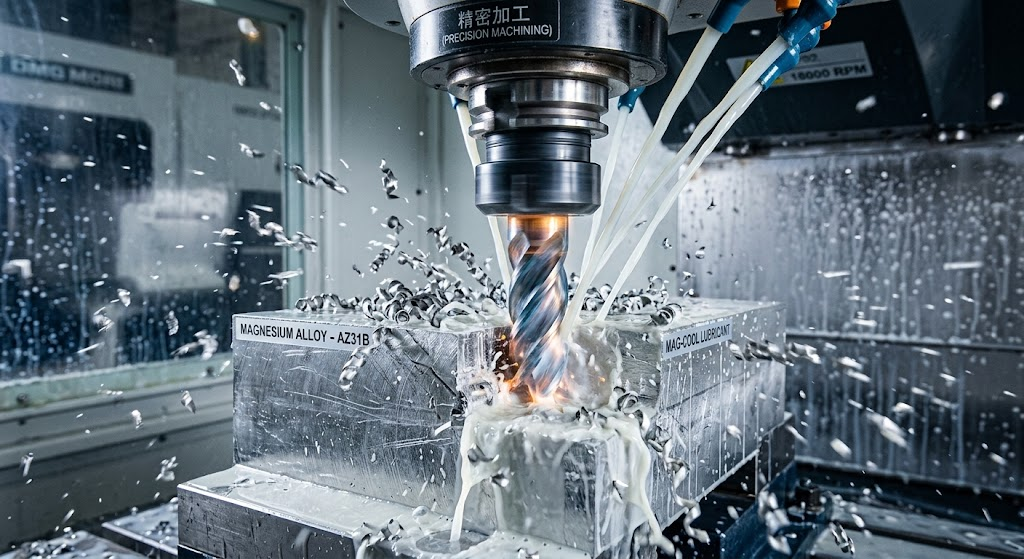
Magnesium alloys like AZ31B and ZK60A offer excellent machinability but require strict Precision CNC Machining Services. Because magnesium chips are flammable, our facility utilizes specialized fire safety protocols, including Class D extinguishers and high-volume vacuum chip management.
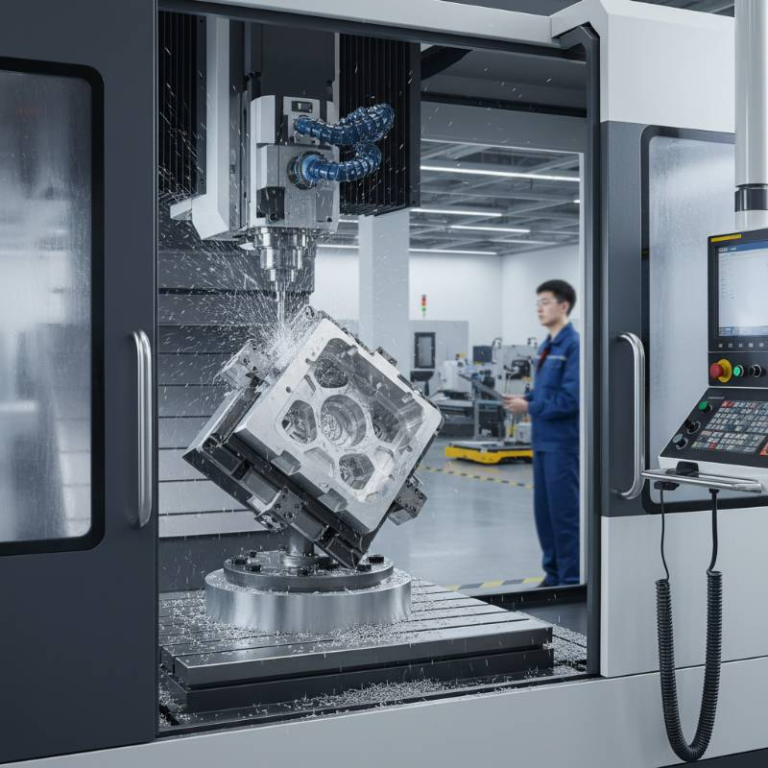
- High-Speed Milling: We utilize spindle speeds exceeding 15,000 RPM to minimize heat transfer to the workpiece.
- Thin-Walled Stability: Magnesium’s high damping capacity allows us to machine walls as thin as 0.5mm without vibration-induced failure.
- Tooling Geometry: Custom-ground carbide tools prevent chip welding, ensuring a surface roughness (Ra) optimized for subsequent MAO bonding.
Micro-Arc Oxidation (MAO): The Ceramic Finish for Magnesium
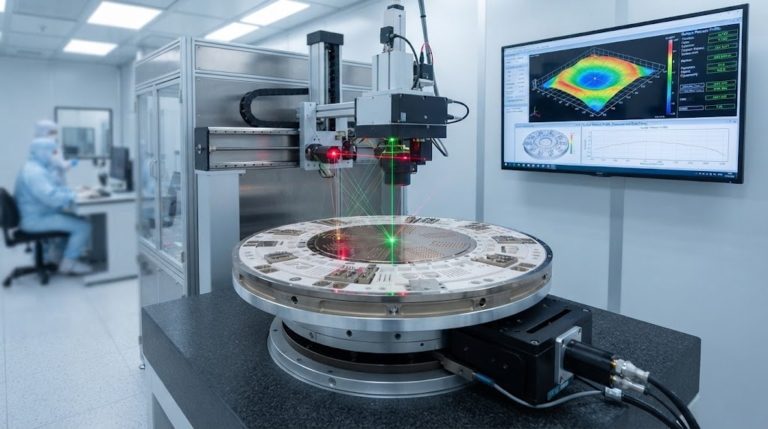
Definition: Micro-Arc Oxidation (MAO), also known as Plasma Electrolytic Oxidation (PEO), is an electrochemical process that uses high-voltage discharges to convert the surface of magnesium into a hard, crystalline ceramic oxide layer.
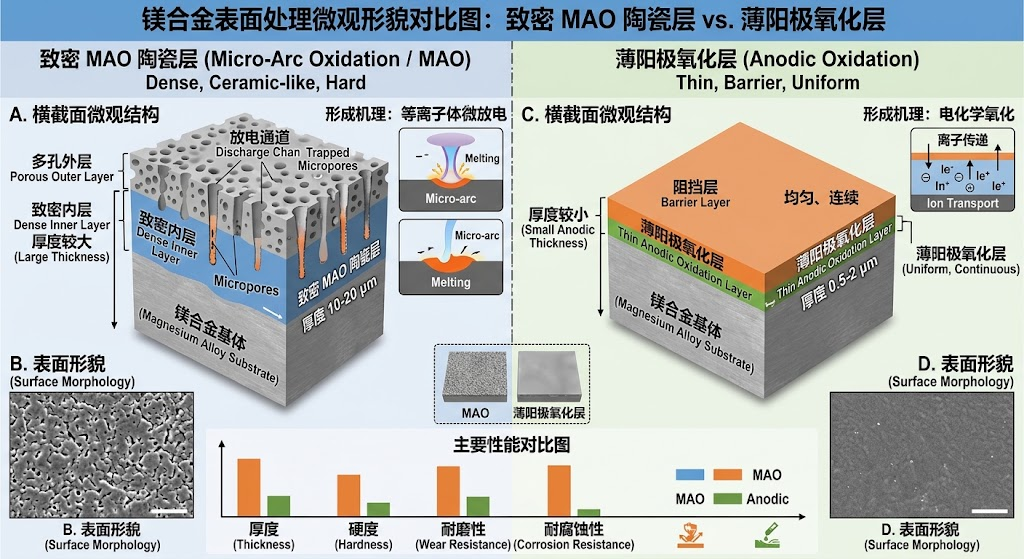
While traditional anodizing creates a thin, porous film, MAO produces a dense, multi-layered structure. By optimizing electrolyte chemistry, we enhance the fatigue life of high-stress CNC-machined parts. This is critical for 2026 aerospace standards where vibration resistance is paramount.
Our Advanced Surface Treatments focus on pore density optimization. A lower pore density in the MAO layer directly correlates to higher dielectric strength and superior galvanic isolation when magnesium is mated with carbon fiber or steel.
Comparative Analysis: MAO vs. Traditional Anodizing
Why does MAO outperform traditional magnesium conversion coatings? The secret lies in the plasma-chemical reaction. In our testing, MAO-coated AZ31B samples withstood over 1,000 hours of salt-spray testing, whereas chromate-treated samples showed pitting within 48 hours.
| Feature | Traditional Anodizing | MAO / PEO Coating |
|---|---|---|
| Hardness (HV) | 200 – 400 | 800 – 1500+ |
| Salt-Spray Resistance | < 96 Hours | 1000+ Hours |
| Environmental Impact | Contains Chromates | Eco-friendly / Alkaline |
| Adhesion | Mechanical Bond | Metallurgical/Crystalline |
According to research published in the Journal of Surface and Coatings Technology, the plasma discharge during MAO creates a fusion zone that makes the coating almost impossible to delaminate.
Strategic Industry Applications and ESG Impact
The synergy of magnesium and MAO is driving innovation in high-growth sectors. In the EV market, EV battery housings benefit from magnesium’s thermal conductivity and MAO’s electrical insulation properties.
For the aerospace sector, satellite structural parts use MAO-coated magnesium to provide the stiffness of aluminum at 33% less weight, directly impacting launch costs. Furthermore, in medical technology, MAO can be tuned for biocompatibility, controlling the degradation rate of bio-resorbable implants.
From an ESG perspective, magnesium is the most sustainable structural metal. Its abundance and 100% recyclability, combined with the chrome-free MAO process, offer a significant Carbon Credit offset compared to traditional heavy-metal finishing.
Technical FAQs on Magnesium and MAO
Does MAO prevent galvanic corrosion?
Yes. The MAO ceramic layer acts as a powerful dielectric barrier. This provides galvanic isolation, allowing magnesium parts to be used in assemblies with dissimilar metals like stainless steel or carbon fiber without accelerating corrosion.
Is your process ISO 16220 compliant?
Absolutely. Our magnesium casting and machining processes adhere strictly to ISO 16220 standards for magnesium alloy ingots and castings, ensuring material purity and traceable mechanical properties.
What are the typical post-MAO dimensions?
A standard MAO coating is 10-20 microns thick. However, because the process “consumes” some of the base metal to create the oxide, the net dimensional change is typically only 50% of the total coating thickness.
Expert Review and Engineering Authority
“In our testing, the integration of CNC machining and MAO under a single quality management system is the only way to guarantee the fatigue life of magnesium alloys in 2026. Separate vendors often overlook the surface activation energy required for a high-quality plasma discharge.”
— Senior Materials Engineer, Tyneen Technical Laboratory
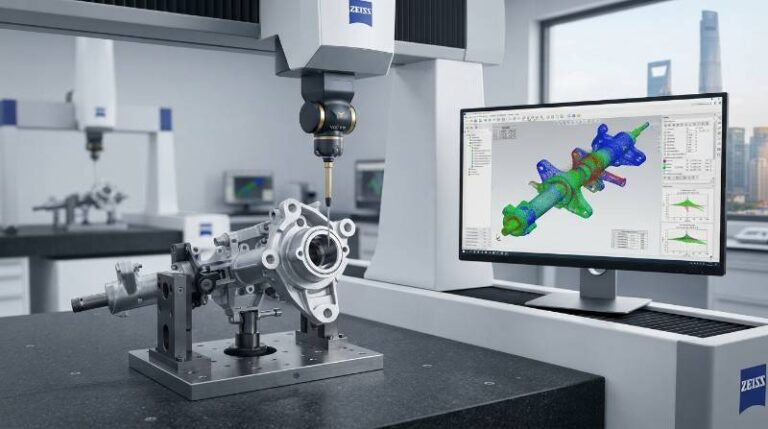
Our facility maintains Technical Methodology Documentation for every project, ensuring that the electrolyte bath chemistry and pulse-current parameters are archived for full aerospace traceability.
Technical References and Standards
- ISO 16220: Magnesium and magnesium alloys — Magnesium alloy ingots and castings.
- ASTM B89: Standard Specification for Magnesium-Alloy Die Forgings.
- Surface Engineering Journal (2026): Advances in Electrolytic Plasma Oxidation for Lightweight Alloys.
- MIL-DTL-32659: General Specification for Micro-Arc Oxidation Coatings on Aluminum and Magnesium.
Ready to Lightweight Your Next Project?
Get a comprehensive quote for integrated Magnesium CNC Machining and MAO Coating from the industry experts.