Automotive Lightweighting Molds for 2026 EV Platforms
The Evolution of Automotive Lightweighting Molds in 2026
In 2026, the global push for extended electric vehicle (EV) range has shifted the focus from battery chemistry alone to the structural efficiency of the chassis. For EV platform engineers and Tier 1 suppliers, the primary bottleneck isn’t just design—it’s the tooling. Automotive lightweighting molds have become the cornerstone of high-volume production, enabling the transition from heavy steel assemblies to integrated, multi-material components.
Advanced Manufacturing: MuCell Injection Molds and Beyond
Automotive lightweighting molds are high-precision tooling systems designed to process advanced materials like thermoplastic resins and magnesium alloys to reduce overall vehicle mass. These molds utilize technologies such as microcellular foaming (MuCell) and high-pressure die casting to create structural components that maintain high structural integrity while using significantly less raw material.
MuCell injection molds represent a massive leap in cycle time optimization. By injecting supercritical nitrogen or carbon dioxide into the melt, we create a microcellular foam structure within the part. This reduces material usage by 15-20% without compromising the mechanical properties required for interior trim or under-the-hood components.
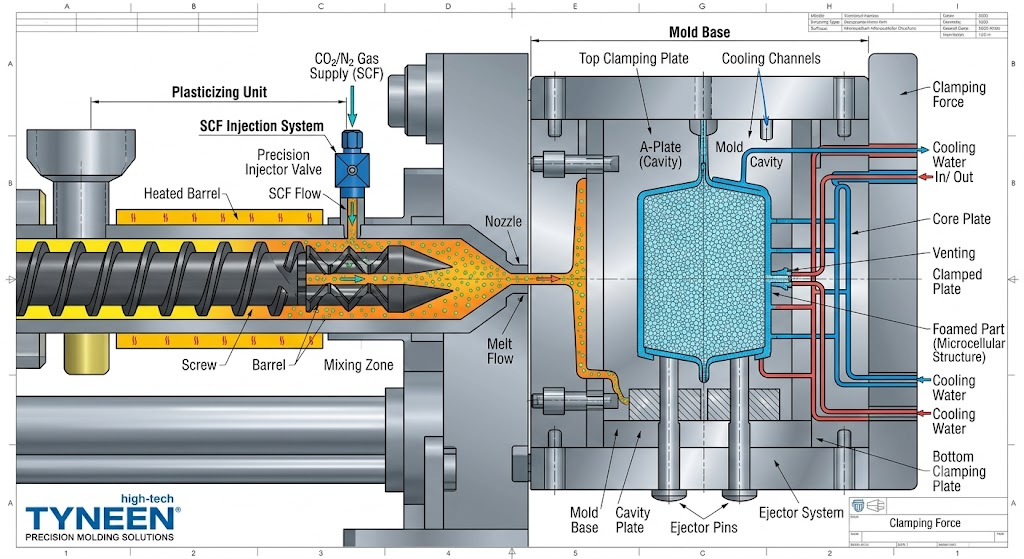
Beyond foaming, compression molding for Carbon Fiber Reinforced Polymer (CFRP) panels is seeing rapid adoption for 2026 luxury EV platforms. These molds must withstand extreme pressures while ensuring perfect surface finishes for “Class A” exterior parts. At Tyneen, we integrate specialized sensors to monitor mold flow analysis in real-time, preventing fiber wash and ensuring uniform strength.
Tooling for Next-Gen EV Battery Enclosures
The shift toward solid-state battery housing requires a fundamental rethink of mold durability. Unlike current lithium-ion frames, 2026 solid-state architectures demand tighter tolerances and superior thermal management properties. EV battery component molding now involves integrating cooling circuits directly into the structural housing.
“The move to solid-state batteries has increased our mold precision requirements by 30%. We are no longer just making a box; we are making a thermally active structural skeleton that must survive 100,000+ high-pressure cycles.”
— Marcus Thorne, Lead Tooling Engineer
For large-scale components, the industry is moving toward Giga Press technology. However, the molds for these massive aluminum castings require specialized high-pressure die casting techniques to manage the heat of magnesium alloys and aerospace-grade materials. Utilizing our EV Battery Housing Solutions, manufacturers can bridge the gap between prototype and high-volume production with greater speed.
The Omni-Light 4D Tooling Protocol
To address the complexities of multi-material integration, we have developed The Omni-Light 4D Tooling Protocol. This proprietary methodology focuses on four dimensions of mold performance: Material Synergy, Thermal Velocity, Structural Longevity, and Adaptive Precision.
- Material Synergy: Designing molds that can handle the disparate thermal expansion rates of UHSS tooling and magnesium inserts.
- Thermal Velocity: Implementing AI-optimized cooling paths that follow the part geometry precisely.
- Structural Longevity: Using advanced coatings to extend the life of molds when processing abrasive glass-filled polymers.
- Adaptive Precision: Real-time mold adjustment based on sensor feedback during the injection phase.
This protocol ensures that even a large automotive mold maker can maintain the precision of a small-scale tool while producing parts as large as a full vehicle floor pan. Our commitment to Custom Mold Design Services ensures every tool is optimized for its specific polymer-metal hybrid application.
Generative Design and 3D-Printed Hybrid Inserts
Generative design is revolutionizing how we approach conformal cooling channels. Instead of traditional straight-drilled lines, we use AI to “grow” cooling networks that wrap around the part’s most complex features. This results in uniform cooling, which is critical for preventing warpage in large EV structural components.
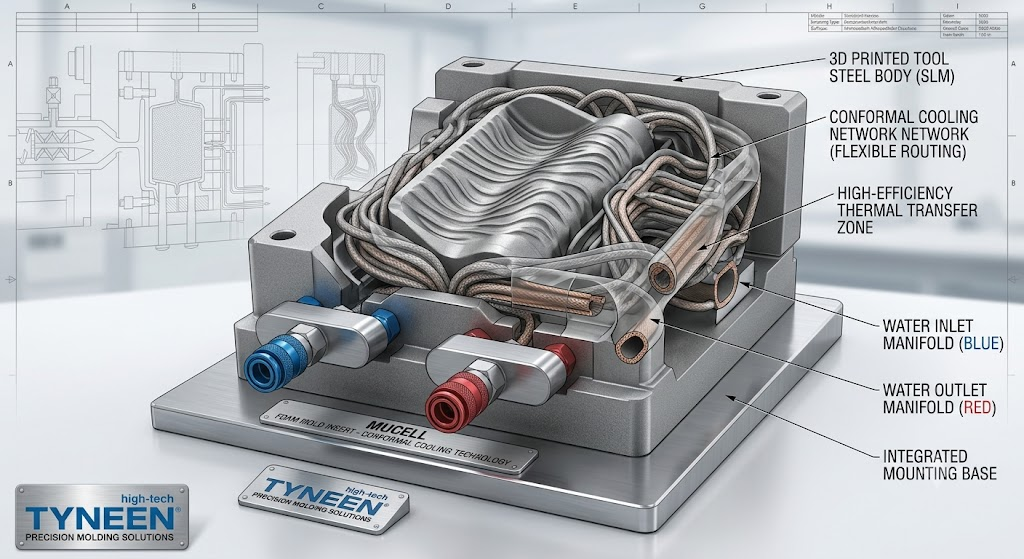
The transition to hybrid 3D-printed mold inserts allows for rapid prototyping of 2026 EV platforms. By 3D printing the core of the mold with tool steel and finish-machining the cavity, we reduce lead times from months to weeks. This speed is essential for OEMs trying to beat competitors to market with new integrated motor housings.
Material Compatibility Matrix for 2026 Platforms
Choosing the right mold material is as important as the part material itself. The following table compares common 2026 lightweighting materials and their impact on tooling requirements.
| Material Type | Mold Durability | Thermal Conductivity | Typical Throughput |
|---|---|---|---|
| Bio-based Composites | High (Low Abrasion) | Medium | High |
| CFRP (Compression) | Medium (High Pressure) | Low | Medium |
| Magnesium Alloys | Very High (Heat Resist) | Very High | Ultra-High |
Global Regulatory Compliance and Reshoring Strategies
Navigating US/EU regulatory hubs requires detailed carbon footprint data for every tool produced. Modern OEMs are increasingly looking for a large automotive mold maker that can provide verified sustainability metrics. Reshoring mold production is no longer just about lead times; it’s about meeting Sustainable Manufacturing Practices.
By localizing production, Tier 1 suppliers can significantly reduce transportation emissions. Furthermore, reshoring ensures that intellectual property regarding sensitive 2026 EV architectures remains secure. We recommend reviewing the latest SAE International standards for lightweighting safety to ensure your tooling meets global crash-test requirements.
Our focus on Sustainable Manufacturing Practices helps our partners achieve Net Zero targets while maintaining the aggressive production schedules required by the modern market.
Frequently Asked Questions
What is the typical ROI for lightweighting molds?
While initial tooling costs may be 20% higher due to conformal cooling and advanced materials, the ROI is usually realized within 18 months through reduced cycle times and lower material waste. For a Tier 1 supplier, this can equate to millions in annual savings across a single EV platform.
How does mold maintenance change for MuCell systems?
Mold maintenance for MuCell requires specialized attention to gas injection valves and seal integrity. Regular ultrasonic cleaning of the vents is necessary to prevent gas traps, which can cause surface defects in lightweight parts.
Can current molds be retrofitted for 2026 EV platforms?
Most 2024-era molds require significant modification to meet 2026 structural integrity standards. However, hybrid 3D-printed inserts can often be used to upgrade existing mold bases, providing a cost-effective path to modernization.
Ready to Optimize Your 2026 EV Tooling?
Partner with the experts in automotive lightweighting molds to reduce cycle times and increase part performance.