ISO 13485 Precision Turning for Medical Device Components
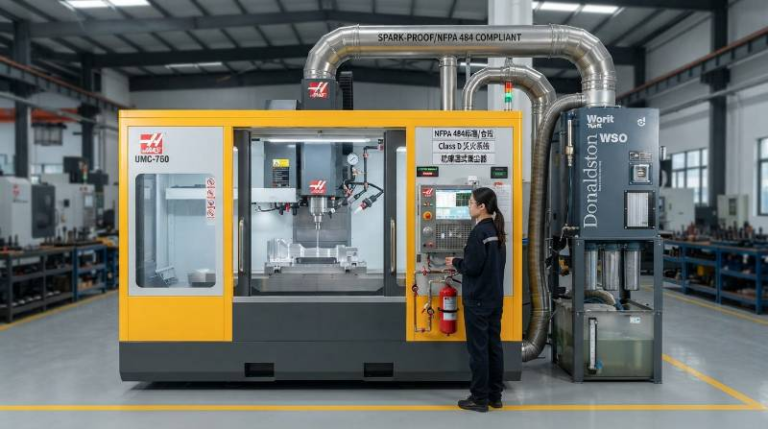
Standard commercial CNC machining fails to satisfy the stringent requirements of medical contract manufacturing. ISO 13485 precision turning bridges the gap between digital CAD design and risk-mitigated surgical hardware through validated machining kinematics, specialized cutting geometry, and comprehensive process controls.
Evaluating Medical Precision Turning: The 4-Pillar Quality & Risk Framework
Procuring micro-machined components for medical assemblies requires a risk-based evaluation framework. Engineering teams evaluate contract manufacturers across four technical and compliance pillars to ensure zero functional failures in vivo or in clinical environments.
1. Regulatory QMS & Complete Lot Traceability
The manufacturing facility must maintain audited certification under ISO 13485:2016. This mandates complete downward and upward traceability from raw bar stock melt heats to finished sterile packaging.
2. Micro-Dimensional Precision & Geometric Form Control
Standard diametral tolerance is insufficient on its own. True position (≤ 0.005 mm), roundness, cylindricity (≤ 0.001 mm), and concentricity must be maintained without introducing mechanical clamping stress on ultra-thin walls (≤ 0.1 mm).
3. Biocompatible Material Integrity & Contamination Control
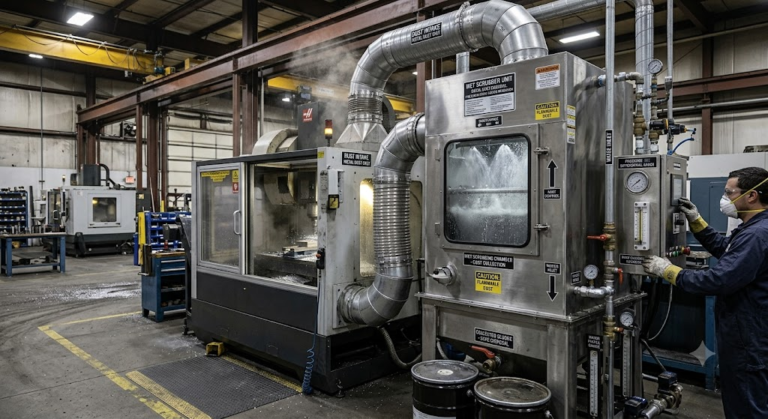
Dedicated tooling paths, synthetic bio-neutral lubricants, and isolated chip extraction systems prevent cross-contamination between ferrous alloys, implantable polymers, and superalloys during ISO 13485 CNC turning services.
4. Post-Processing Passivation & Metrology Validation
Chemical passivation per ASTM standards, micro-deburring verified under 50× magnification, and multi-sensor coordinate metrology ensure every component satisfies bio-inertness and fatigue criteria.
Kinematics & Machining Physics: Engineering Formulas for Precision Turning
Medical turning processes rely on predictable kinematic models to achieve micro-inch surface finishes and eliminate sub-surface work hardening in refractory and reactive metals.
Vc: Cutting Speed (m/min), D: Workpiece/Feature Diameter (mm), n: Spindle Speed (RPM)
When turning micro-diameters (such as ⌀0.5 mm wire guides or trocar tips), achieving an optimal cutting speed (Vc) of 45–60 m/min in titanium requires spindle speeds exceeding 25,000 RPM. Sliding-headstock Swiss turning utilizes high-frequency motorized live spindles to maintain required surface velocities without inducing chatter.
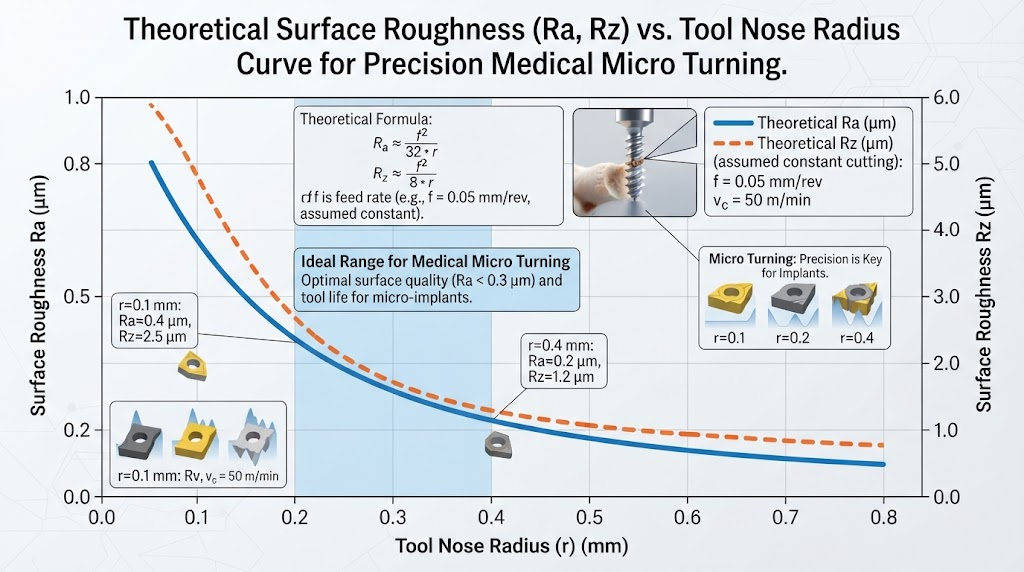
Rth: Theoretical Peak-to-Valley Roughness (mm), f: Feed per Revolution (mm/rev), rε: Tool Corner Radius (mm)
To compute the theoretical arithmetic average surface roughness (Ra) for a clean single-point turning pass:
Ra: Arithmetic Average Roughness (mm), f: Feed Rate (mm/rev), rε: Tool Nose Radius (mm)
Achieving a mirror-like finish of Ra 0.2 μm on implant-grade titanium requires a controlled feed rate of 0.02–0.04 mm/rev paired with an ultra-sharp, polished PCD or fine-grained carbide insert radius (rε = 0.1 mm–0.2 mm).
Swiss Micro-Turning vs. 5-Axis Mill-Turn Centers: Technical Crossover Criteria
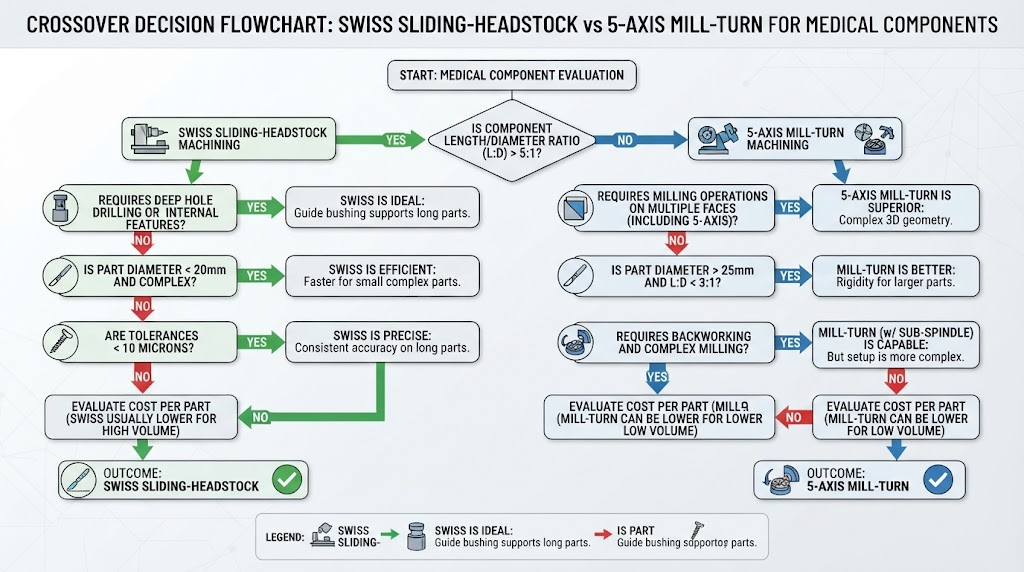
Selecting between a sliding-headstock Swiss-type lathe and a multi-axis mill-turn center depends on the component’s aspect ratio, geometric complexity, and structural stiffness.
In Swiss turning, the raw bar feeds through a guide bushing while the cutting tool acts directly adjacent to the support point (typically within 1.0 mm to 2.5 mm). This eliminates workpiece deflection caused by radial cutting forces, enabling the machining of high aspect ratio features (L/D > 3:1) down to ±0.002 mm tolerances.
Standard fixed-headstock mill-turn centers lack this continuous axial support, limiting slender shaft machining due to radial deflection:
δ: Deflection (mm), F_r: Radial Cutting Force (N), L: Overhang Length (mm), E: Young’s Modulus (GPa), I: Area Moment of Inertia (mm⁴)
Because deflection scales with the cube of length (L³), any component with an aspect ratio exceeding 3:1 rapidly experiences dimensional taper and chatter on fixed-headstock machines unless secondary steady rests are deployed. For prismatic medical components with lower aspect ratios, Tyneen leverages advanced precision machining capabilities to execute complex 5-axis operations in a single clamping cycle.
| Kinematic Parameter | Sliding-Headstock Swiss Turning | 5-Axis Multi-Tasking Mill-Turn |
|---|---|---|
| Length-to-Diameter (L/D) Ratio | L/D > 3:1 up to 30:1 (Deflection Free) | L/D ≤ 3:1 (Without Tailstock/Steady Rest) |
| Diameter Working Range | ⌀0.2 mm to ⌀38.0 mm | ⌀10.0 mm to ⌀350.0 mm+ |
| Bone Screw Threading Method | High-Speed Thread Whirling (Single Pass) | Multi-Pass Single-Point Turning / Thread Milling |
| Micro-Hole Drilling Capability | Down to ⌀0.05 mm (High RPM Live Tooling) | Down to ⌀0.5 mm |
| True Position & Concentricity | ±0.003 mm to ±0.005 mm | ±0.005 mm to ±0.010 mm |
Biocompatible Material Machining Dynamics: Superalloys & Implant Polymers
Medical components interface directly with human tissue, bloodstream environments, or bone structures. Machining these specialized materials requires specific cutting speeds, custom chipbreakers, and oil-free coolant regimes.
Tyneen maintains dedicated stock lines of certified biocompatible medical materials, ensuring material test reports (MTR) accompany every batch.
Ti-6Al-4V ELI (Grade 23, ASTM F136)
Extra Low Interstitial titanium offers high fracture toughness and biocompatibility per ASTM F136 standards. Its low thermal conductivity (6.7 W/m·K) concentrates cutting heat at the tool-chip interface. This requires high-pressure through-tool coolant (≥ 100 bar) to prevent thermal degradation and chemical dissolution of the tool edge.
Medical Stainless Steels (316LVM ASTM F138 & Custom 465)
Vacuum Arc Remelted (LVM) stainless steel exhibits high ductility and a strong work-hardening tendency. Positive rake tooling and sharp hone profiles prevent work hardening of the shear plane during multi-pass profile turning.
Superalloys: Nitinol & MP35N
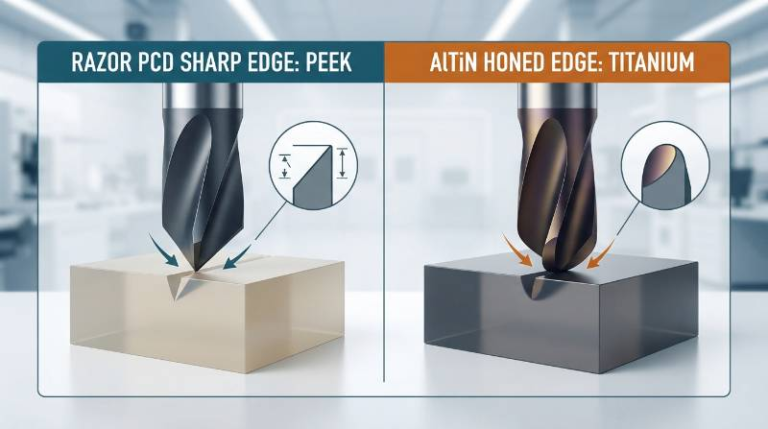
Nickel-Titanium (Nitinol) shape memory alloys and Cobalt-Nickel-Chromium MP35N alloys exhibit extreme abrasive tool wear and pseudoelasticity. Turning requires micro-grain carbide tooling with high-adhesion PVD AlTiN coatings, rigid tool clamping, and low surface speeds (15–30 m/min).
Implantable Polymers (PEEK-OPTIMA ASTM F2026 & UHMWPE)
PEEK exhibits low thermal conductivity and high thermal expansion. High cutting temperatures cause internal stress concentrations, micro-crazing, and dimensional creep. Tyneen utilizes monocrystalline diamond (MCD) or PCD tooling with cryogenic or oil-free compressed air cooling to maintain tight geometric tolerances without polymer contamination.
| Material Grade | Recommended Cutting Speed (Vc) | Feed Rate (f) | Tool Substrate & Coating | Thermal & Coolant Protocol |
|---|---|---|---|---|
| Ti-6Al-4V ELI (ASTM F136) | 45 – 65 m/min | 0.02 – 0.08 mm/rev | Ultra-fine Sub-micron Carbide + TiAlSiN / Uncoated | High-Pressure Direct Coolant (≥ 100 bar) |
| 316LVM (ASTM F138) | 70 – 110 m/min | 0.03 – 0.10 mm/rev | PVD AlCrN Coated Micro-Grain Carbide | Synthetic Bio-Compatible Flood Coolant |
| MP35N / CoCrMo | 20 – 35 m/min | 0.01 – 0.04 mm/rev | Nano-composite PVD Coated Carbide | High-Pressure Micro-Jet Through Tool |
| PEEK-OPTIMA (ASTM F2026) | 120 – 250 m/min | 0.05 – 0.15 mm/rev | Polycrystalline Diamond (PCD) / Polished Carbide | Dry Clean Cold Air Vortex Jet / DI Water Mist |
The Tyneen Med-Turn™ Zero-Defect Validation Protocol: IQ, OQ, PQ & DHR
To eliminate process variation, Tyneen uses a four-stage validation protocol that complies with FDA 21 CFR Part 820 and ISO 13485 quality frameworks.
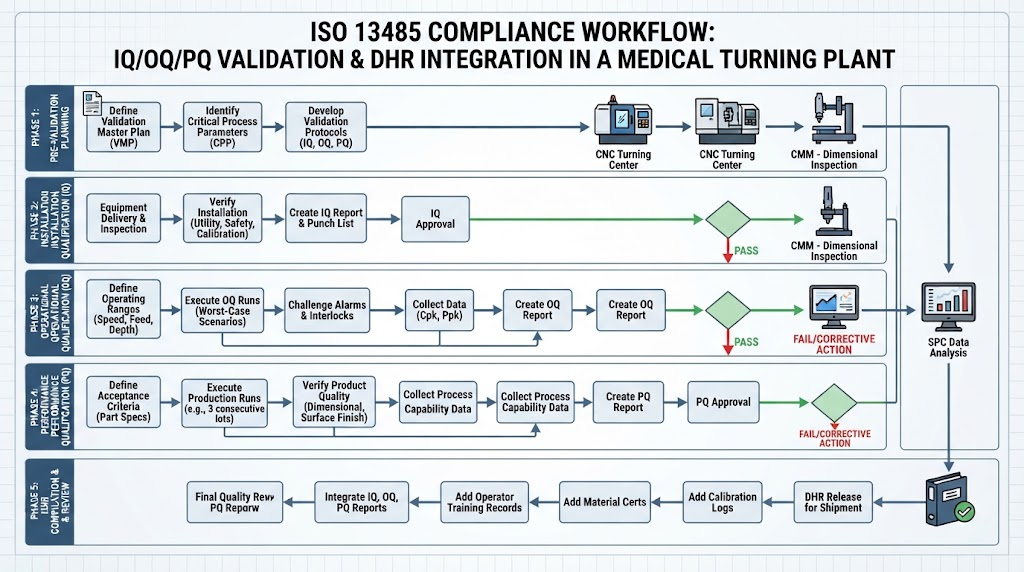
Stage 1: Installation Qualification (IQ)
Verifies machine alignment, spindle runout (≤ 0.001 mm), linear scale repeatability, high-pressure coolant pressure, and dynamic bar feeder vibration dampening.
Stage 2: Operational Qualification (OQ)
Identifies optimal process windows via Design of Experiments (DOE). Speeds, feed rates, tool deflection offsets, and guide bushing clearances are challenged across upper and lower boundary limits.
Stage 3: Performance Qualification (PQ)
Validates serial production stability over multiple machine runs. Critical-to-Quality (CTQ) geometric features must demonstrate a process capability index (Cpk) ≥ 1.67, with measurement systems exhibiting Gauge R&R < 10%.
Stage 4: Device History Record (DHR) Compilation
Every manufactured batch includes an archived DHR package containing raw material MTRs, 100% First Article Inspection Reports (FAIR per AS9102), in-process SPC records, and passivation batch certifications.
Substantiating Quality: Passivation Standards & Micro-Deburring Verification
Microscopic burrs and embedded iron free-particles on turned medical components present critical risks in surgical applications. Proper post-machining chemical processing and micro-deburring are essential steps in the production sequence.
Citric acid passivation per ASTM A967 has largely replaced legacy nitric acid baths for medical components. Citric formulations selectively dissolve free iron from the surface layer without leaching nickel or chromium, producing a deep, corrosion-resistant passive oxide layer (Cr₂O₃/TiO₂).
| Specification | Chemistry / Method | Target Substrates | Biocompatibility & Safety Benefits |
|---|---|---|---|
| ASTM A967 (Citric 1–5) | Citric Acid Formulations (4–10% vol, 20–60°C) | 316LVM, Custom 465, 17-4PH | Zero heavy metal fumes, no hazardous waste, targeted iron extraction. |
| ASTM A967 (Nitric 1–4) | Nitric Acid + Sodium Dichromate (20–55% vol) | Martensitic & Precipitation Hardened Steels | High oxidizing potential; requires thorough neutralization rinse. |
| ASTM F86 | Standard Practice for Surface Prep of Metallic Implants | Titanium Ti-6Al-4V, Cobalt-Chrome, Tantalum | Removes embedded surface contaminants before final packaging. |
Micro-Deburring Verification Protocol
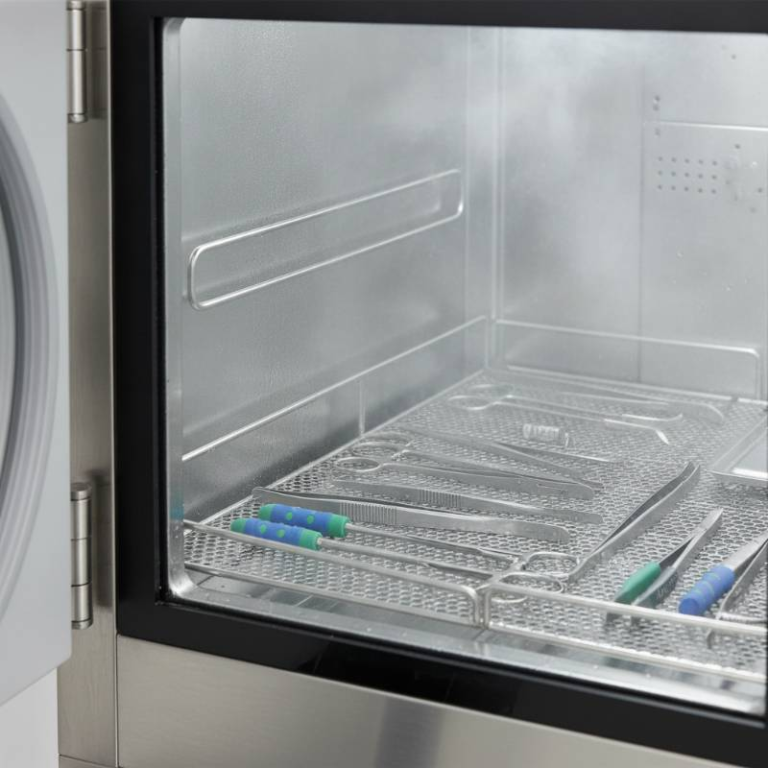
Micro-burrs on cannulated surgical tools and threaded implants are removed using automated micro-abrasive blasting, centrifugal barrel finishing, or high-frequency ultrasonic baths. Verification is performed under 50× optical magnification with zero allowable loose particulates or edge rollover.
Benchmark Engineering Case: Micro-Turning Titanium Endoscopic Housings
A Tier 1 medical device manufacturer partnered with Tyneen to produce a sub-miniature camera housing for next-generation flexible endoscopes. The part required multi-axis turning and milling on medical-grade Ti-6Al-4V ELI bar stock.
The design featured thin outer wall profiles (0.08 mm ± 0.003 mm), multi-luminal internal channels (⌀0.8 mm), and complex lens-seat micro-counterbores requiring a position tolerance of ±0.005 mm relative to datum centerlines.
Tyneen developed a single-setup process using multi-axis Citizen Swiss sliding-headstock machines equipped with high-frequency live spindles and synchronized sub-spindle back-machining. This approach eliminated secondary handling and fixturing error, achieving the tight true-position requirements and combining micro-turning with synchronized multi-axis CNC milling features.
| Critical Feature / Parameter | Design Drawing Spec | Tyneen Production Result | Metrology Method |
|---|---|---|---|
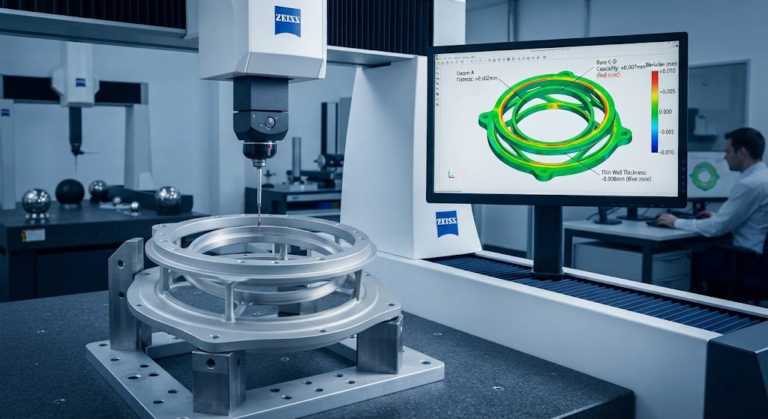
| Outer Wall Thickness | 0.080 mm ± 0.003 mm | 0.081 mm ± 0.001 mm | Zeiss Non-Contact Chromatic White Light Sensor |
| Multi-Lumen True Position | ⌀0.005 mm at MMC | ⌀0.0028 mm max deviation | Zeiss O-INSPECT Multisensor Metrology |
| Optical Sealing Surface Ra | Ra ≤ 0.20 μm | Ra 0.14 – 0.17 μm | Mitutoyo Surftest Laser Stylus Profilometer |
| Micro-Burr Inspection | Zero burr under 30× mag | Zero burr under 50× mag | Keyence VHX-7000 4K Digital Microscope |
| Process Capability (Cpk) | Cpk ≥ 1.33 | Cpk = 1.84 | Statistical Process Control (SPC) 500-pc Run |
Tyneen Certified Quality Infrastructure: ISO 13485, Zeiss CMM & Cleanroom Packaging
Tyneen operates dedicated medical manufacturing facilities governed by dual ISO 9001:2015 and ISO 13485:2016 management systems, alongside aerospace AS9100D and automotive IATF 16949 accreditations.
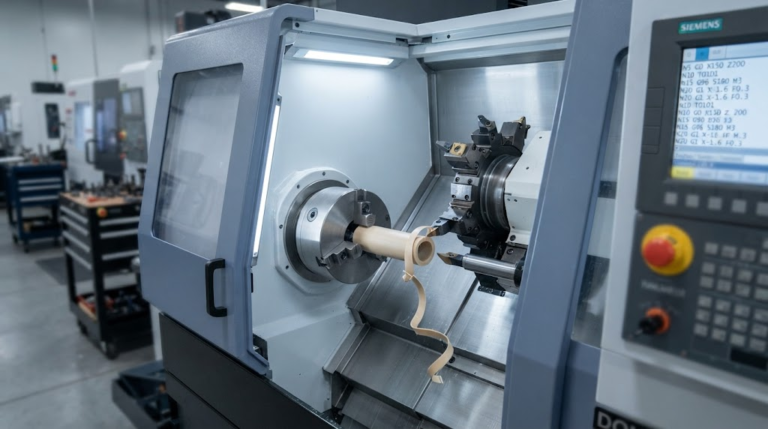
Our production floor features multi-axis Citizen Swiss sliding-headstock lathes and high-precision DMG MORI turn-mill centers. Machines operate in climate-controlled environments (20°C ± 0.5°C) to eliminate thermal drift on micro-turned geometries.
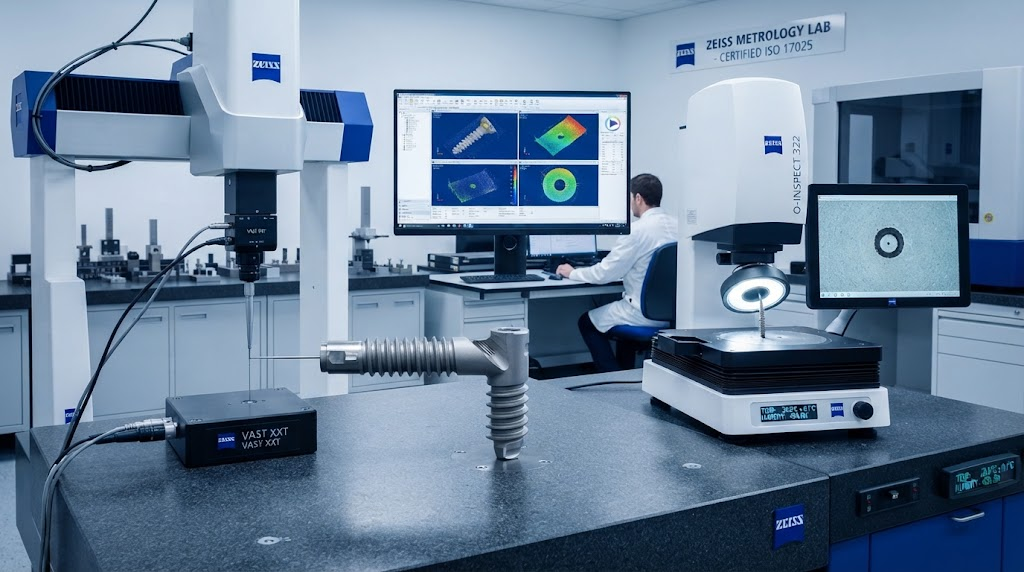
Metrology validation is performed in temperature-controlled clean labs equipped with Zeiss multisensor tactile and optical CMMs, Keyence 4K digital micro-profilers, and air-gauge diameter comparators. Cleaning, passivation verification, and dual-barrier medical pouch packaging take place in an ISO Class 7 cleanroom environment.
3-Step Medical Prototyping-to-Production Pathway with Tyneen
Accelerate your medical device commercialization through Tyneen’s validated production ramp:
Precision Medical Manufacturing with Tyneen
- Step 1: Secure CAD & GD&T Upload
Submit 3D CAD models (STEP, IGES) along with 2D drawings outlining critical tolerances, biocompatibility standards, and material specifications. - Step 2: Automated DFM & Quoting Within 2 Hours
Tyneen’s medical applications engineering team reviews your design for manufacturability, defines optimal tooling pathways, and delivers a competitive quotation within 2 hours. - Step 3: Pilot Turn & Serial Production with Full DHR
Fast-turn pilot lots are machined, passivated, and delivered with a Zeiss CMM inspection dossier, material certifications, and FAIR documentation prior to full volume ramp.
Frequently Asked Questions on ISO 13485 Precision Medical Turning
What are the tightest tolerances achievable on Swiss micro-turned medical parts?
Using temperature-controlled sliding-headstock Swiss lathes with high-precision collet systems, Tyneen regularly achieves outer diameter tolerances of ±0.002 mm (±0.00008 in), true position within 0.005 mm, and surface finishes down to Ra 0.2 μm on micro-scale features.
What quality documentation accompanies an ISO 13485 turned order?
Each delivery includes a complete Device History Record (DHR) packet containing raw material Mill Test Reports (MTR), certificate of biocompatibility compliance, First Article Inspection Reports (FAIR per AS9102), automated CMM dimensional data, and passivation certification.
Why is citric acid passivation preferred over nitric acid for medical device turning?
Citric acid passivation per ASTM A967 selectively removes surface free-iron without depleting chromium or nickel in stainless steels. It generates no toxic nitrogen oxide fumes, leaves no heavy-metal chemical residue, and meets stringent biocompatibility safety guidelines for implantable components.
How does Tyneen prevent cross-contamination when turning medical polymers like PEEK?
We maintain dedicated machines for implantable polymers, utilizing dry clean vortex cooling or USP Class VI water-soluble lubricants. Tooling used for metals is never interchanged with polymer stock to eliminate cross-particle embedding.
What is the typical turnaround time for medical prototyping and IQ/OQ/PQ validation?
Prototypes and DFM feedback are delivered in as fast as 3 to 5 business days. Full IQ/OQ/PQ validation runs and complete DHR dossiers for volume production ramps are typically executed within 2 to 3 weeks, depending on component complexity.