Precision Tungsten Steel Machining | Tyneen
Material Science & Machinability: WC Grain Size, Cobalt Binder, and Thermal Dynamics
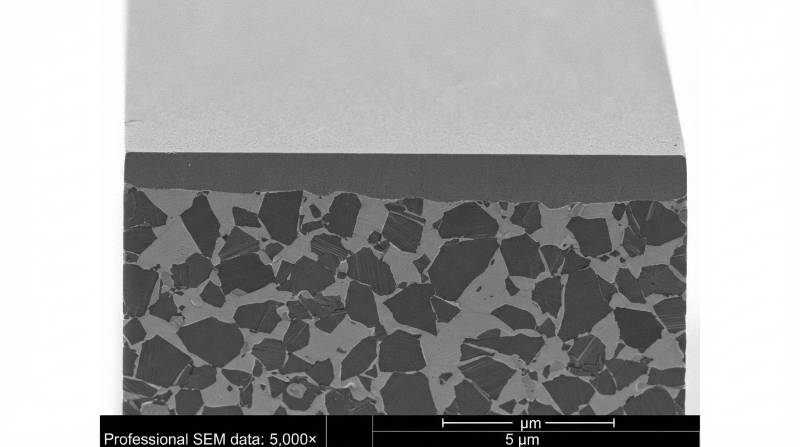
Tungsten steel, metallurgically known as cemented tungsten carbide (WC-Co), is an inorganic metal matrix composite. It consists of hard tungsten monocarbide grains bonded within a ductile metallic cobalt matrix via high-temperature vacuum liquid-phase sintering.
Cemented Tungsten Carbide (WC-Co): A refractory sintered composite engineered with 85% to 97% tungsten carbide particles embedded in a 3% to 15% cobalt or nickel binder, delivering typical hardness ratings from 89 to 93 HRA (approx. 1400 to 2200 HV30) and compressive strengths exceeding 4,000 MPa.
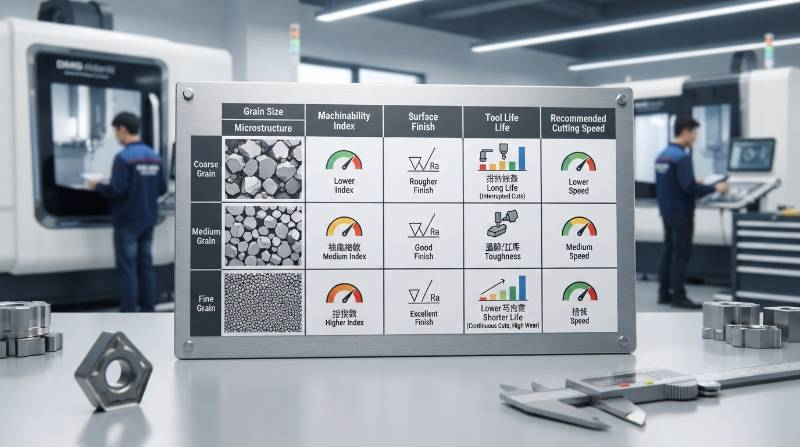
The mechanical behavior and machinability of tungsten carbide depend directly on its cobalt binder percentage and mean grain size (ranging from ultrafine <0.5 µm to coarse >2.5 µm). Lower cobalt levels elevate abrasive wear resistance and hardness, but increase material brittleness, necessitating rigid cutting conditions to prevent catastrophic edge chipping. Consult our engineering materials guide to evaluate compositional selections for your application.
Tungsten carbide exhibits a thermal conductivity of roughly 80 to 110 W/(m·K), which is double that of typical unalloyed tool steels. However, its low thermal expansion coefficient (4.5 to 5.5 × 10⁻⁶/K) creates localized thermal gradients during conventional cutting. In dry or erratic milling conditions, these thermal spikes provoke thermal shock and localized micro-fractures along cutting boundaries.
Global Grade Cross-Reference: Chinese, ISO, and US ASTM Classifications
Engineering cross-referencing across international markets requires precise mapping of chemical compositions, density thresholds, and transverse rupture strengths (TRS). Specifications should align with international standardization bodies such as ISO 513:2012 and standard metallurgical classifications.
| Chinese Grade (GB) | ISO Category | US Industry / ASTM Code | Nominal Binder (% Co) | Hardness (HRA) | Typical Applications |
|---|---|---|---|---|---|
| YG6 | ISO K10–K20 | C-2 / ASTM B777 Class 1 | 6.0% | 90.5 | Wear parts, wire drawing dies, roughing tools |
| YG8 | ISO K30 | C-1 / C-2 | 8.0% | 89.5 | Impact stamping dies, progressive punches, drill inserts |
| YG10X | ISO K30–K40 Micrograin | C-11 (Micrograin) | 10.0% | 91.5 | Precision micro-punches, extrusion mandrels, high-toughness wear rings |
| YL50 | ISO K05 Ultrafine | C-3 / Sub-micron | 9.0% | 92.5 | High-speed solid carbide micro-endmills, rotary cutters |
The Engineering Evaluation Matrix: Deciding Between PCD Milling, Wire EDM, and Diamond Grinding
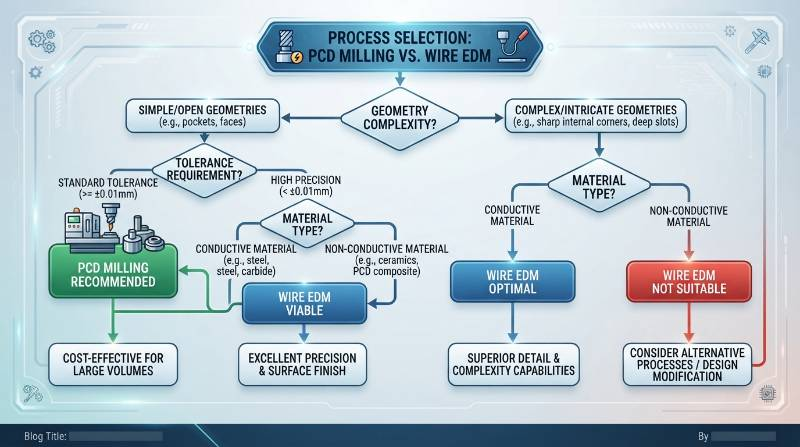
Machining sintered tungsten carbide at 90+ HRA makes standard high-speed steel and conventional carbide tooling ineffective. Production engineers select processes using a balance of part geometry, surface roughness criteria, aspect ratios, and recast layer tolerances.
Tyneen evaluates three primary subtractive methods across key technical dimensions within our advanced machining services workflow:
| Machining Technology | Achievable Tolerance | Surface Roughness (Ra) | Primary Geometric Strengths | Thermal Impact / HAZ |
|---|---|---|---|---|
| PCD Micro-Milling | ±0.003 mm | Ra 0.15–0.30 µm | 3D complex freeform surfaces, blind cavities, chamfers | None (purely mechanical shear) |
| Oil-Bath Slow Wire EDM | ±0.0015 mm | Ra 0.10–0.20 µm | Through-slots, micro-gear teeth, sharp internal radii (<0.05mm) | Controlled recast layer (<2.0 µm) |
| Optical Profile Diamond Grinding | ±0.001 mm | Ra 0.05–0.10 µm | Rotary shafts, precision OD/ID steps, flat seal faces | Negligible (flood oil coolant) |
Advanced Machining Methodologies for High-Hardness Tungsten Carbide
Machining fully sintered tungsten carbide requires specialized cutting kinematics, diamond superabrasives, and rigid machine platforms to minimize chatter and surface defects.
PCD and CBN Micro-Milling Parameters & Tool Path Optimization
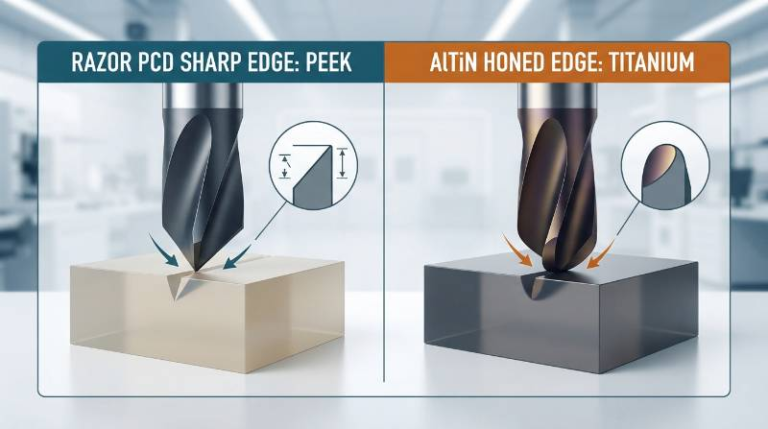
Direct CNC hard milling of tungsten steel relies on Polycrystalline Diamond (PCD) or Cubic Boron Nitride (CBN) tooling. Tyneen utilizes 5-axis high-speed milling spindles (30,000 to 42,000 RPM) featuring HSK-E toolholders with total system runout verified below 1.5 µm.
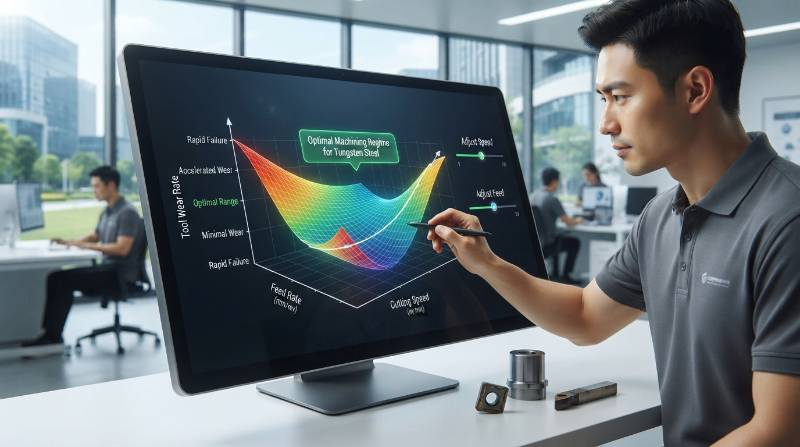
- Cutting Speed ($V_c$): Maintain between 15 and 40 m/min. Speeds above 50 m/min accelerate cobalt binder vaporization and diamond graphitization.
- Feed per Tooth ($f_z$): Target 0.002 to 0.008 mm/tooth. The feed must exceed the hone radius of the PCD edge to avoid burnishing against the hard carbide grains.
- Axial Depth ($a_p$) & Radial Width ($a_e$): Keep $a_p$ within 0.02 to 0.10 mm and $a_e$ below 5% to 10% of tool diameter to lower cutting forces.
- Milling Strategy: Use climb (down) milling exclusively. Climb milling produces maximum chip thickness at entry and tapers to zero at exit, reducing tensile stresses and micro-chipping on the workpiece edge.
Review our precision CNC milling capabilities for complex 3D hard-metal prototyping and production tooling.
Precision Wire EDM & Oil-Bath EDM: Eliminating Micro-Cracking and Recast Layers
Electrical Discharge Machining (EDM) is effective for non-standard geometric profiles in tungsten carbide. However, excessive thermal discharge can create a brittle white recast layer (consisting of re-solidified tungsten carbide and depleted cobalt), which is prone to spontaneous micro-cracking.
Tyneen employs Japanese oil-dielectric slow-feeding wire EDM machines (utilizing 0.05mm to 0.20mm zinc-coated brass or tungsten wire). Dielectric hydrocarbon oil limits cobalt leaching, which commonly occurs in water-based EDM units.
- Roughing Pass: Uses higher peak amperage with high-frequency pulse-on times ($T_{on} < 0.2\text{ µs}$) to remove bulk material while keeping the heat-affected zone (HAZ) under 5 µm.
- Multi-Skim Finishing Passes (5 to 7 trims): Successively reduces pulse energy to nano-joule spark regimes. This trims away prior recast layers, leaving a final surface integrity with a recast thickness of <0.5 µm.
CNC Optical Diamond Profile Grinding & Lapping to Ra 0.1µm
For cylindrical wear sleeves, punches, and precision shafts, CNC diamond grinding provides high geometric stability and dimensional accuracy. Vitrified and resinoid bond diamond grinding wheels (grit sizes ranging from D46 down to D7) run in high-pressure oil-coolant environments to clear wheel loading and maintain cool contact zones.
Post-grinding operations employ diamond abrasive paste lapping (polycrystalline diamond slurry with 0.5 to 3.0 µm grit size) on cast-iron or composite plates. This lapping removes mechanical grinding marks, providing mirror finishes with surface roughness down to Ra 0.05–0.1 µm while maintaining flatness within 0.0005 mm.
The Tyneen Micro-Integrity Protocol: 4-Stage Subsurface Defect Elimination
Machined carbide under cyclic hydraulic, structural, or impact loads can suffer early fatigue failure if subsurface micro-cracks remain. Tyneen applies a systematic 4-stage quality protocol on all critical hard-metal parts to ensure long-term structural integrity.
- Stage 1: Pre-Machining Thermal Stabilization: Sintered blanks undergo cryogenic cycling and controlled thermal stabilization to equalize residual internal stresses before cutting.
- Stage 2: Multi-Pass Energy-Stepped EDM: High-precision wire EDM executes progressively stepped energy regimes, eliminating thermal tension in the workpiece.
- Stage 3: Chemical & Diamond Micro-Abrasive Removal: Parts undergo light chemical etching or fine diamond abrasive polishing to strip away residual recast skins and surface oxidation layers.
- Stage 4: Ultrasonic Non-Destructive Testing (NDT) & Micro-Profilometry: Components are verified via high-frequency ultrasonic flaw detection to ensure zero internal voids, followed by optical contact profilometry to confirm target Ra/Rz finishes.
Extreme Niche Benchmark: Sub-Micron Machining of Micro-Extrusion Dies (90% WC / 10% Co)
A multinational medical and precision fluidics customer required a multi-cavity micro-extrusion die set manufactured from 90% WC / 10% Co ultrafine tungsten carbide (YG10X equivalent). The component features micro-orifice channels with strict operational requirements:
- Concentricity / True Position: ±0.002 mm relative to outer datum.
- Bore Diameter Tolerance: +0.002 / -0.000 mm on a Ø0.850 mm extrusion bore.
- Surface Roughness: Ra 0.1 µm inside extrusion throats to eliminate polymer shear melt and material drag.
Tyneen developed an integrated hybrid manufacturing workflow. We performed rough boring using multi-axis oil-bath wire EDM with 0.07mm wire, followed by 5-axis PCD micro-milling at 38,000 RPM to define precise lead-in chamfers. Internal diameters were brought to final dimensional tolerances using custom diamond micro-lapping pins oscillating at 45 kHz.
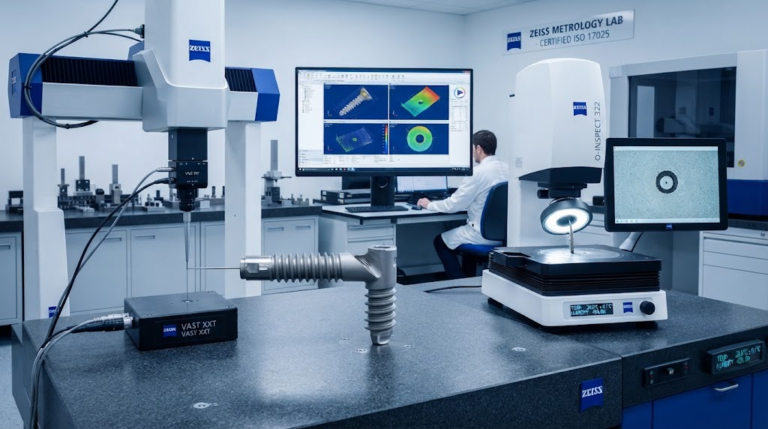
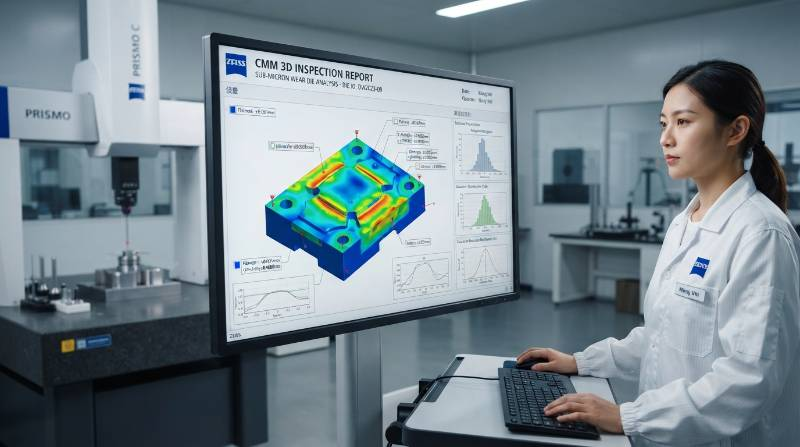
Final inspection on our Zeiss CMM and White Light Interferometer confirmed ±0.0014 mm concentricity and an average interior bore roughness of Ra 0.082 µm. The customer reported zero micro-fracture failures over 2.5 million extrusion cycles.
Deep Comparison & Verification: Tool Steel vs. Tungsten Carbide and Recast Layer Inspection
When selecting tooling and wear materials, design engineers frequently evaluate hardened tool steels against cemented carbides. Review the operational characteristics below:
| Property / Metric | Tungsten Carbide (YG10X) | AISI D2 Tool Steel (60 HRC) | CPM-10V Powder Tool Steel |
|---|---|---|---|
| Hardness Range | 89.0–92.5 HRA (74–80 HRC Equiv.) | 58–62 HRC | 62–64 HRC |
| Compressive Yield Strength | >4,200 MPa | 2,150 MPa | 2,750 MPa |
| Elastic Modulus (Young’s) | 550–650 GPa | 210 GPa | 225 GPa |
| Relative Abrasive Wear Life | 15× – 25× Baseline | 1.0× (Baseline) | 4.5× Baseline |
Post-Machining Authenticity & Recast Verification Checklist
To ensure parts meet drawing specifications without hidden structural defects, verify each item against this quality checklist:
- Metallographic Cross-Sectioning: Sample testing under 1000× magnification to verify that the recast layer (white layer) measures <1.5 µm across EDM-cut edges.
- Eddy Current Testing: Non-destructive electromagnetic testing to detect subsurface cobalt depletion or micro-cracks before dispatch.
- Optical Profilometry: Multi-point measurement verifying Ra, Rz, and Rmax across ground and lapped functional sealing surfaces.
- Material Test Report (MTR) Traceability: Complete compositional and density validation matching certified mill specifications according to ASTM standards.
Precision Manufacturing Standards: Tyneen Quality Assurance, Tooling Rigidity, and Metrology
Machining hard metals requires strict structural rigidity and environmental stability. Tyneen operates climate-controlled machining centers maintained at 20°C ± 0.5°C to eliminate thermal drift during high-precision cycles.
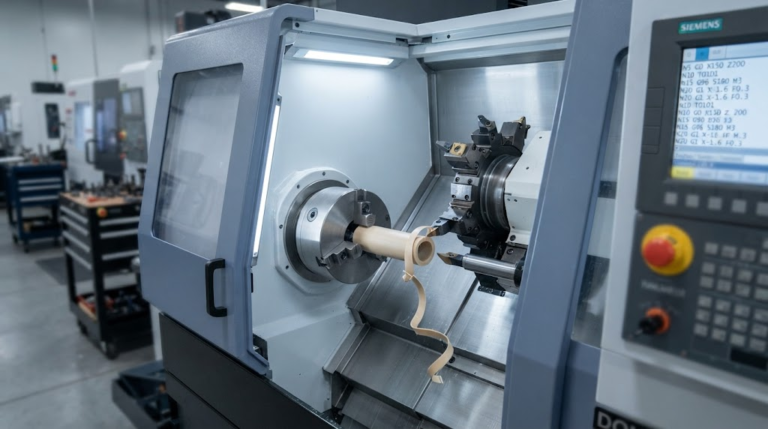
Our production floor includes 5-axis DMG MORI machining centers, Sodick and Makino oil-bath wire EDMs, and Okamoto CNC surface profile grinders. For complex rotational parts, our custom CNC turning centers use diamond tooling for accurate ID and OD hard-turning on cylindrical carbide shafts and bushes.
Our quality management systems are certified to ISO 9001:2015, IATF 16949, and AS9100D. Metrology inspection is anchored by high-accuracy Zeiss 3D Coordinate Measuring Machines (CMM) achieving probing repeatability down to 0.5 µm, ensuring complete conformity to GD&T schematics.
Design for Manufacturability (DFM) Guidelines for Hard-Metal Components
Following key Design for Manufacturability (DFM) principles helps reduce fabrication costs, minimize tooling wear, and shorten delivery lead times:
- Avoid Direct Tapped Threads: Tungsten carbide is too hard for direct tapping. Design assemblies with wire-EDM thread profiles, through-holes with counterbores, or integrate brazed/interference-fit stainless steel threaded bushings.
- Maintain Minimum Internal Radii: Specify internal corner radii of at least $R \ge 0.2\text{ mm}$ ($R \ge 0.5\text{ mm}$ preferred) to allow rigid micro-endmills or standard EDM wire diameters without localized stress risers.
- Wall Thickness Limitations: Keep unsupported wall thicknesses $\ge 1.0\text{ mm}$. Thin walls can crack during high-pressure coolant impingement or spark discharge operations.
- Blind Hole Venting: Add pressure release vents to blind cavities and pin guides to prevent hydraulic pressure build-up and vacuum lock during operation.
Frequently Asked Questions About Tungsten Steel Machining
Why is water-based wire EDM problematic for tungsten carbide?
Deionized water promotes electrochemical corrosion and cobalt leaching along the grain boundaries. This leaching weakens the carbide matrix and leaves microscopic pits. Using hydrocarbon oil-based EDM fluids eliminates cobalt wash-out and maintains surface integrity.
Can standard carbide endmills machine tungsten steel?
No. Standard carbide endmills lack the required hardness differential to cut sintered tungsten carbide. Machining hard-metal requires Polycrystalline Diamond (PCD), binderless PCD, or vitrified diamond grinding tools.
What tolerances can Tyneen reliably achieve on tungsten carbide?
With optical profile grinding and multi-skim wire EDM, Tyneen reliably delivers dimensional tolerances of ±0.0015 mm (±1.5 µm), concentricities within ±0.002 mm, and surface finishes down to Ra 0.05–0.1 µm.
How do you protect tungsten carbide from thermal shock during CNC milling?
We use high-pressure oil mist lubricators with anti-shock thermal tool paths. Constant engagement angles and climb-milling avoid sudden entry shock, preventing thermal and mechanical tool failure.
3-Step Action Plan: Rapid DFM Validation to High-Precision Component Delivery
Precision Tungsten Steel Manufacturing Workflow
Move your hard-metal components from drawing to production through Tyneen’s precision manufacturing workflow:
- Step 1: Upload CAD Model & 2D Prints: Submit your 3D STEP/IGES files and 2D engineering drawings with GD&T specifications through our secure portal.
- Step 2: DFM Analysis & Quote in <2 Hours: Our tooling engineers evaluate your geometries, run tool-clearance simulations, and return a comprehensive DFM report with transparent pricing.
- Step 3: Precision Production & CMM Inspection: We manufacture parts using 5-axis PCD milling, oil-wire EDM, and optical grinding, delivering certified parts with complete Zeiss CMM inspection reports.