Aerospace High-Temp Material Selection Guide | Tyneen
Engineering teams developing hardware for aerospace industry manufacturing solutions must consider hot-gas path degradation alongside machinability, raw stock availability, and strict aerospace compliance frameworks.
The Tyneen Aerospace Thermal-Mechanical Material Selection Matrix (TTM-Matrix)
To prevent premature fatigue and thermal distortion, Tyneen evaluates flight-critical stock using a standardized four-pillar evaluation matrix:
“High-temperature aerospace qualification is not defined by ambient tensile strength. It is governed by continuous elevated-temperature creep rupture strength, Coefficient of Thermal Expansion (CTE) predictability, strain-hardening behavior during cutting, and complete AMS chemical verification.”
- Pillar 1: Elevated Yield & Creep Rupture Threshold: Minimum 100-hour stress-rupture life under operational loads at steady-state operating temperatures.
- Pillar 2: CTE & Thermal Conductivity Matching: Prevention of thermal fatigue cracking caused by severe localized thermal gradients between adjacent structural components.
- Pillar 3: Machinability & Strain-Hardening Index: Assessing tool-workpiece interface reactivity, shear strain localization, and post-machining residual stress.
- Pillar 4: Regulatory & Material Traceability: Full compliance with SAE AMS, ASTM International, and MIL-spec standards supported by certified Mill Test Reports (MTR).
Explore our complete inventory of certified high-performance aerospace materials to review verified alloy specs and stock forms.
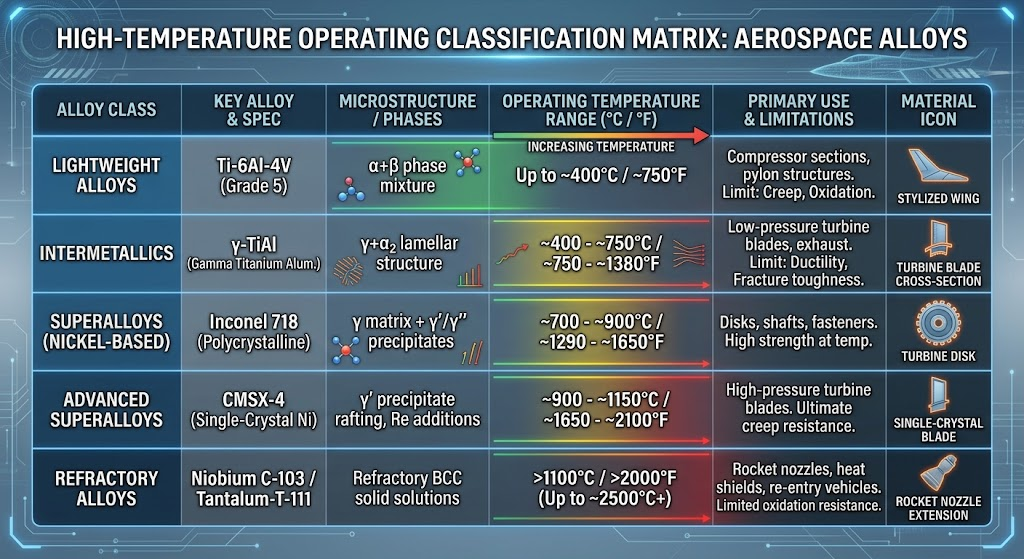
Aerospace Temperature Tiers and Material Classification
Thermal environments within modern aerospace systems dictate alloy chemistry. Materials fall into four primary operating regimes based on continuous thermal exposure:
| Thermal Tier | Operating Range | Primary Alloy Systems | Typical Flight Applications |
|---|---|---|---|
| Tier 1: Moderate Warm | 150°C – 350°C | Al 2219, Ti-6Al-4V (Grade 5) | Compressor forward stages, nacelles, pylons |
| Tier 2: Intermediate | 350°C – 600°C | Ti-6242, 17-4PH, Custom 465 | High-pressure compressor disks, blisks, casing rings |
| Tier 3: Hot Section | 600°C – 1050°C | Inconel 718, Inconel 625, Haynes 282, Waspaloy | Turbine disks, combustor liners, exhaust ducts |
| Tier 4: Ultra-High / Refractory | 1000°C – 2200°C+ | Niobium C-103, Moly TZM, Tungsten, C/SiC CMCs | Rocket nozzles, hypersonic leading edges, RCS thrusters |
Titanium Alloys for Intermediate Temperature Regimes (300°C to 600°C)
Alpha-beta titanium alloys like Ti-6Al-4V (Grade 5, AMS 4928) deliver exceptional strength-to-weight ratios up to 350°C. Above this limit, oxygen pick-up causes surface embrittlement (alpha-case formation) and a rapid drop in creep resistance.
Ti-6242: The High-Temp Compressor Standard
For operations between 350°C and 540°C, near-alpha Ti-6Al-2Sn-4Zr-2Mo (Ti-6242, AMS 4919/4975) is the standard material choice. The silicon addition (0.1 wt%) forms silicide precipitates along grain boundaries, significantly retarding dislocation climb and creep strain.
- Creep Superiority: Ti-6242 provides up to 10× lower creep deformation than Ti-6Al-4V at 450°C under 310 MPa loads.
- Weight Reduction: Replaces heavy nickel-based superalloys in intermediate compressor stages, yielding an approximate 42% component mass reduction.
- Machining Nuance: Poor thermal conductivity (7.2 W/m·K) concentrates cutting heat at the tool edge. This requires high-pressure flood coolant and micro-grain solid carbide cutters to prevent thermal galling.
Nickel and Cobalt-Based Superalloys for Hot Sections (650°C to 1050°C)
When operating environments exceed 600°C, nickel-based superalloys become mandatory due to their face-centered cubic (FCC) gamma-austenitic matrix, which retains yield strength near its melting point.
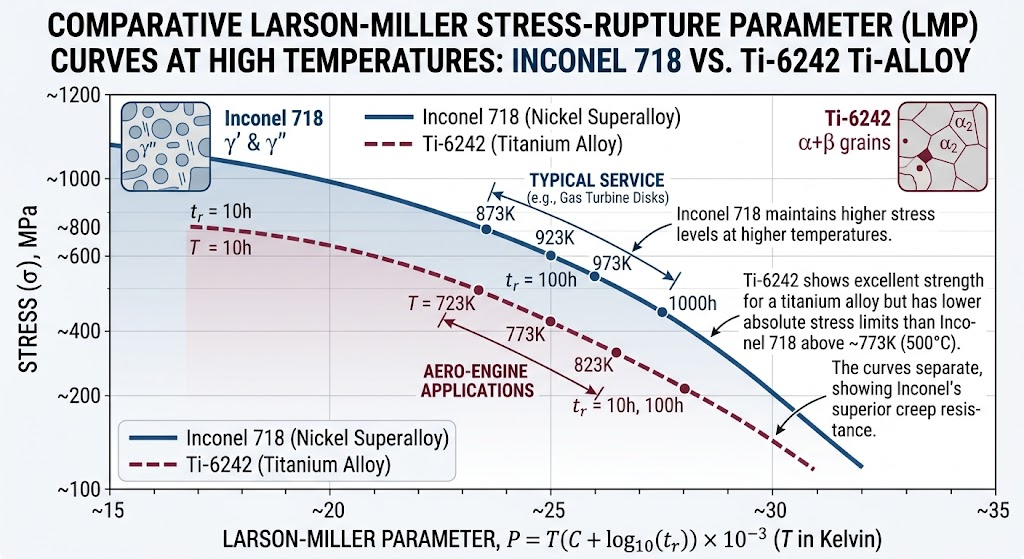
Inconel 718 (UNS N07718 / AMS 5662, AMS 5663)
Inconel 718 is a precipitation-hardened nickel-chromium superalloy strengthened primarily by body-centered tetragonal (BCT) gamma-double-prime [Ni₃Nb] precipitates. It delivers room-temperature yield strengths exceeding 1100 MPa and maintains exceptional tensile performance up to 650°C.
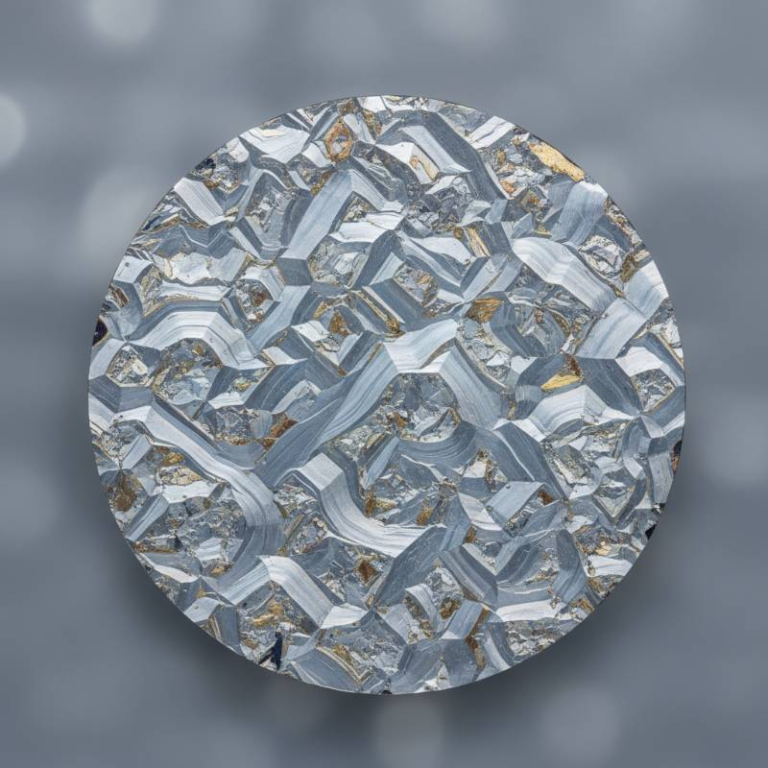
Above 650°C, the metastable gamma-double-prime phase transforms into the equilibrium orthorhombic delta phase, causing rapid softening. Consequently, Inconel 718 is optimized for high-pressure turbine disks, rotating shafts, and structural diffuser cases.
Inconel 625 & Haynes 282
Inconel 625 (AMS 5666): A solid-solution strengthened alloy relying on molybdenum and niobium within a nickel-chromium matrix. While its elevated yield strength is lower than Inconel 718, it offers superior resistance to oxidation, pitting, and thermal fatigue up to 980°C, making it standard for aircraft exhaust systems and fuel nozzles.
Haynes 282: A gamma-prime strengthened superalloy engineered specifically for thermal stability up to 900°C. It exhibits better creep resistance than Waspaloy and avoids the severe strain-age cracking risks associated with René 41 during post-weld heat treatment.
Refractory Metals and Ceramic Matrix Composites (1000°C+ and Ultra-High Temp)
Liquid rocket thrust chambers, hypersonic control surfaces, and atmospheric reentry structures operate beyond the melting points of nickel superalloys (1350°C–1430°C). These demanding regimes require refractory alloys and non-oxide composites.
- Niobium C-103 (Nb-10Hf-1Ti): Excellent ductile-to-brittle transition temperature (below -150°C) and robust strength retention up to 1370°C. Requires disilicide protective coatings (such as R512E) to eliminate high-temperature atmospheric oxidation.
- Molybdenum TZM (Mo-0.5Ti-0.08Zr): High thermal conductivity (126 W/m·K) and low thermal expansion make it ideal for high-flux rocket nozzles and hot gas valves operating up to 1400°C in non-oxidizing atmospheres.
- Silicon Carbide Composites (SiC/SiC CMCs): Density of roughly 2.6–3.0 g/cm³ (one-third that of nickel), allowing hot-section components to operate uncooled at gas temperatures reaching 1200°C–1400°C.
Machining High-Temperature Superalloys: Tool Wear, Feeds, and Thermal Drift Control
Machining nickel- and cobalt-based superalloys presents distinct challenges. Low thermal conductivity, dynamic strain-hardening, and abrasive carbide inclusions (MC/M₂₃C₆) accelerate notch wear and tool failure.
Vc: Cutting Speed (m/min), D: Cutter Diameter (mm), n: Spindle Speed (RPM)
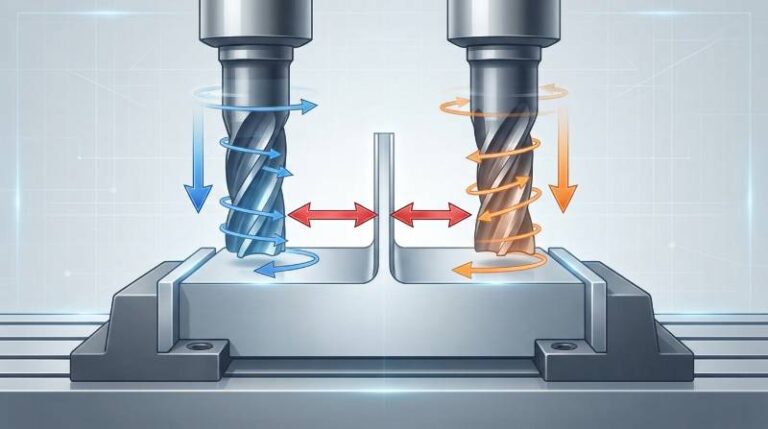
To prevent localized work-hardening during precision CNC milling services, maintain positive rake geometries and keep feed per tooth (fz) above 0.05 mm to cut cleanly beneath the previously hardened layer.
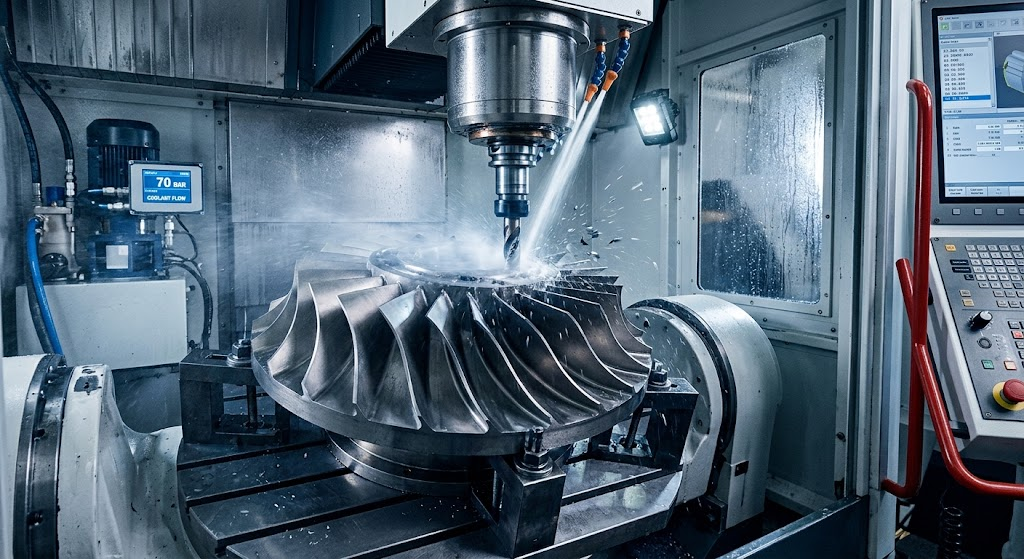
Recommended Cutting Envelopes for Solution-Treated & Aged Inconel 718 (44 HRC)
- Carbide Milling Speed (Vc): 25 – 45 m/min using AlTiN or TiSiN multi-nanolayer PVD coated micrograin carbide.
- Ceramic Whisker (SiCw) Roughing Speed: 180 – 300 m/min under dry or air-blast conditions for rapid bulk material evacuation.
- Coolant Delivery: 70-bar (1000 PSI) through-spindle high-pressure coolant (HPC) directed precisely at the tool-chip interface to break chips and suppress micro-welding.
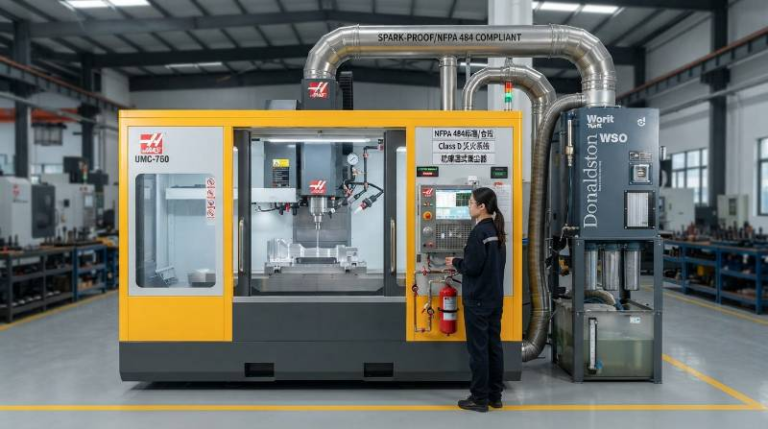
- Thermal Drift Compensation: Climate-controlled enclosures (maintained at 20°C ±0.5°C) paired with real-time spindle thermal compensation to hold ±0.005 mm true position tolerances across long cycle times.
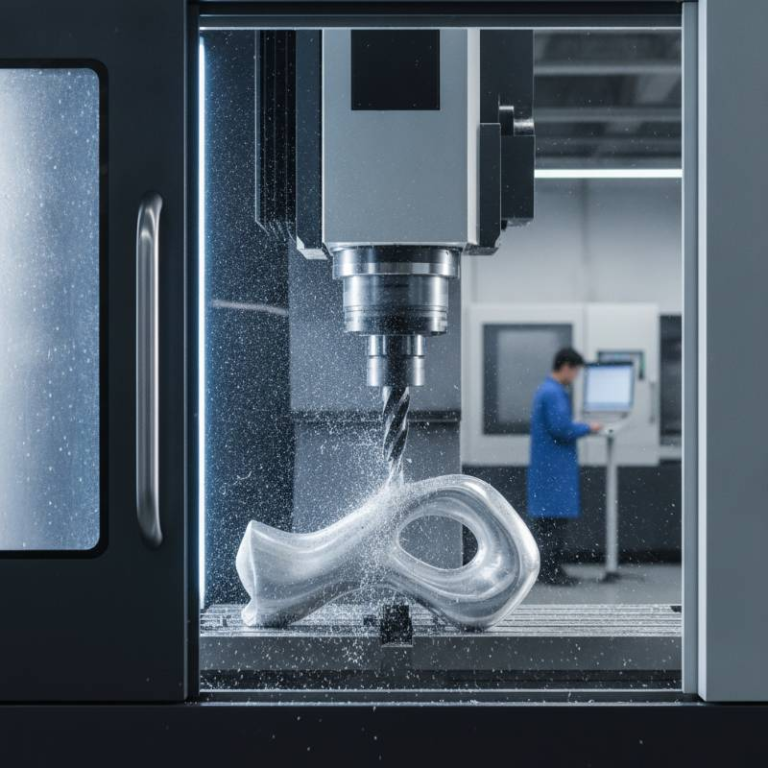
Extreme Niche Benchmark: 5-Axis CNC Machining of Thin-Walled Inconel 718 Diffusers
To demonstrate high-temperature alloy capabilities, consider the production of an aerospace turbine exhaust diffuser machined from an aged Inconel 718 forging (AMS 5663).
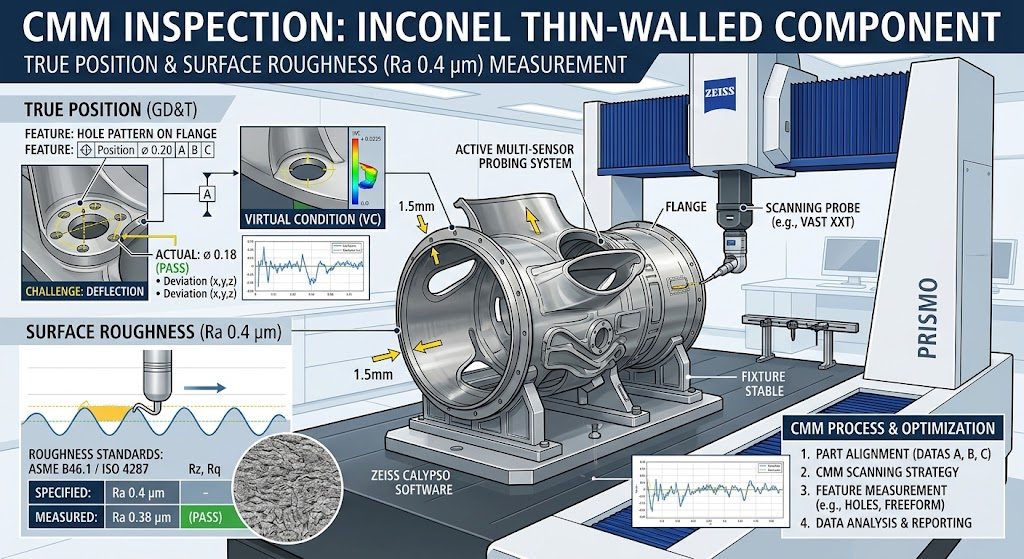
Component Engineering Constraints
- Minimum Wall Thickness: 0.80 mm ±0.025 mm along a complex 3D swept aerodynamic contour.
- Cooling Passage Profile Tolerance: ±0.005 mm true position across 36 integrated micro-vanes.
- Surface Finish Requirement: Ra 0.4 μm directly off the machine to avoid manual blending that could induce uneven residual stresses.
- Material Hardness: 42–45 HRC (AMS 5663 aged condition).
Tyneen Advanced Manufacturing Strategy
Executing this geometry required our 5-axis DMG MORI machining centers operating custom adaptive trochoidal toolpaths. We counteracted harmonic chatter and dynamic deflection through tuned mechanical fixtures and sacrificial dampening cores.
By leveraging advanced precision machining methodologies, Tyneen delivered complete profile compliance with zero micro-cracking, backed by full AS9102 First Article Inspection (FAI) reports.
Direct Alloy Head-to-Head Comparisons & Thermal Distortion Checklist
Selecting the right alloy requires balancing yield strength retention, oxidation life, and material density:
| Alloy Grade | Density (g/cm³) | Max Continuous Temp (°C) | Yield Strength @ 650°C (MPa) | Machinability Index (AISI B1112=100) |
|---|---|---|---|---|
| Ti-6Al-4V | 4.43 | 350°C | N/A (Exceeds limit) | 22% |
| Ti-6242 | 4.54 | 540°C | 380 | 18% |
| Inconel 718 | 8.19 | 650°C | 1000 | 12% |
| Inconel 625 | 8.44 | 980°C | 410 | 14% |
| Haynes 282 | 8.27 | 930°C | 680 | 10% |
| Niobium C-103 | 8.85 | 1370°C (coated) | 190 (@ 1000°C) | 8% |
Manufacturing & Residual Stress Verification Checklist
- Intermediate Stress Relief: Verify vacuum stress-relief annealing between roughing and finishing passes (e.g., AMS 5664 specs for Inconel).
- Recast Layer Elimination: Ensure full mechanical removal (minimum 0.05 mm stock pass) of all White Layer / Recast Layer generated by Wire EDM or Sinker EDM.
- Surface Integrity Verification: Conduct Fluorescent Penetrant Inspection (FPI / ASTM E1417) to detect any micro-cracking induced by thermal stress during milling.
- Rotational Part Concentricity: Utilize specialized aerospace CNC turning capabilities with live tooling to achieve continuous concentricity under 0.008 mm TIR.
Tyneen AS9100D Quality Assurance, Zeiss CMM Metrology, and AMS Material Traceability
Manufacturing critical flight components requires strict quality management and comprehensive traceability at every processing stage.
- Certifications: Fully certified under AS9100D, ISO 9001:2015, and IATF 16949 standards for precision manufacturing.
- Metrology Validation: Zeiss Prismo and Zeiss Spectrum Coordinate Measuring Machines (CMM) in temperature-regulated quality labs ensure profile accuracy down to ±0.002 mm.
- 100% Raw Stock Traceability: Complete chemical, mechanical, and melt-source verification documented with raw material Mill Test Reports (MTR) meeting DFARS and AMS requirements.
- Non-Destructive Testing (NDT): In-house and partner-certified NDT workflows covering FPI, ultrasonic testing, and complete AS9102 First Article Inspection documentation.
Frequently Asked Questions About Aerospace High-Temp Material Selection
What is the primary difference between Inconel 718 and Inconel 625 for turbine components?
Inconel 718 is a precipitation-hardened superalloy offering high mechanical yield and tensile strength up to 650°C, making it optimal for high-load rotating components. Inconel 625 is a solid-solution strengthened alloy that maintains lower mechanical strength but delivers superior resistance to oxidation, corrosion, and thermal fatigue up to 980°C.
How do engineers prevent galvanic corrosion when mating titanium to high-temp superalloys?
Titanium and nickel superalloys share relatively compatible galvanic potentials. However, to eliminate crevice corrosion at temperatures above 300°C, engineers apply ceramic diffusion barrier coatings, high-purity aluminum sacrificial coatings, or anodized interfacial surface treatments.
Why is stress relief heat treatment required after machining Inconel 718?
Inconel 718 exhibits rapid work-hardening during cutting, generating severe internal residual stresses across the workpiece. Post-machining vacuum stress relief (following AMS 5662/5664 protocols) relieves these forces, preventing dimensional drift during final finishing or operational thermal cycling.
When should Ti-6242 be selected over standard Ti-6Al-4V Grade 5?
Ti-6242 is recommended whenever continuous operating temperatures fall between 350°C and 540°C. Standard Ti-6Al-4V experiences microstructural degradation and accelerated creep above 350°C, whereas Ti-6242 preserves its creep rupture strength and oxidation resistance in this intermediate regime.
3-Step Engineering Action Pathway: From CAD/DFM to Flight-Ready Components
Streamline your aerospace hardware prototyping and production with Tyneen’s integrated manufacturing workflow:
Fast-Track Aerospace Production Process
Upload your native STEP, IGES, or DXF files with mechanical tolerances, alloy specifications (AMS/ASTM), and surface roughness requirements.
Receive a detailed Design for Manufacturability (DFM) review evaluating tool reach, thin-wall vibration risks, feed optimization, and an instant, competitive quote.
Production on multi-axis DMG MORI CNCs, comprehensive Zeiss CMM inspection, raw material MTR certification, and expedited global delivery.