Titanium CNC Turning for Orthopedic Bone Screws
Titanium CNC Turning for Orthopedic Bone Screws: Technical Fundamentals
Titanium CNC turning for orthopedic bone screws utilizes multi-axis Swiss lathes, thread whirling units, and high-pressure through-spindle coolant systems to achieve dimensional tolerances within ±0.005 mm on medical-grade alloys. By synchronizing high-speed rotary cutter rings with slow workpiece rotation, this process produces burr-free buttress and dual-lead threads while eliminating material deflection. It represents the gold standard for producing cortical, cancellous, and micro-cannulated bone screws under strict ISO 13485 and FDA 21 CFR Part 820 controls.
Orthopedic fixation screws require extreme mechanical integrity to withstand dynamic physiologic loads without undergoing stress corrosion cracking or fatigue failure. Producing these fasteners via precision CNC turning services demands uncompromising rigidity at the cutting interface. Titanium’s low elastic modulus (approx. 110 GPa for Ti-6Al-4V) means the bar stock springs back under radial tool pressure, risking dimensional taper and catastrophic thread pitch variation.
In our manufacturing experience across high-volume spinal and trauma hardware runs, standard CNC turning platforms fail when machining slender bone screw aspect ratios exceeding 10:1. Guide-bushing-supported Swiss-type lathes mitigate this by supporting the bar stock mere fractions of a millimeter from the cutting tool, maintaining absolute concentricity and runout control under 0.003 mm.
Medical Titanium Metallurgy: ASTM F136 (Ti-6Al-4V ELI) vs. Commercial Pure Grade 4
Selecting suitable medical grade titanium alloys is the primary step in orthopedic fastener production. The metallurgical composition dictates shear strength, ductility, notch sensitivity, and machinability behavior during turning operations.
ASTM F136 Specification: The standard specification for wrought Titanium-6Aluminum-4Vanadium ELI (Extra Low Interstitial) alloy (UNS R56401) for surgical implant applications. Restricts interstitial elements (oxygen ≤ 0.13%, iron ≤ 0.25%, carbon ≤ 0.08%) to drastically improve fracture toughness and cyclic fatigue resistance.
While standard Grade 5 titanium (ASTM B348) is widely applied in aerospace, biomedical screws demand ASTM F136 Ti-6Al-4V ELI. The reduction of interstitial oxygen prevents micro-cleavage sites under dynamic cyclic loads in human bone. Conversely, Unalloyed CP Grade 4 (ASTM F67) delivers superior biocompatibility and osteointegration but exhibits lower ultimate tensile strength, limiting its use to maxillofacial plates and low-load cranial screws.
| Material Grade | Tensile Strength (MPa) | Yield Strength 0.2% (MPa) | Elongation at Break (%) | Elastic Modulus (GPa) | Machinability Index (AISI 1212=100) |
|---|---|---|---|---|---|
| Ti-6Al-4V ELI (ASTM F136) | 860 – 965 | 790 – 875 | ≥ 10% | 110 – 114 | 22% |
| Ti-6Al-4V Grade 5 (ASTM B348) | ≥ 895 | ≥ 828 | ≥ 10% | 114 | 20% |
| CP Grade 4 Titanium (ASTM F67) | ≥ 550 | ≥ 483 | ≥ 15% | 104 | 30% |
Titanium’s thermal conductivity (6.7 W/m·K for Ti-6Al-4V ELI) is nearly 80% lower than standard carbon steel. Heat fails to dissipate through the chip or workpiece during turning; instead, 80% of generated thermal energy concentrates directly at the cutting edge, accelerating crater wear and tool plastic deformation.
Thread Whirling vs. Single-Point Turning for Complex Bone Screw Geometries
Orthopedic bone screws feature aggressive, non-standard thread profiles—including deep buttress, dual-lead differential pitch, and reverse-cutting flutes designed to bite into trabecular and cortical bone. Manufacturing these geometries with conventional single-point turning presents severe technical limitations.
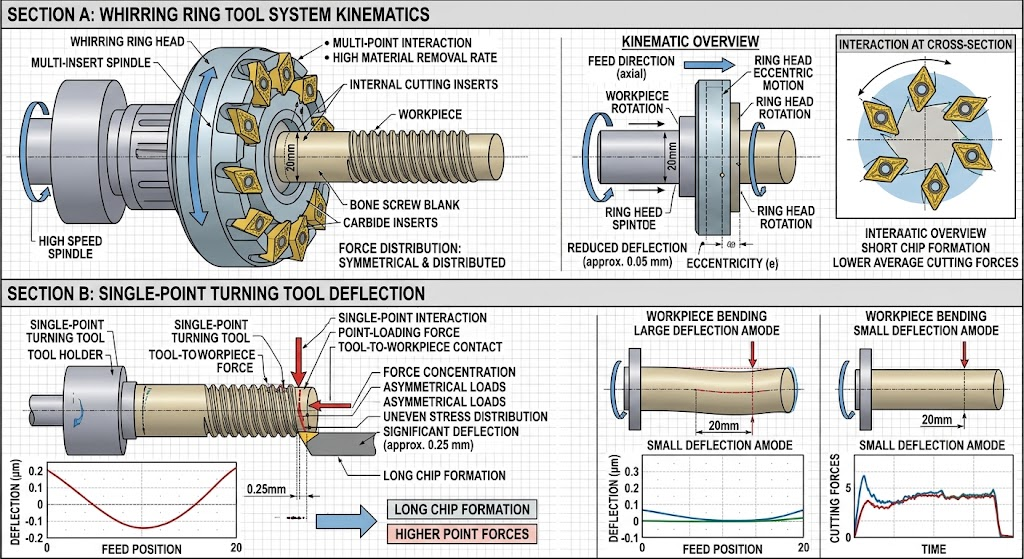
Single-point threading requires 12 to 20 incremental passes to cut a standard 1.75 mm pitch orthopedic thread. In titanium alloys, multiple passes induce severe work-hardening at the shear zone, cause burr accumulation at the crests, and generate substantial side-load deflection on long, slender screw blanks.
Thread whirling resolves these failure modes through continuous tangential cutting:
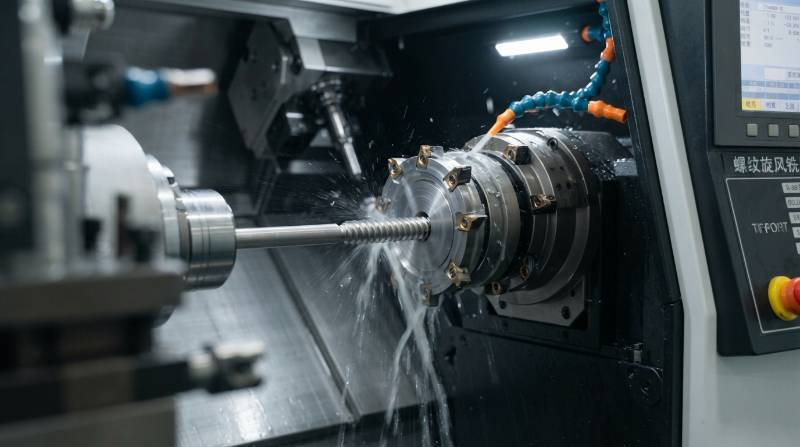
- Kinematic Superiority: A high-speed cutter ring carrying 6 to 12 carbide or PCD inserts rotates eccentrically at 4,000–6,000 RPM around the slowly rotating screw blank (10–30 RPM).
- Single-Pass Generation: The full depth of thread (often up to 1.2 mm deep) is cleared in a single continuous linear pass supported by the guide bushing.
- Zero Crest Micro-Burrs: The tangential entry and exit of the whirling inserts create thin, crescent-shaped chips, preventing plastic material roll-over at the thread root and crest.
- Surface Finish: Generates Ra 0.2–0.4 µm (8–16 µin) surface finishes directly from the lathe, eliminating the need for abrasive manual polishing that risks altering thread profile geometry.
Machining Micro-Cannulated Screws: Deep-Hole Gun Drilling & L/D Guidelines
Cannulated bone screws feature a central longitudinal bore that permits surgeons to insert Kirschner guide wires (K-wires) for precise percutaneous placement under fluoroscopic imaging. Drilling a micro-cannulation (inner diameter 0.8 mm to 1.6 mm) through a 60 mm long screw presents extreme aspect ratio challenges.
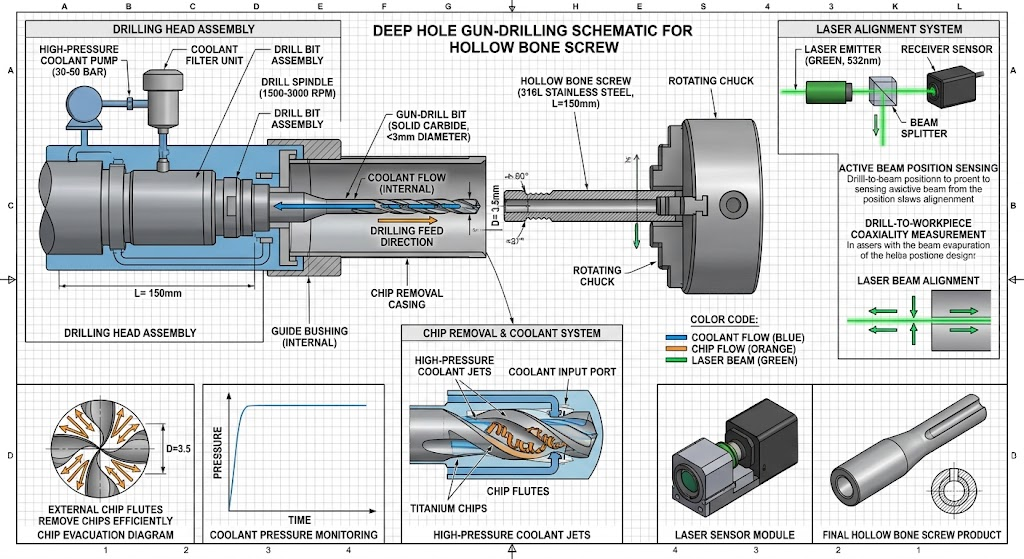
Standard twist drilling fails catastrophically beyond a length-to-diameter (L/D) ratio of 5:1 due to chip packing, thermal buildup, and rotational wander. For cannulated fasteners with L/D ratios reaching 30:1, specialized single-lip solid carbide gun drilling or micro-deep-hole drilling with through-tool high-pressure coolant is mandatory.
Cannula Drift Tolerance Formula:
$\Delta = k \cdot \left(\frac{L}{D}\right)^2 \cdot \frac{f_n}{E_{tool}}$
Where $\Delta$ is total axis runout at exit, $k$ is material shear coefficient, $L/D$ is aspect ratio, $f_n$ is feed per revolution, and $E_{tool}$ is tool substrate modulus.
To ensure concentricity wall-thickness variation remains below ±0.025 mm across the entire screw length, our Swiss turning centers use counter-rotating spindles (workpiece spins at 2,000 RPM forward; gun drill spins at 6,000 RPM reverse). This kinematic balance neutralizes core wandering and cancels out lateral harmonics.
Empirical Cutting Parameters & Heat Dissipation Strategies for Titanium Turning
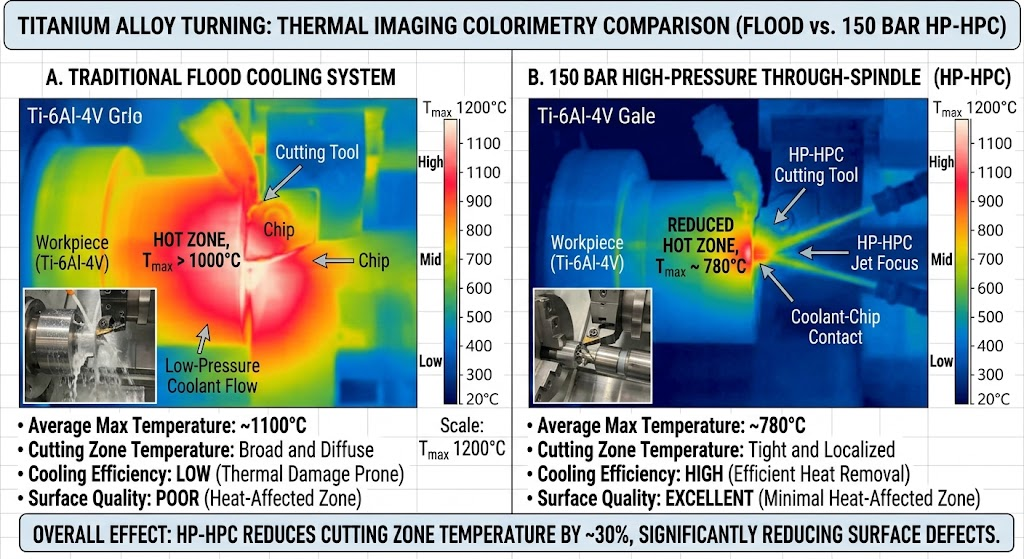
Controlling heat generation during titanium screw turning requires precise cutting parameters matched with ultra-fine grain micro-carbide tooling. Tool substrates require high cobalt binder contents (8–10%) coated with physical vapor deposition (PVD) Titanium Aluminum Nitride (TiAlN) or Aluminum Chromium Nitride (AlCrN), which maintain hardness up to 900°C.
| Machining Operation | Cutting Speed $V_c$ (m/min) | Feed Rate $f_z$ (mm/tooth or rev) | Depth of Cut $a_p$ (mm) | Coolant Pressure (bar) | Tool Coating Type |
|---|---|---|---|---|---|
| OD Rough Turning | 45 – 65 | 0.08 – 0.15 mm/rev | 0.80 – 1.50 | 70 – 100 | PVD AlCrN |
| OD Finish Turning | 65 – 90 | 0.02 – 0.05 mm/rev | 0.10 – 0.25 | 100 – 140 | PVD TiAlN / DLC |
| Thread Whirling | 90 – 130 | 0.03 – 0.08 mm/tooth | Full Depth (1 Pass) | 120 – 160 | Nano-composite AlTiN |
| Cannulation Gun Drilling | 30 – 45 | 0.005 – 0.015 mm/rev | Drill Diameter | 140 – 200 | PVD TiCN / Uncoated Fine Sub-Micron |
| Hexalobular Broaching | 15 – 25 | 0.02 – 0.04 mm/stroke | Incremental Index | Flood / High Lub | CVD TiN / TiCN |
High-pressure coolant delivery (minimum 140 bar / 2000 psi) aimed precisely at the shear boundary hydraulic wedge fractures titanium chips instantaneously. This eliminates long, stringy chip ribbons that foul live whirling heads and scratch critical screw surfaces.
The Tyneen Ultra-Precision OrthoTurn™ Protocol
To eliminate scrap rates and satisfy stringent biomedical quality thresholds, Tyneen executes a proprietary 5-phase manufacturing methodology: The Tyneen Ultra-Precision OrthoTurn™ Protocol. This systematic workflow integrates metallurgical verification, closed-loop Swiss turning, and cleanroom handling.
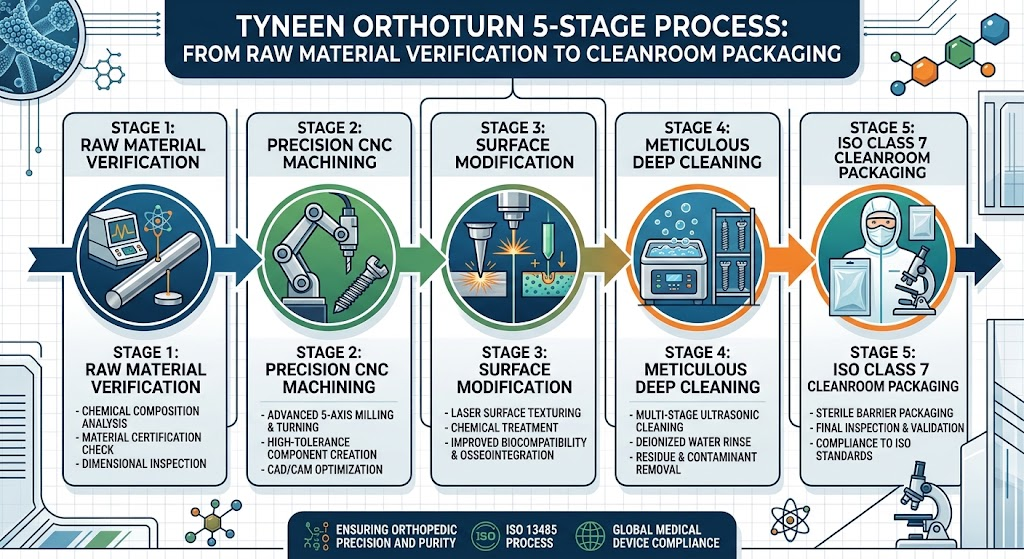
- Phase 1: Raw Material Lot Pre-Qualification: 100% PMI (Positive Material Identification) ultrasonic eddy-current bar screening. Verifies grain size (ASTM E112 Grade 5 or finer) and absolute interstitial gas limits on incoming ASTM F136 titanium lots.
- Phase 2: Swiss Synchronous Multi-Axis Turning: Real-time thermally compensated 7-to-9 axis Swiss turning. Executes single-pass thread whirling, flute milling, and rear spindle pickoff deburring with sub-micron synchronous repeatability.
- Phase 3: High-Pressure Coaxial Cannulation: Synchronized counter-rotational deep-hole drilling running 160+ bar synthetic ester oil to guarantee runout under 0.025 mm across lengths up to 120 mm.
- Phase 4: Electrochemical & Micro-Abrasive Deburring: Non-contact ECM removes internal burrs at cross-holes and cutting flutes without rounding critical cutting edges or leaving abrasive embedded residues.
- Phase 5: Validated Passivation & Surface Treatment: Ultrasonic solvent cleaning followed by automated ASTM F86 chemical passivation and AMS 2488 anodization with 100% bio-burden batch tracking.
Post-Processing & Surface Engineering: ASTM F86 Passivation and Anodizing
Machined orthopedic screws must undergo rigorous surface engineering before implantation. Residual free iron particles transferred from cutting tools or guide bushings can initiate localized galvanic corrosion in the biological environment.
Chemical passivation is performed strictly in accordance with ASTM F86. Screws are subjected to ultrasonic alkaline degreasing to strip cutting fluids, followed by immersion in 20–40% nitric acid baths (or validated citric acid formulations). This dissolves all trace free-iron and enriches the passive titanium dioxide ($TiO_2$) protective barrier.
Following passivation, screws receive specialized anodizing treatments:
- AMS 2488 Type II Anodization: An alkaline bath treatment producing a dense, grey micro-layer that substantially reduces the coefficient of friction, eliminates galling during high-torque bone insertion, and increases fatigue resistance.
- Type III Color Anodization: An electrochemical process creating controlled oxide interference layers without chemical dyes. Color-codes screw lengths and diameters (e.g., Magenta for Ø2.0 mm, Gold for Ø2.7 mm, Teal for Ø3.5 mm) for rapid intraoperative surgical identification.
Metrology, ISO 13485 Quality Assurance, and Regulatory Compliance
Quality assurance for medical screws leaves zero room for error. Fasteners undergo rigid dimensional verification at our manufacturing centers to guarantee compliance with orthopedic device manufacturing solutions and global regulatory frameworks.
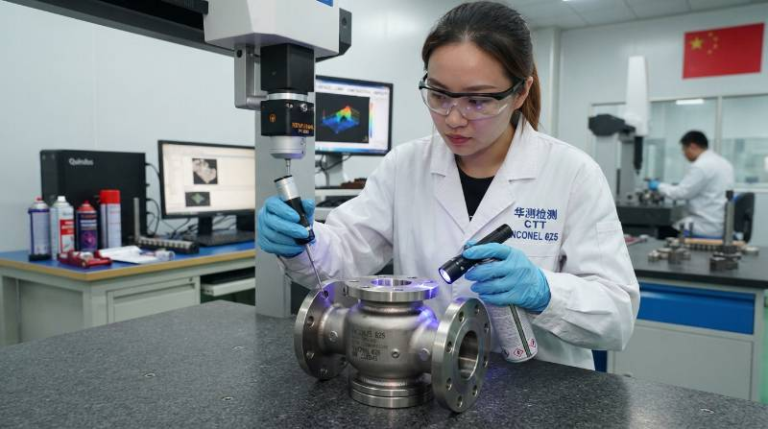
Tactile coordinate measuring machines (CMM) risk deflecting micro-threads. Therefore, dimensional verification relies on non-contact high-resolution optical profile comparators, 3D telecentric laser measurement, and chromatic confocal microscopy:
- Thread Profile Metrology: Major diameter, pitch diameter, flank angles, and root radius are verified to within ±0.002 mm against 3D CAD step files.
- Drive Recess Inspection: Go/No-Go plug gauging alongside optical micro-topography validates Hexalobular (Torx/Torx Plus per ISO 10664) drive depths to prevent intraoperative cam-out.
- Cannula Concentricity & Straightness: High-precision air gauging checks inner bore continuity, roughness, and axial drift.
Under our ISO 13485:2016 quality management system and FDA 21 CFR Part 820 requirements, every bone screw batch maintains end-to-end Device History Record (DHR) traceability, including raw material melt certificates, chemical mill tests, CNC machine telemetry, and passivation validation logs.
DFM Best Practices & Cost Optimization for Orthopedic Fasteners
Designing bone screws with manufacturing realities in mind avoids unnecessary production cost spikes while ensuring clinical efficacy. Applying Design for Manufacturability (DFM) rules during CAD modeling maximizes yields when leveraging advanced Swiss machining capabilities.
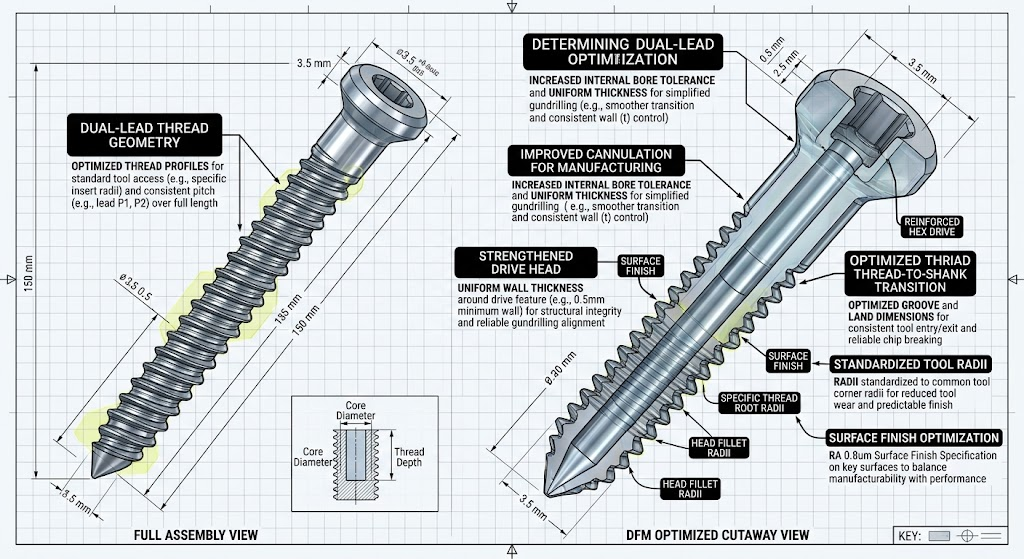
- Drive Geometry: Hexalobular (Torx) recesses provide up to 40% higher torsional transmission compared to traditional hex or cruciform drives. Specify standard ISO 10664 drive sizes to eliminate custom micro-broach tooling expenses.
- Flute Runout Transitions: Design cutting flutes with a gradual blend radius at the screw tip rather than sharp square step-downs. This avoids stress concentration zones and increases rotary milling cutter life by 300%.
- Thread Crest Flatness: Avoid razor-sharp knife-edge thread crests. Specifying a minimal crest flat (0.05–0.10 mm) prevents micro-chipping during whirling and eliminates the need for expensive secondary tumbling cycles.
- Cannula Sizing: Standardize inner cannulation diameters to standard commercial gun drill sizes (e.g., 0.8 mm, 1.1 mm, 1.35 mm, 1.6 mm) to bypass costly custom-ground drill lead times.
Frequently Asked Questions About Titanium CNC Bone Screw Turning
Why is thread whirling preferred over thread milling for bone screws?
Thread whirling cuts the full thread profile in a single pass while the stock is directly supported by the Swiss guide bushing, preventing bar deflection. Thread milling requires circular interpolation passes that exert substantial radial force, creating runout and chatter on long, slender screw blanks.
What is the smallest screw diameter Tyneen can produce?
Tyneen’s Swiss micro-machining centers turn micro-bone screws with outer diameters as small as 1.0 mm (e.g., for craniomaxillofacial, neurosurgical, and hand/wrist fixation), holding tight thread pitch and drive tolerances within ±0.005 mm.
How are cross-hole and cannulation burrs removed?
We integrate synchronized electrochemical deburring (ECD) and automated high-pressure micro-abrasive flow processes. This dissolves intersection burrs inside the cannulation and cutting flutes without rounding functional cutting edges.
How is raw material traceability verified for implant compliance?
Every bar of ASTM F136 Ti-6Al-4V ELI titanium is delivered with full EN 10204 3.1 chemical and mechanical mill certifications. We verify these specs through optical emission spectroscopy and archive the records in the Device History Record for 10+ years.
Partner with Tyneen for High-Precision Orthopedic CNC Machining
Delivering mission-critical medical hardware demands precision, validated cleanroom processes, and uncompromising metallurgical controls. Tyneen operates state-of-the-art multi-axis Swiss CNC machining facilities dedicated to orthopedic OEMs worldwide, manufacturing cortical, cancellous, trauma, and custom cannulated fasteners.
Whether you require fast-turnaround clinical trial prototypes or full-scale ISO 13485 certified production lots, our engineering team provides comprehensive Design for Manufacturability (DFM) analyses to minimize costs and accelerate delivery.