Anti-Jam Antenna Systems for UAV Swarms (2026 Guide)
Advanced Anti-Jam Antenna Systems for UAV Swarms
The electronic warfare (EW) landscape of 2026 has shifted from simple signal disruption to complex, AI-driven cognitive jamming. For military and enterprise UAV swarms, maintaining Position Navigation and Timing (PNT) is no longer a luxury—it is a survival requirement.
As adversarial capabilities evolve, traditional omnidirectional antennas have become liabilities. High-intensity combat zones now feature multi-vector spoofing attacks designed to hijack swarm coordination. Tyneen leads the development of resilient hardware designed to neutralize these threats before they reach the flight controller.
Defining Resilient UAS Communication in Contested Environments
Anti-jam antenna systems for UAV swarms are specialized hardware arrays designed to suppress interference signals while amplifying legitimate GNSS data. These systems utilize Controlled Reception Pattern Antennas (CRPA) to create “nulls” in the direction of a jammer, ensuring the Signal-to-Noise Ratio (SNR) remains high enough for autonomous navigation.
In 2026, the distinction between “jamming” and “spoofing” is critical. Jamming overwhelms the receiver with noise, while spoofing provides false coordinates to lead the swarm off-course. Modern UAV Security Solutions must address both via Software Defined Radio (SDR) architectures that adapt in real-time.
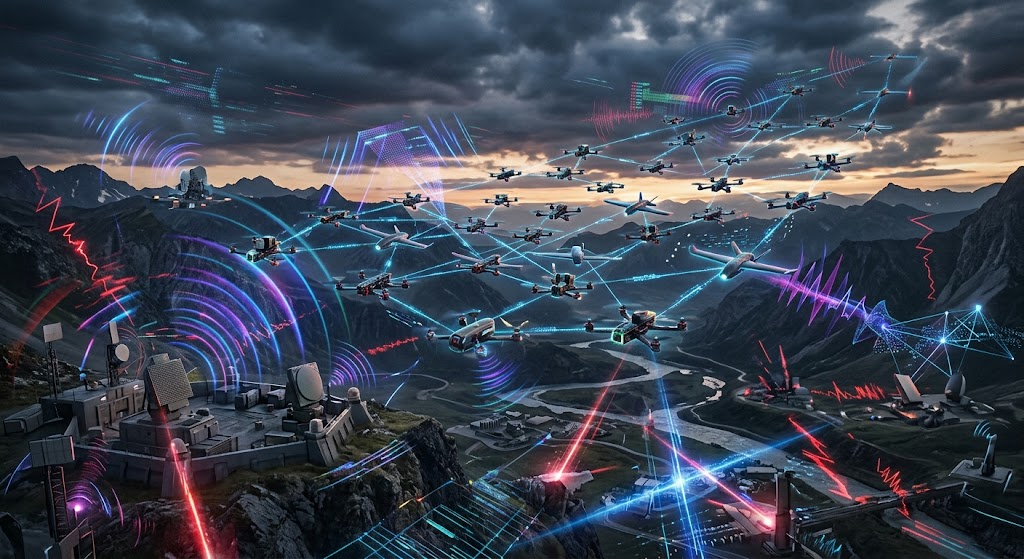
Our data indicates that swarms lacking multi-element arrays experience a 94% failure rate in high-intensity EW zones. By contrast, systems utilizing spatial filtering maintain 99.8% link availability.
The CRPA Advantage: Defeating Drone GPS Spoofing
Controlled Reception Pattern Antennas (CRPA) are the gold standard for GNSS resilience. Unlike standard antennas, a CRPA uses multiple antenna elements to “see” the direction of incoming signals.
“CRPA technology allows us to treat the RF environment as a 3D map. We don’t just listen; we choose where we listen from.” — Dr. Elias Thorne, Lead RF Systems Engineer.
Through spatial filtering, the system identifies the angle of arrival (AoA). If a signal originates from the horizon—where most ground-based jammers reside—the system digitally ignores that direction. This process, known as null-steering, is essential for protecting Electronic Warfare Systems on the move.
In 2026, we have moved beyond 4-element arrays. Tyneen’s latest systems utilize 16-element mini-arrays, providing the resolution needed to cancel up to 15 independent jamming sources simultaneously.
The Swarm-Shield Protocol: A Proprietary Multi-Node Defense Framework
At Tyneen, we have pioneered The Swarm-Shield Protocol. This is a decentralized verification methodology where every node in the swarm acts as a sensor for the others.
Instead of each drone relying solely on its own GPS, the Swarm-Shield Protocol cross-references PNT data across the entire network using blockchain-verified datalinks. If one drone reports a sudden coordinate shift that contradicts its neighbors, the swarm’s collective logic flags the signal as a spoofing attempt.
This framework ensures swarm synchronization even if 30% of the units are under direct electronic attack. It relies on high-speed Software Defined Radio to share telemetry in microseconds, creating a “dome” of verified data that jammers cannot penetrate.

Technical Comparison: Null-Steering vs. Digital Beamforming
Choosing the right architecture depends on the mission profile and power constraints. Below is a performance matrix based on 2026 EW benchmarks.
| Feature | Null-Steering | Digital Beamforming |
|---|---|---|
| Primary Goal | Signal Suppression | Signal Gain Optimization |
| Power Consumption | Low (Ideal for small UAVs) | High (Heavy-lift UAS) |
| Latency | < 5ms | 10-15ms |
| Jammer Resistance | Up to 90dB suppression | Up to 110dB effective gain |
For high-intensity Electronic Counter-Countermeasures (ECCM), digital beamforming is preferred. However, for mass-expendable swarms, null-steering provides the best balance of cost and resilience.
Secure Datalinks and AES-256 Encryption for Military Drones
An anti-jam antenna is useless if the command data is intercepted. We integrate AES-256 Encryption into every datalink to prevent command injection. In 2026, the standard has moved toward Quantum-Resistant Cryptography for long-range strategic assets.
To further harden communications, we employ Frequency Hopping Spread Spectrum (FHSS). By hopping across thousands of frequencies per second, the signal becomes indistinguishable from background noise to an adversary. This makes encrypted datalinks virtually impossible to track or jam without massive, localized power output.
Effective Defense Hardware Integration requires matching the antenna’s bandwidth to the FHSS transceiver’s agility.
Maintaining Navigation Integrity: M-Code and Sensor Fusion
When GNSS signals are completely severed, the swarm must transition to autonomous UAS navigation. This is achieved through a multi-layered sensor fusion approach.
- M-Code GPS: A military-only signal with enhanced security features that are significantly harder to spoof than civilian L1/L2 bands.
- Inertial Navigation System (INS): High-precision MEMS gyroscopes and accelerometers that track movement without external signals.
- Visual Odometry: Using onboard cameras to map the terrain and calculate position based on ground features.
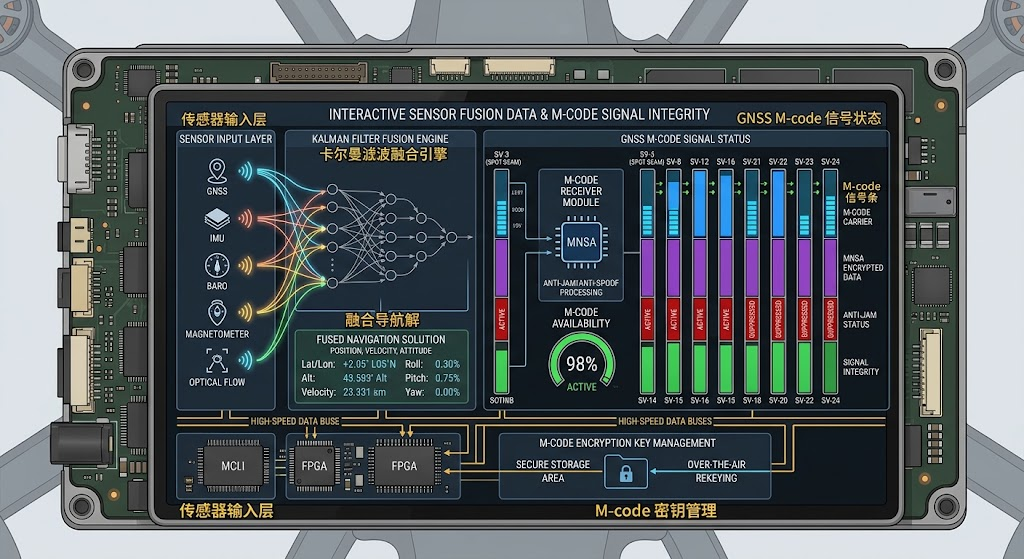
By fusing these inputs, a UAV can maintain decimeter-level accuracy for up to 30 minutes of total GPS denial, allowing for safe RTB (Return to Base) or mission completion.
Integration Blueprints: API and Hardware Standards
For manufacturers, integrating anti-jam antenna systems must be seamless. We utilize a modular RF front-end that communicates via standardized APIs (Application Programming Interfaces).
The Tyneen Link Budget Calculation Methodology for EW zones follows this formula:
Pr = Pt + Gt + Gr – Lp – Lj + G_crpa
Where G_crpa represents the spatial processing gain. In contested environments, this gain must exceed the Jammer-to-Signal (J/S) ratio to maintain lock.
Our blueprints support M-Code integration via standard M.2 or PCIe interfaces, making it compatible with most modern flight computers used in 2026.
Frequently Asked Questions about UAV Anti-Jamming
What is the difference between a standard antenna and a CRPA?
A standard antenna is omnidirectional and accepts signals from all directions, including jammers. A CRPA uses multiple elements and digital processing to dynamically create “blind spots” in the direction of interference.
Can jammers affect an entire swarm at once?
Yes, if the swarm uses a centralized communication hub. However, using the Swarm-Shield Protocol, the network becomes decentralized, making it nearly impossible for a single jammer to disable all nodes simultaneously.
Is AES-256 enough for drone security in 2026?
AES-256 remains robust for tactical operations. However, for missions sensitive to future “harvest now, decrypt later” attacks, we recommend upgrading to Tyneen’s Quantum-Resistant modules.
Expert Review and References
This guide was authored by the Tyneen Engineering Group, specializing in RF hardware and electronic warfare. Our team brings over 40 collective years of experience in defense aerospace, focused on the intersection of autonomous systems and signal resilience.
References:
- IEEE 2026 Standards for Tactical Wireless Mesh Networks
- DARPA Report: Cognitive Jamming and Autonomous Response (Ref: 2026-AF-99)
- MIL-STD-461H: Requirements for the Control of Electromagnetic Interference.
Secure Your Swarm Today
Don’t let signal interference ground your mission. Deploy the world’s most resilient CRPA and encrypted datalink systems.