Temperature Controlled Freight for Precision CNC Parts
Temperature Controlled Freight for Precision CNC Parts: The Metrology-to-Transit Bridge
Temperature controlled freight for precision CNC parts is an active climate-regulated logistics process that stabilizes transit environments at standard metrology temperatures (20°C / 68°F) to eliminate thermal dimensional distortion and condensation. Maintaining strict thermal boundaries during transit ensures that flight-critical, medical, and optical components manufactured to micron-level tolerances arrive at destination facilities in an inspection-ready state.
Sub-micron machining tolerances demand equal precision across the distribution supply chain. Machining a complex aerospace housing to a ±0.0001 in (±2.5 µm) tolerance profile in an ISO Class 7 climate-controlled cleanroom is rendered meaningless if the component endures ambient swings from -20°C in an aircraft cargo hold to 45°C on a desert tarmac.
In our CNC manufacturing operations, transit temperature variances represent one of the largest unmonitored sources of false-positive Non-Conformance Reports (NCRs) at incoming receiving inspections. Bridging the gap between metrology lab standards and intermodal transit requires active thermal regulation, calibrated IoT telemetry, and engineered barrier packaging.

Understanding Thermal Drift and Coefficient of Thermal Expansion (CTE) in Machined Alloys
Every structural alloy undergoes dimensional distortion when exposed to temperature changes. This physical behavior is governed by the linear Coefficient of Thermal Expansion (CTE), defined by the fundamental thermodynamic relationship:
Linear Thermal Expansion Formula:
ΔL = L0 · α · ΔT
Where ΔL is linear expansion/contraction, L0 is initial length, α is the material linear CTE (µm/m·K), and ΔT is temperature delta relative to standard baseline (20°C).
Consider an unconditioned 500 mm structural spar machined from 6061-T6 aluminum. If transit temperatures increase by 25°C inside an uninsulated trailer, that component expands by over 280 microns (0.011 inches)—far exceeding typical aerospace GD&T profile tolerances of ±10 µm.
Selecting suitable high-performance CNC materials requires evaluating how their in-transit thermodynamic properties affect downstream assembly.
| Alloy / Material | Mean CTE (µm/m·K at 20°C) | Expansion at ΔT = +15°C (500mm) | Expansion at ΔT = +30°C (500mm) | Tolerance Risk Level |
|---|---|---|---|---|
| Aluminum 6061-T6 | 23.2 | +174.0 µm (+0.0068 in) | +348.0 µm (+0.0137 in) | Critical |
| Stainless Steel 316L | 16.0 | +120.0 µm (+0.0047 in) | +240.0 µm (+0.0094 in) | High |
| Titanium Gr. 5 (Ti-6Al-4V) | 8.6 | +64.5 µm (+0.0025 in) | +129.0 µm (+0.0051 in) | Moderate |
| Invar 36 (FeNi36) | 1.2 | +9.0 µm (+0.0003 in) | +18.0 µm (+0.0007 in) | Low |
| Virgin PEEK (Unfilled) | 47.0 | +352.5 µm (+0.0139 in) | +705.0 µm (+0.0277 in) | Severe |
While material expansion is theoretically reversible, asymmetric thermal exposure can induce permanent internal residual stress relief. In complex geometries, uneven thermal gradients cause unrecoverable geometric warping across thin-walled sections.
How to Protect Machined Parts from Temperature Variations and Dew Point Condensation
Temperature fluctuations inside transit enclosures create a critical chemical risk: dew point condensation. When warm, humid air cools rapidly against the high thermal mass of a metal part, water vapor condenses instantly onto precision-machined surfaces.
On mirror-finish sealing interfaces (Ra < 0.2 µm) and optical reference datums, micro-condensation triggers flash oxidation, galvanic pitting, and staining within hours. Preventing this degradation requires strict control over moisture vapor transmission rates (MVTR) and transit dew point envelopes.
Engineering Insight: Industrial packaging per ISO 9001 shipping compliance and MIL-STD-2073-1D requires keeping the internal package relative humidity below 30% throughout transit to suppress corrosion kinetics completely.
We mitigate condensation risk using engineered preservation protocols:
- Desiccant Unit Calculation: Sizing activated clay or molecular sieve desiccants in accordance with DIN 55474 based on container volume and transit duration.
- Hermetic Vacuum Sealing: Packaging components inside heavy-gauge aluminum foil-laminated barrier films (MIL-PRF-131K Class 1) purged with dry nitrogen.
- Volatile Corrosion Inhibitors (VCI): Deploying multi-metal VCI emitters that saturate the internal microenvironment with non-reactive molecular protective layers.
Engineered Thermal Insulated Packaging for High-Tolerance CNC Deliverables
For high-reliability deliverables produced via advanced CNC machining services, standard corrugated shipping cartons are insufficient. Protecting sub-thousandth-inch geometric profiles requires multi-layer thermal barrier containment.
Passive thermal protection systems combine vacuum insulation panels (VIPs) with organic or inorganic phase change materials (PCMs). VIPs deliver thermal resistance up to R-40 per inch—over five times more insulating capacity than standard expanded polystyrene (EPS).
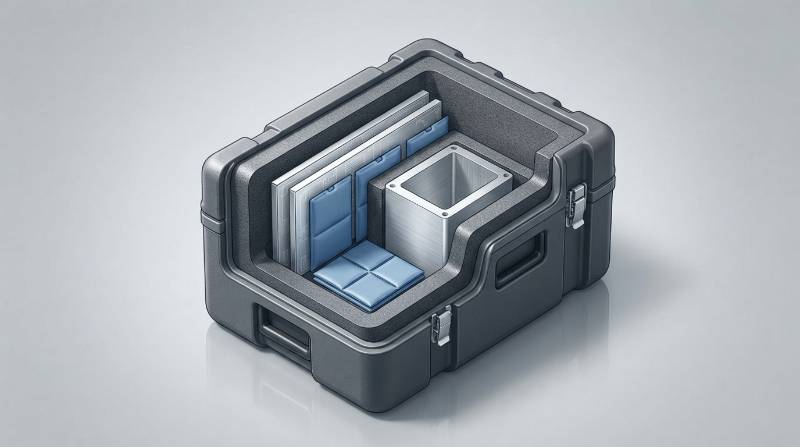
Multi-Layer Packaging Architecture
- Primary Layer: Anti-static nitrogen-purged ESD/VCI vacuum barrier film preventing surface contact and atmospheric exchange.
- Secondary Cushioning: Custom CNC-milled high-density cross-linked polyethylene (XLPE) foam inserts matched to component CG and delicate datums.
- Thermal Buffer: PCM latent-heat packs tuned to a 20°C phase-change transition temperature to absorb outside ambient flux.
- Tertiary Barrier: Vacuum Insulated Panels (VIPs) encased in an impact-resistant structural composite outer transit crate.
IoT Telemetry & Real-Time Data Loggers for Shipping Containers
Passive protection must be validated with verified physical data. Real-time IoT environmental telemetry provides end-to-end chain of custody validation across intercontinental transit routes.
When delivering mission-critical parts machined with precision CNC milling, multi-sensor IoT loggers capture core part temperatures, external container ambient levels, relative humidity, barometric pressure, and 3-axis shock/vibration impacts up to 200G.
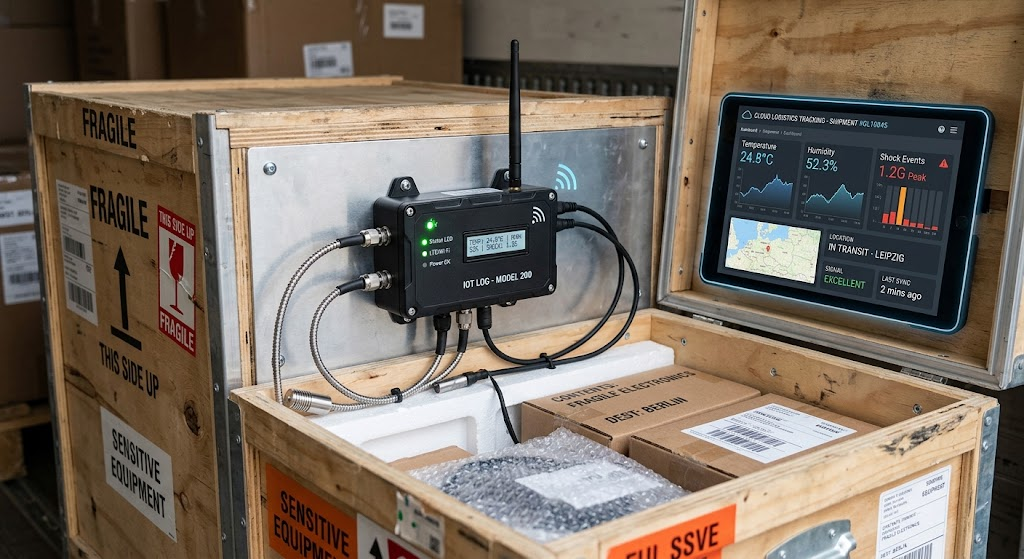
Critical Data Logger Calibration & Compliance
To satisfy quality management mandates like AS9100D and ISO 13485:2016, all tracking loggers must carry NIST Traceable Calibration certificates with accurate sampling frequencies:
- Sampling Frequency: Configured for continuous 1-minute to 5-minute sampling intervals for short air-freight hops, or 15-minute bursts for long ocean transit.
- Sensor Redundancy: Dual PT100/PT1000 RTD temperature probes accurate to ±0.1°C across the -40°C to +85°C operating range.
- Connectivity: Automated 5G/LTE-M cellular backhaul with geofenced satellite fallback and encrypted BLE data downloads.
The Tyneen Machining-to-Transit Stabilization Protocol (MTSP)
To eliminate shipping-induced non-conformances, we developed a proprietary 4-stage logistics framework: the Tyneen Machining-to-Transit Stabilization Protocol (MTSP). This framework governs precision handling from the final spindle pass to receiving inspection.
- Stage 1: Post-Machining Thermal Stabilization
Following machining and deburring, components sit in our metrology cleanroom for a 24-hour thermal stabilization cycle at 20°C ± 0.5°C before final CMM dimensional sign-off. - Stage 2: Inert Nitrogen Barrier Containment
Parts are sealed inside custom MIL-PRF-131K moisture-barrier enclosures with desiccants and molecular nitrogen purging to hold relative humidity strictly under 25%. - Stage 3: Telemetric Climate-Controlled Freight
Shipments transition to active climate-controlled reefer freight or dedicated active air-cargo containers (e.g., Envirotainer / CSafe) maintaining continuous 20°C ± 2°C, monitored by NIST-calibrated IoT loggers. - Stage 4: In-Transit Verification & Acclimation Dossier
Telemetry logs synchronize directly with receiving facilities. A complete thermal journey report is integrated into the final AS9102 First Article Inspection (FAI) package.
Destination CMM Inspection: Establishing Pre-Measurement Thermal Soak Standards
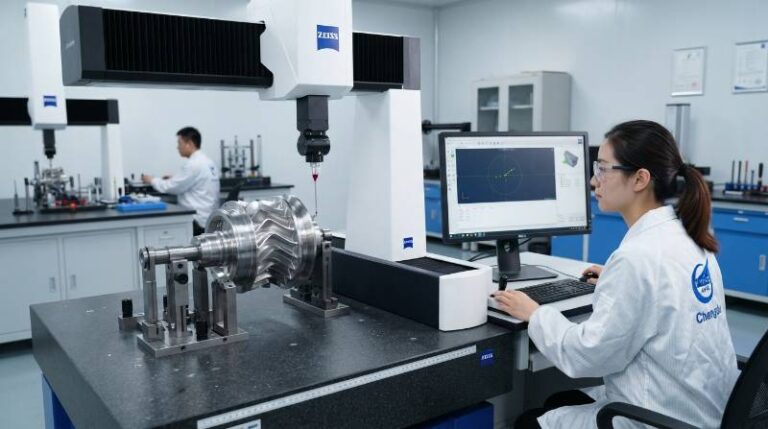
Under the international metrology baseline standard ISO 1, all engineering drawings and geometrical dimensional tolerances apply exclusively at 20°C (68°F). Measuring components that have not fully stabilized to this baseline leads to false rejections or false acceptances.
Even with temperature-controlled freight, incoming parts require a controlled “thermal soak” inside the receiving metrology room before CMM probe contact. The required soaking time depends on component material, mass, and wall thickness.
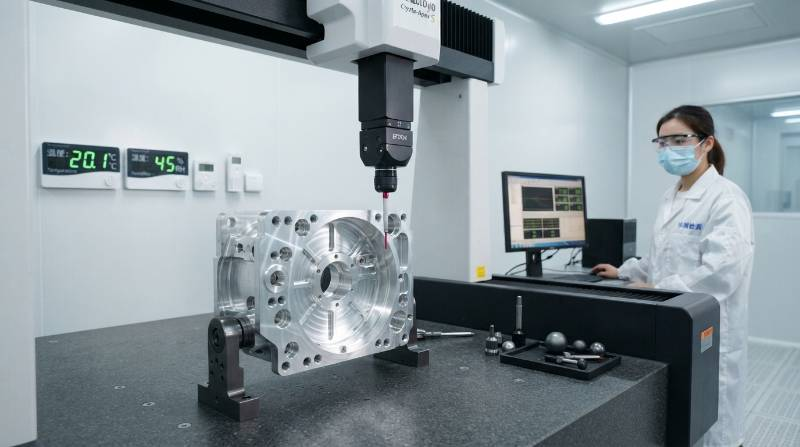
| Component Net Mass | 6061-T6 Aluminum | Titanium Ti-6Al-4V | 316L Stainless Steel | Engineered Polymers (PEEK) |
|---|---|---|---|---|
| < 2.0 kg (< 4.4 lbs) | 2 to 4 Hours | 4 to 6 Hours | 4 to 6 Hours | 8 to 12 Hours |
| 2.0 kg to 15.0 kg | 6 to 8 Hours | 8 to 12 Hours | 10 to 14 Hours | 16 to 24 Hours |
| 15.0 kg to 50.0 kg | 12 to 16 Hours | 18 to 24 Hours | 20 to 28 Hours | 36 to 48 Hours |
| > 50.0 kg (> 110 lbs) | 24+ Hours | 36+ Hours | 48+ Hours | 72+ Hours |
Procurement Checklist for Temperature-Controlled CNC Logistics
When assessing precision machining logistics providers, supply chain managers must vet freight capabilities with the same rigor used for five-axis CNC capabilities. Use this checklist during vendor qualification:
- Active vs. Passive Carrier Specifications: Does the carrier provide active reefer climate tracking (set to 20°C ± 2°C) or rely solely on passive box insulation?
- Air-Ride Suspension: Are shipping trailers equipped with calibrated pneumatic air-ride suspensions to limit low-frequency dynamic resonance?
- NIST-Traceable Data Logging: Are IoT telemetry loggers calibrated according to NIST standards, and is continuous raw data included in receiving docs?
- Pre-Conditioning Protocols: Does the manufacturer pre-condition custom foam and crate assemblies to 20°C before crating components?
- AS9100 Freight Integration: Is the freight workflow audited under the manufacturer’s AS9100 / ISO 9001 quality management system?
To partner with a manufacturing team that integrates precision machining directly with certified logistics protocols, request a precision manufacturing quote from our engineering team.
Frequently Asked Questions (FAQ)
Why is 20°C (68°F) the universal standard for shipping and measuring precision CNC parts?
Under ISO 1 standard specifications, 20°C is the internationally agreed reference temperature for geometrical product specification and verification. Controlling transit and inspection environments at this baseline ensures that thermal expansion matches the exact CAD model baseline.
How does active temperature-controlled freight differ from passive thermal packaging?
Active temperature-controlled freight uses mechanical refrigeration and heating units inside trailers or air containers to regulate ambient cargo air. Passive thermal packaging uses insulating materials like VIP panels and Phase Change Materials (PCMs) to buffer ambient shifts without external power.
What happens if a precision CNC component undergoes extreme temperature swings during transit?
Extreme thermal swings cause linear expansion or contraction. In complex or thin-walled geometries, uneven thermal gradients cause internal stress relaxation, leading to permanent distortion, out-of-round bores, warped sealing surfaces, or surface oxidation from condensation.
Are IoT data loggers required for all AS9100 precision CNC shipments?
While AS9100 does not universally mandate continuous IoT loggers for every SKU, aerospace and defense primes frequently specify active environmental telemetry in quality assurance provisions (Q-Notes) for critical flight hardware and optical payloads.
Secure Your High-Tolerance Supply Chain with Tyneen
From micron-accurate multi-axis machining to fully validated, climate-controlled global delivery, Tyneen provides complete end-to-end quality assurance for critical aerospace, medical, and defense applications.