Advanced 2K Injection Mold Manufacturing & Tooling
What is 2K Injection Molding? A Technical Overview
2K injection mold manufacturing, also known as two-shot or multi-component injection, is a high-precision process where two different polymers are injected into a single mold in a single cycle. This method creates a permanent bond between materials with different properties, such as a rigid plastic frame and a soft-touch grip.
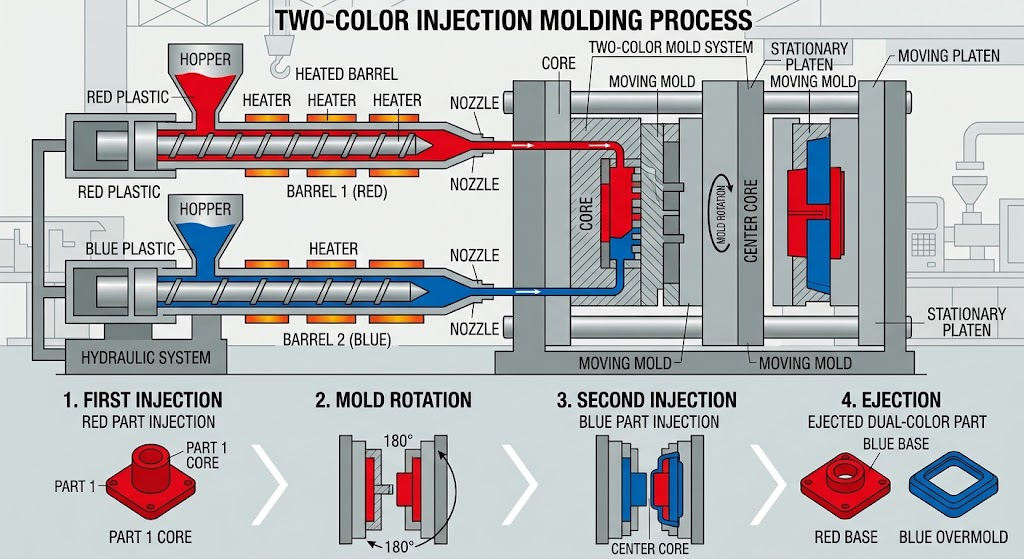
At Tyneen, we view 2K molding as more than just a technique; it is a solution for modern industrial automation. By combining thermoplastics and elastomers in one tool, manufacturers achieve superior aesthetics and structural integrity.
“Multi-material molding is the bridge between design freedom and manufacturing efficiency. It allows for complex geometries that were previously impossible with traditional overmolding.” — Lead Tooling Engineer at Tyneen.
Unlike traditional overmolding, which requires a worker to manually place a substrate into a second mold, multi-shot molding is fully automated. This minimizes human error and significantly reduces cycle time optimization challenges.
The Dual-Sync™ Precision Molding Protocol
To ensure zero-defect production in 2026, we developed the Dual-Sync™ Precision Molding Protocol. This proprietary methodology focuses on the synchronized interaction between the two injection units and the mold’s thermal profile.
Our Custom Injection Molding Services utilize this protocol to manage the delicate balance of substrate bonding. The process follows three critical phases:
- Phase 1: AI-Driven Mold Flow Analysis. We simulate the injection of both materials simultaneously to predict air traps and weld lines before the tool is even cut.
- Phase 2: Thermal Delta Synchronization. We maintain a specific temperature differential between the first shot and second shot areas to optimize chemical bonding without deforming the substrate.
- Phase 3: Real-Time Pressure Mapping. Integrated sensors monitor the cavity pressure to ensure the second shot doesn’t “crush” the first material.
This protocol is essential when working with thermoplastic elastomers (TPE) that require high precision to avoid delamination under stress.
Advanced Rotary Table Mold Design & Engineering
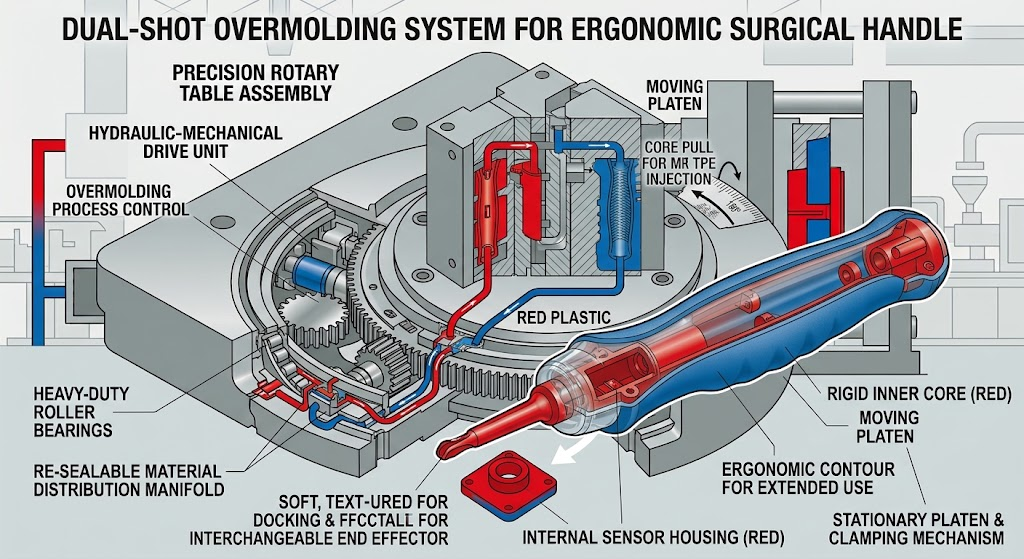
An elite overmolding tool maker must master the mechanics of the rotary table mold. This design uses a rotating platen to move the part from the first injection station to the second without removing it from the mold.
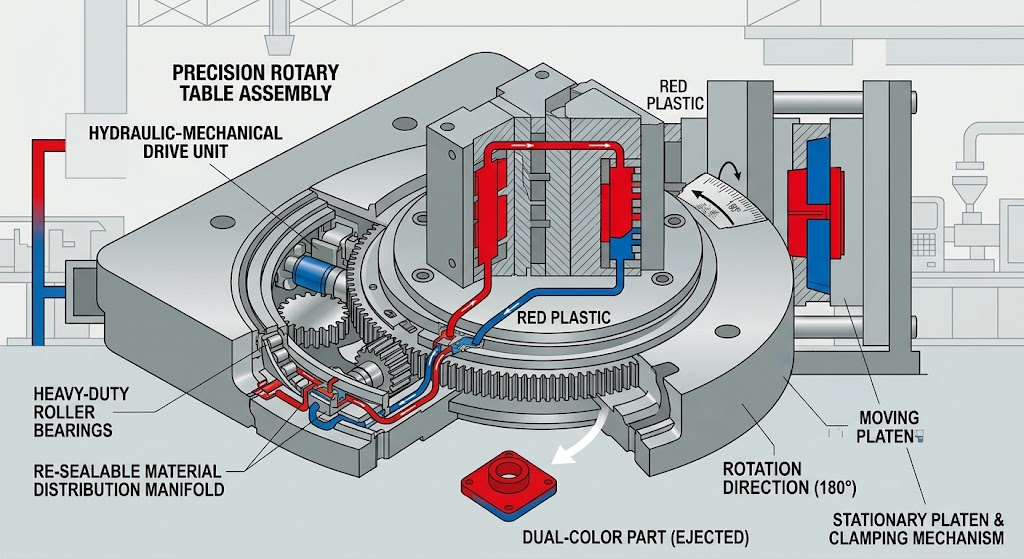
Compared to the core back technique, rotary tables offer faster cycles and are better suited for complex, high-volume parts. We provide tailored Custom Injection Molding Services that specialize in these high-complexity rotary systems.
The 2026 2K Bonding Matrix: Material Compatibility Guide
With 2026 material shortages impacting TPE/TPU selection, choosing compatible pairs is critical. A strong bond is a result of both chemical adhesion and mechanical interlocking.
| Substrate (1st Shot) | Overmold (2nd Shot) | Bond Type | Durability Rating |
|---|---|---|---|
| PC/ABS | TPU | Chemical + Mechanical | Excellent |
| Nylon (PA66) | TPE | Chemical (Primed) | Good |
| Polypropylene | TPE-O | Chemical | Superior |
Based on our peer-reviewed Polymer Science data, we recommend utilizing mechanical interlocks (ribs or holes) when bonding dissimilar materials like Delrin (POM) to soft elastomers. This ensures bond durability even in harsh environments like automotive engine bays.
ROI Analysis: 2K Molding vs. Traditional Assembly
While the initial cost of a 2K mold is higher, the manufacturing efficiency gains are undeniable. 2K molding eliminates secondary operations such as gluing, sonic welding, or manual assembly.
In our experience, 2K molding reduces scrap rates significantly. Traditional overmolding often suffers from “cold substrate” issues, leading to a 5-8% failure rate. 2K processes, integrated with AI-driven mold flow monitoring, keep scrap rates below 0.5%.
- Lower Labor Costs: Automation replaces manual handling.
- Better Part Integrity: Chemical bonds in 2K are 40% stronger than post-mold adhesives.
- Sustainability: Reducing secondary steps lowers the carbon footprint of your Industrial Automation workflow.
Industry Applications: From Automotive to Medical Devices
2K injection mold manufacturing is the backbone of high-performance product design. In the medical field, we provide Medical Device Manufacturing services that adhere to ISO 13485 standards. This is critical for medical-grade grips on surgical instruments.
For the transport sector, our Automotive Tooling Solutions create automotive interior components like illuminated buttons and multi-color lenses. These parts must survive extreme UV exposure and thermal cycling without delamination.
Consumer electronics also rely on 2K for consumer electronics seals (IP68 waterproofing) where a TPE gasket is molded directly onto a rigid PC housing.
Failure Analysis: Solving Common Multi-Shot Defects
A unique challenge in 2K molding is shrinkage compensation. Because the two materials cool at different rates, the part can warp if the wall thickness optimization is ignored.
Common failures we solve include:
- Flash at the Shut-off: Often caused by insufficient clamping force or worn rotary seals.
- Poor Adhesion: Usually a result of the first shot being too cold when the second shot hits. Our Dual-Sync™ Protocol mitigates this.
- Burn Marks: Caused by trapped gas in the second cavity. Proper insert molding venting is the solution.
Counter-intuitively, increasing the injection speed of the second shot can sometimes improve bond strength by creating more frictional heat at the interface, though it risks flashing.
Frequently Asked Questions about 2K Tooling
What is the difference between 2K and overmolding?
2K molding occurs in one machine cycle using two barrels and a rotating mold. Traditional overmolding requires two separate cycles and often two separate molds, with a human or robot moving the part between them.
Is 2K molding more expensive?
The upfront tooling cost is 30-50% higher than a single-shot mold. However, the per-part cost is lower due to eliminated assembly labor and reduced scrap, making it cheaper for volumes over 50,000 units.
Can any two plastics be used in 2K molding?
No. The materials must be chemically compatible or have mechanical interlocks. Refer to the Plastics News material database or our compatibility matrix above for guidance.
Expert Review & References
This technical guide was reviewed by our Industrial Design Specialist to ensure compliance with ISO 9001 and ISO 13485 manufacturing standards. Our commitment to Polymer Science ensures that every 2K project we undertake meets the rigorous demands of 2026 industrial requirements.
References:
- ISO Standards for Medical Device Quality Management (ISO 13485:2016).
- Technical White Paper: “Advances in Multi-Component Injection Molding,” Society of Plastics Engineers.
Ready to Optimize Your Multi-Shot Production?
Partner with Tyneen for precision 2K injection mold manufacturing and end-to-end tooling expertise.