Precision Mill-Turn CNC Machining Services | Tyneen
Tyneen’s precision mill-turn CNC machining services deploy multi-tasking centers that merge complete multi-axis turning with full 5-axis milling inside a single envelope. By executing complete parts in a single clamping cycle, our advanced machining capabilities eliminate fixture-induced datum drift, holding tolerances down to ±0.005 mm across mission-critical aerospace, medical, and defense hardware.
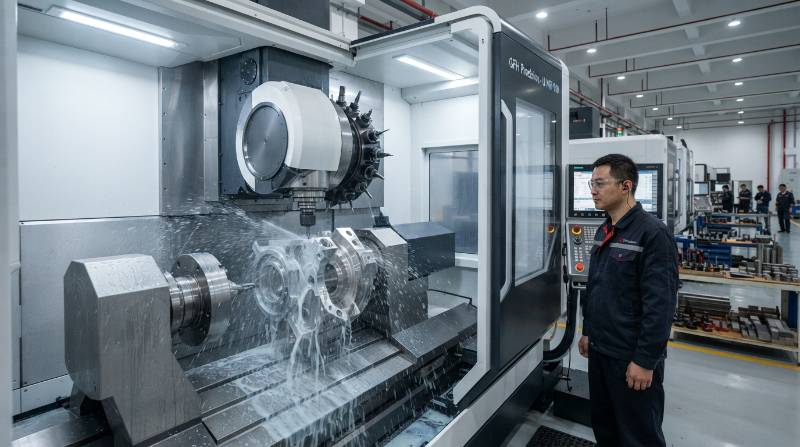
The Mill-Turn Engineering Evaluation Matrix: Overcoming Cumulative Datum Drift
In standard sequential machining, a part moves from a 2-axis CNC lathe to a 3-axis or 5-axis vertical machining center. Each transfer introduces physical re-clamping variables: collet jaw runout, chuck face misalignment, hydraulic clamping distortion, and human positioning variance.
Cumulative Datum Drift is the compounding geometric error introduced when a workpiece is unchucked and re-fixtured across successive machine tools, directly degrading geometric dimensioning and tolerancing (GD&T) baselines.
To mathematically quantify the advantage of single-setup multi-tasking architectures, our applications engineering team evaluates parts against four foundational engineering metrics:
- Fixture Consolidation Ratio (FCR): The total reduction in required hard setups. Mill-turn platforms collapse conventional 4-setup or 5-setup jobs into a single setup (FCR ≥ 4:1), eliminating dedicated custom soft jaws and tombstones.
- True Position Preservation (TPP): Maintaining tight location requirements. When reference features never leave the primary kinematic spindle chuck, true position tolerances of ≤ ⌀0.01 mm relative to Datum A are consistently preserved.
- Dynamic Thermal Drift Control: Sequential setups allow thermal cycles to fluctuate as parts sit between operations. Integrated mill-turn platforms feature internal chiller-controlled thermal stabilization, keeping raw stock and cutting zones within steady gradients.
- In-Line Metrology Validation: High-precision contact probing inspects critical features prior to parting off, dynamically adjusting offsets without breaking the coordinate frame.
Core Kinematics: Simultaneous B-Axis Spindles vs. Live-Tooling Turrets
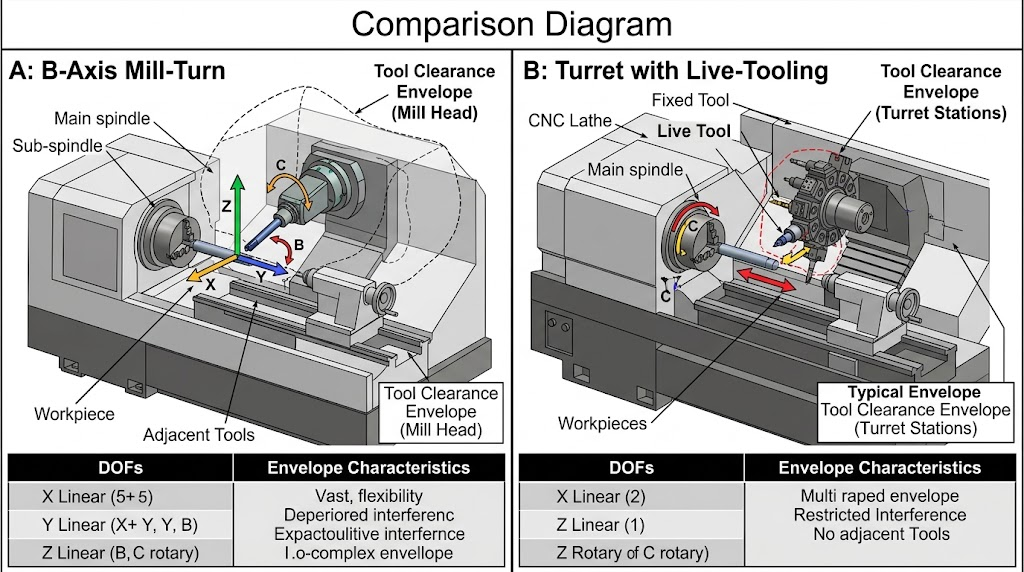
Multi-tasking architectures generally split into two categories: live-tooling turret systems and continuous articulated B-axis milling heads. Understanding their mechanical differences determines manufacturing feasibility for complex components.
Articulated B-Axis Spindles
Continuous B-axis milling spindles operate as full 5-axis machining heads mounted onto an orthogonal turning platform. These spindles typically provide 240° of angular articulation (±120° from vertical), rotate up to 20,000 RPM, and generate over 120 Nm of cutting torque.
Equipped with standard Capto C6 or HSK-T63 tool interfaces, B-axis heads eliminate clearance limitations, enabling simultaneous 5-axis impeller profiling, compound-angle port drilling, and undercut thread milling on turned shafts.
Driven-Tool Radial Turrets
Turret-based multi-tasking relies on static tool disks with driven planetary live-tool holders (typically BMT55 or BMT65 connections). While driven speeds are lower (typically 4,000 to 8,000 RPM) and limited to orthogonal (axial or radial) orientations, turrets offer rapid index-to-index tool changes (0.2 seconds).
They excel at high-speed turning balanced with secondary cross-drilling and planar slotting, but lack the angular reach and dynamic clearance required for complex contouring.
fz: Chip Load per Tooth (mm/tooth), vf: Table Feed Rate (mm/min), n: Spindle Speed (RPM), z: Number of Flutes
When operating live tools on off-center turned geometries, calculating exact chip load per tooth (fz) is critical to prevent cutter deflection and premature chatter on high-strength alloys.
Synchronized Sub-Spindle Part Handoff and Back-Working Strategies
Achieving a true “Done-in-One” process requires dual-spindle capability. Twin-spindle mill-turn centers pair an identical or complementary sub-spindle opposed along the Z-axis to automate back-working operations.
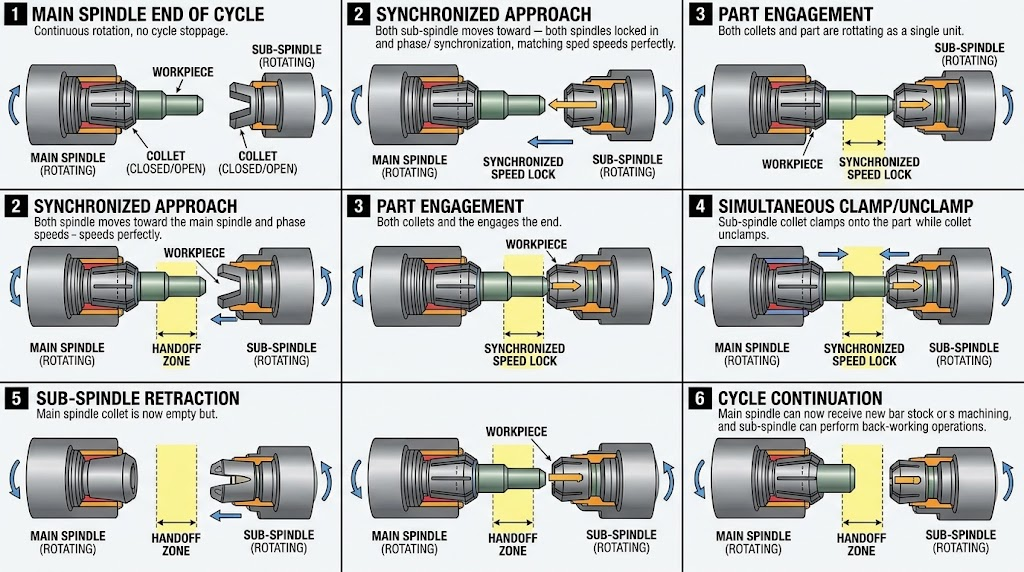
Spindle handoff occurs through dynamic C-axis phase-matching. Both main and sub-spindles accelerate to matching RPM and phase-lock within 0.001° before the sub-spindle approaches along the Z-axis to clamp the exposed workpiece.
Once clamped, a balanced parting tool parts off the stock while both spindles maintain matching torque. The sub-spindle retracts smoothly, allowing rear-face profiling, deep concentric boring, and secondary bolt-circle milling without manual operator intervention.
This automated transfer maintains concentricity and coaxiality within ±0.005 mm between front and rear features, completely eliminating the radial runout common to manual chucking.
The Tyneen Precision-Datum Synchronous Protocol (PDSP)
To eliminate process variables across demanding multi-tasking runs, Tyneen uses a proprietary five-phase methodology: the Precision-Datum Synchronous Protocol (PDSP).
- Digital Twin Kinematic Collision Simulation: Complete CAM post-processing through Siemens NX and CAMplete validates multi-axis toolpaths against machine geometry, tool holders, and sub-spindle chuck envelopes to eliminate gouging risks.
- Adaptive Hydraulic Chuck Pressure Regulation: Thin-walled tubular sections undergo computerized clamping analysis, adjusting hydraulic chuck pressure (down to 0.5 MPa) to prevent out-of-round deformation during high-torque turning.
- In-Process Laser Metrology & Thermal Tracking: Built-in non-contact laser tool setters check for microscopic tool wear and thermal expansion before every finishing pass.
- Synchronized Dynamic Handoff: C-axis spindle phase-locking controls part transfer, preserving coaxial orientation across both chuck centers.
- Automated Work Coordinate Transformation: Integrated touch-trigger probing validates the transferred datum on the secondary spindle, updating work coordinate offsets in real time.
Aerospace Hydraulic Valve Sleeve Case Study: 15-5PH Stainless Steel Benchmark
A leading flight-control system client required a precision hydraulic control valve sleeve manufactured from precipitation-hardened 15-5PH stainless steel (Condition H1025, 35-42 HRC). Conventional sequential processing generated a 22% scrap rate due to bore taper and radial angular misalignment across intersecting cross-ports.
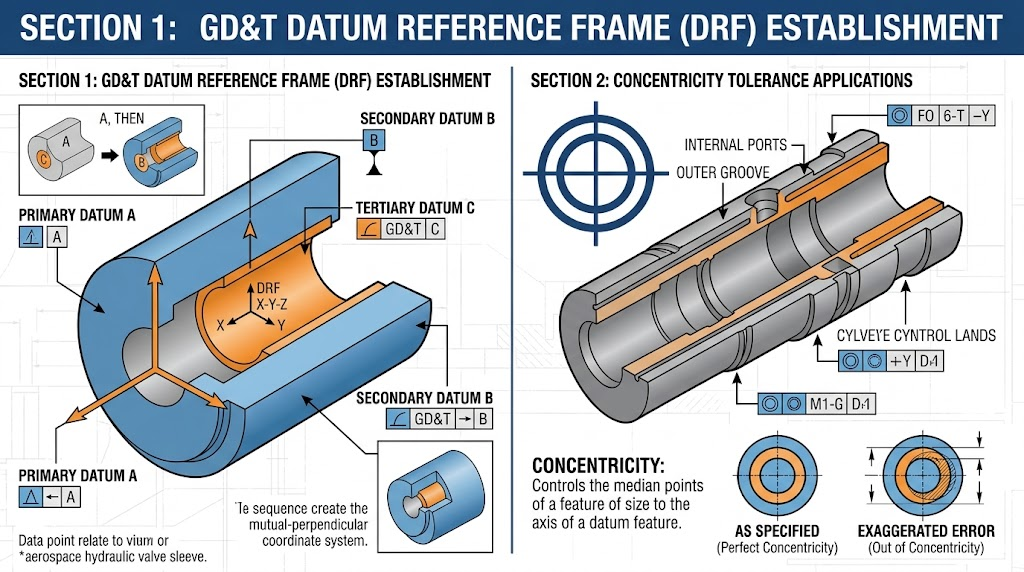
The component demanded exacting engineering criteria:
- Internal primary bore concentricity ≤ 0.005 mm relative to the main mounting register over a 120 mm length.
- Four off-axis cross-ports angled at 37° intersecting the central hydraulic channel with zero burr ingress.
- Twin external helical sealing grooves requiring an uninterupted surface finish of Ra 0.4 μm.
Tyneen migrated the entire production route to a 9-axis continuous B-axis mill-turn center, pairing our high-precision CNC turning with synchronous high-speed micro-milling. Custom micro-grain carbide boring tools finished the central bore, while the simultaneous B-axis spindle interpolated the 37° cross-ports in the same cycle.
The sub-spindle completed the back-turn features without secondary handling. Final Zeiss coordinate measuring machine (CMM) reports confirmed bore concentricity within 0.0035 mm, a surface finish of Ra 0.32 μm, and scrap rates fell to 0% across the full 500-piece flight qualification run.
DFM Architecture for Complex Mill-Turn Geometries
Designing components for multi-tasking centers requires balancing radial turning mechanics with multi-axis milling tool clearance envelopes. Applying specific design-for-manufacturability (DFM) rules avoids chatter, lowers tooling overhead, and improves surface finish.
Key design considerations for hardware engineers include:
- Tubular Wall Thickness Ratios: Keep turned-and-milled wall thicknesses at t ≥ 0.8 mm (preferably t ≥ 1.2 mm for stainless alloys). Walls below 0.6 mm often flex under live-tool cutting loads, resulting in out-of-round bores and chatter marks.
- Tool Clearance Envelopes for B-Axis Milling: When integrating off-axis ports or compound features close to the primary chuck, provide at least 25 mm of longitudinal clearance between the chuck face and the feature. This permits clearance for the milling head housing without requiring excessive tool overhang.
- Thread Generation Selection: For threads adjacent to shoulder diameters, prioritize thread milling over single-point turning inserts. Thread milling requires significantly smaller relief grooves (as little as 1.5 thread pitches of clearance) compared to single-point turning tool runouts.
- Fillet Radii in Milled Undercuts: Incorporate internal radii of R ≥ 1.0 mm on planar milling pockets cut across cylindrical surfaces. This allows the use of rigid, high-diameter end mills driven by our precision CNC milling workflows, avoiding slow micro-tooling steps.
Material Machinability Matrix: Superalloys, Steels, and Light Alloys
Multi-tasking operations encounter diverse chip-forming dynamics within a single cycle, shifting from continuous shear turning chips to interrupted milling cuts. Selecting the right materials and balancing cutting parameters is essential for process reliability.
Tyneen works with a wide inventory of high-performance CNC materials, applying verified feeds, speeds, and cooling strategies to maximize tool life and part stability:
| Alloy Category | Typical Spec | Turning Speed Vc (m/min) | Milling Speed Vc (m/min) | Coolant Delivery | Machining Consideration |
|---|---|---|---|---|---|
| Nickel Superalloy | Inconel 718 | 35 – 55 | 25 – 40 | 70 bar HP Through-Spindle | Severe work hardening; use ceramic or PVD TiAlN tooling. |
| Titanium Alloy | Ti-6Al-4V Gr. 5 | 60 – 90 | 45 – 65 | 70 bar Micro-Mist / High Pressure | Low thermal conductivity; manage cutting heat at tool edge. |
| Precipitation Hardened | 17-4PH / 15-5PH | 110 – 150 | 80 – 120 | High-Pressure Flood (40 bar) | Abrasive burr formation; use rigid climb-milling toolpaths. |
| Austenitic Stainless | AISI 316L | 130 – 180 | 90 – 130 | Standard Flood / HP Assist | Gummy chip evacuation; requires sharp positive-rake geometries. |
| Pre-Hardened Steel | AISI 4140 (30 HRC) | 180 – 240 | 140 – 190 | Standard Flood / Air Blast | Good machinability; ideal for complex shafts and splines. |
| High-Strength Aluminum | Al 7075-T6 | 500 – 900 | 400 – 800 | Air Blast / Emulsion Flood | High-speed cutting; clear chips rapidly to prevent re-cutting. |
To prevent thermal buildup and built-up edge (BUE) when machining heat-resistant superalloys, Tyneen’s multi-tasking centers utilize dedicated 70-bar through-spindle high-pressure coolant (HPC) directed precisely at the cutting interface. For detailed material compliance, review international standards such as ASTM A564 for precipitation-hardened alloys.
Mill-Turn vs. Sequential CNC Milling and Turning: Comprehensive Technical Comparison
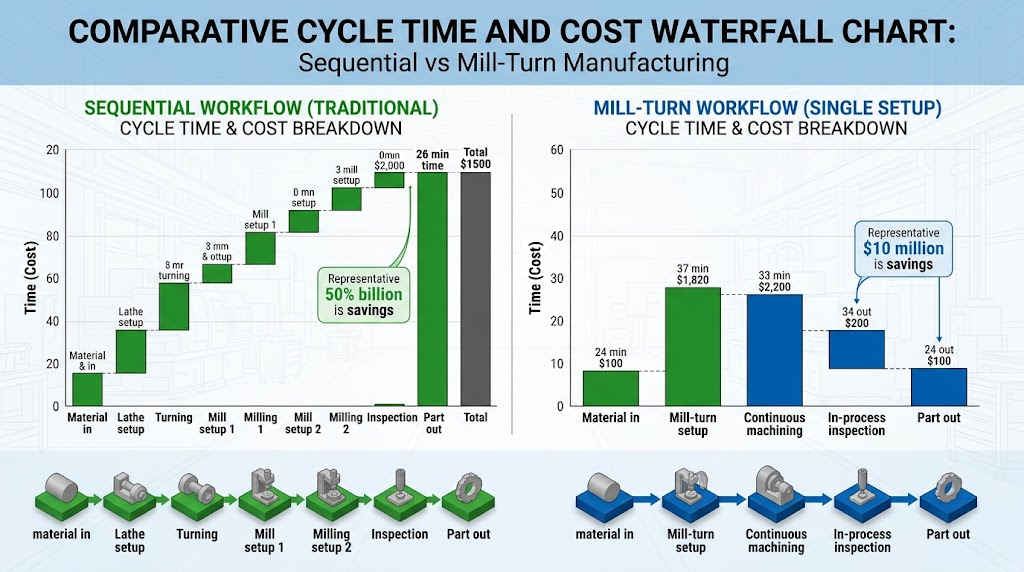
When selecting a manufacturing strategy, engineering teams evaluate both precision capabilities and total cost across the full production run. Moving parts between separate lathe and milling operations introduces hidden tooling expenses and process variation.
| Production Parameter | Sequential Routing (Lathe + VMC/HMC) | Precision Multi-Tasking Mill-Turn |
|---|---|---|
| Setups Required | 3 to 5 discrete physical fixturings | 1 single automated setup |
| Datum Runout / Concentricity | ±0.025 mm to ±0.050 mm (stackup dependent) | ≤ ±0.005 mm |
| True Position Tolerance | Typically ⌀0.05 mm to ⌀0.08 mm | ≤ ⌀0.01 mm relative to Datum A/B |
| Fixturing & Soft Jaw Tooling | 1,500 –4,500 per geometry revision | $0 (uses standard collets/chucks) |
| Production Lead Time | 14 to 21 business days | 3 to 5 business days |
| Human Labor Intervention | High (manual loading per machine) | Minimal (automated bar feed & handoff) |
| Typical Scrapping Probability | 8% – 18% on complex aerospace parts | < 0.5% continuous run scrap rate |
While hourly rates for multi-tasking centers reflect advanced equipment costs, consolidating multiple setups into one run typically reduces total part unit costs by 25% to 40% on complex geometries. This savings comes directly from eliminating custom fixtures, reducing handling labor, and lowering scrap rates.
Tyneen Advanced Multi-Tasking Fleet and Metrology Certification Standards
Precision multi-tasking demands advanced machine platforms and strict metrology controls. Tyneen operates a modern machining fleet housed in temperature-monitored production halls.
Key equipment and capabilities supporting our precision tolerances include:
- Multi-Tasking Fleet: High-rigidity DMG MORI NTX 1000/2000/3000 series and Mazak Integrex i-series machines featuring high-torque integral spindles, scale feedback (0.0001 mm resolution), and high-pressure through-coolant systems.
- Controlled Inspection Facility: Metrology cleanrooms calibrated strictly to 20°C ± 0.5°C to avoid ambient thermal measurement errors.
- Coordinate Measuring Machines: Zeiss Prismo and Zeiss Contura CMMs equipped with continuous-scanning probe heads, maintaining volumetric length measurement accuracy down to
E0,MPE = (0.9 + L/350) μmper ISO 10360-2 metrology protocols. - Quality Certifications: Fully certified to ISO 9001:2015, IATF 16949 (Automotive), and AS9100D (Aerospace), offering complete AS9102 First Article Inspection (FAI) reports and EN 10204 3.1 Material Test Reports (MTR).
Streamlined 3-Step Production Pathway: From CAD/DFM to Zeiss-Verified Delivery
Procuring precision components should be straightforward and reliable. Tyneen combines experienced engineering reviews with quick-turn production to deliver flight-ready and medical-grade parts on schedule.
Launch Your Precision Mill-Turn Project in 3 Steps
- Step 1: Upload CAD Model & Drawings
Upload your 3D models (STEP, Parasolid, or IGES) and 2D drawings with GD&T requirements to our secure, encrypted portal. - Step 2: Engineering DFM & Comprehensive Quotation
Receive a detailed DFM engineering assessment identifying optimal tool orientations, wall thickness validations, and firm pricing in under 2 hours. - Step 3: Multi-Tasking Production & Certified Dispatch
Parts are produced on multi-axis mill-turn centers, fully inspected with Zeiss CMM scanning, paired with full MTRs, and shipped globally via express freight.
Frequently Asked Questions: Multi-Tasking Mill-Turn Engineering
How do you prevent runout accumulation during sub-spindle part handoff?
We use electronic phase-matching where both spindles run at matching speed and angular alignment down to 0.001°. Clamping pressures are carefully calibrated, and in-process tactile probing verifies the secondary datum immediately after handoff to adjust coordinate systems dynamically.
What true position tolerances can be achieved between turned ODs and milled cross-holes?
Because the part is bored, turned, and milled in the same chuck setup without unseating, true position tolerances of ≤ ⌀0.01 mm relative to the primary turned axis (Datum A) are maintained reliably.
Is mill-turn cost-effective for low-volume prototypes (1 to 10 parts)?
Yes. Although programming takes longer than a simple 2-axis lathe setup, eliminating custom soft jaws, fixturing plates, and multiple machine setups makes single-setup mill-turn operations competitive for rapid, tight-tolerance prototyping.
What material test certifications are provided with finished parts?
All stock is sourced from accredited mills with complete traceability. Every order includes an EN 10204 3.1 Material Test Report (MTR) providing verified chemical analysis and mechanical property test data.